
On Monday, the Organization for Economic Cooperation and Development (OECD) revealed that Chinese enterprises in certain industries received government subsidies up to eight times higher than those of other member countries of the organization over the two-decade period ending in 2024, exposing the truth of Beijing distorting the global competitive market.
The OECD, composed of 38 developed economies, released the findings based on their new database “OECD MAGIC” (Manufacturing Group and Industry Companies) on Monday. The project collected subsidy data received by 525 large enterprises in 15 industries globally from 2005 to 2024.
The report likened excessive industrial subsidies by governments to “performance-enhancing drugs” in sports.
According to the latest database, subsidies to super large enterprises in China stood out prominently, with government support received by them being three to eight times higher than that of OECD member countries. This indicator also far exceeded that of some other large non-OECD member countries, such as India and Brazil.
The OECD stated that their analysis shows that national subsidies are reshaping the global economy, with approximately 22% of the growth in market share of enterprises from 2005 to 2023 attributed to subsidies. However, for Chinese enterprises, this percentage is close to 60%.
The focus of data collection was on leading enterprises in the 15 industries. China had the highest number of enterprises, reaching 147, accounting for 28% of the total in these industries. This is roughly consistent with China’s share of global manufacturing value added from 2010 to 2024 (27%).
Geographically, Chinese enterprises have consistently been the biggest beneficiaries of subsidies across almost all 15 industries.
In the 15 industries, solar photovoltaics, semiconductors, aluminum, steel, and shipbuilding ranked among the top five in terms of subsidies as a proportion of revenue.
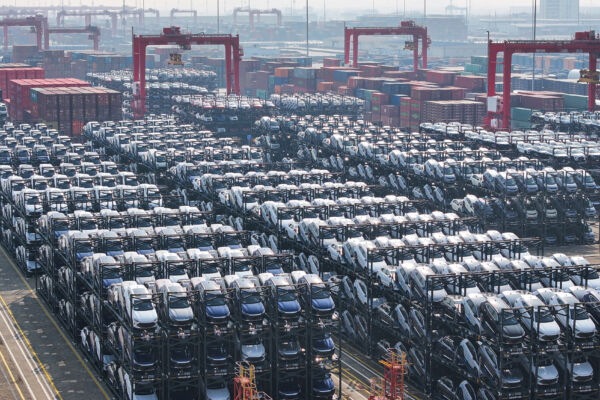
In terms of absolute subsidy values, the automotive industry took the lead. The report pointed out that Chinese automotive manufacturers “consistently receive subsidies that are higher than those of enterprises from OECD member countries, both in absolute and relative terms.”
Subsidies provided by Beijing to Chinese automotive manufacturers mainly include income tax exemptions and grants. Compared to OECD member countries, the absolute value of these subsidies is twice as high, and the relative value is four times as high.
The OECD also found that since around 2019, subsidies and below-market-rate loans received by Chinese automotive manufacturers have “significantly increased,” reflecting the Chinese government’s continued strong support for its “new energy vehicle” industry.
Although 2025 is beyond the scope of the database’s statistics, research indicates that Beijing’s support for the automotive industry continues, with Great Wall Motors and BYD receiving the most subsidies among listed companies in mainland China.
Furthermore, in the semiconductor industry in China in 2021 and 2022, the average subsidy approached 10% of enterprise revenue, while the global average was slightly over 2%.
The organization also stated that subsidies do not enhance productivity and profitability, indicating that subsidies may hinder investment.
In addition to the 15 industries, nine other sectors were examined by the OECD, including aerospace and defense, cement and building materials, chemicals, fertilizers, glass, ceramics and refractory materials, heavy machinery, railway vehicles and signaling systems, telecommunications network equipment, and wind turbines.
The OECD stated that the primary motivation for tracking these subsidies is that such support “could distort international markets,” causing companies to compete in an unfair competitive environment.
As this could lead to less efficient enterprises capturing a larger global market share without significant improvements in productivity and competitiveness, it may “over time affect innovation, fair competition, and global trade support.”
The report noted that in 2023 and 2024, government assistance received by these major manufacturing enterprises reached the highest levels since the global financial crisis.
The OECD stated, “Just as performance-enhancing drugs in sports, subsidies may allow lower-productivity enterprises to win unfairly, damaging the interests of more innovative and efficient enterprises.”
“This could ultimately lead to long-term losses for the global economy, such as reduced innovation, lower product quality, and increased competition, even though consumers may benefit from lower prices in the short term,” the report noted.
Through studying companies’ disclosure documents, tracking grants, tax incentives, and low-interest loans, the OECD seeks to reveal and uncover the actual amounts of subsidies that companies receive. In 2024, the total subsidies tracked by this database across various industries amounted to $108 billion.
OECD Secretary-General Mathias Cormann stated during an event in Paris on Monday, “Global industrial subsidies are growing continuously, but for decades, we have lacked a reliable, comprehensive, and comparable perspective to understand the actual subsidies provided by governments and received by enterprises.”
“Subsidies are not just a fiscal issue; they are reshaping global markets,” added Cormann.
He noted that the database records publicly available data on company subsidy situations, “rather than information selectively disclosed by governments.” Nonetheless, some companies, especially Chinese enterprises, still disclose little or no subsidy information.
The release of the new database coincides with the OECD Ministerial Council Meeting held in Paris on Wednesday and Thursday. The theme of the meeting is “Formulating Industry Policies that Promote Open Markets, Growth, and Prosperity.”
Cormann emphasized that the database is one of the “tools” this week to promote fact-based, data-driven discussions on subsidy and industry policy issues.
The goal is “not to assign blame but to clarify facts and help members and partners find cooperative solutions that truly uphold open markets and rule-based trade interests.”
This study provides a new perspective on government subsidy usage, revealing how subsidies intensify tensions between China and major economies and trade wars.
The core of the accusations by the United States and the European Union against Beijing’s imbalanced economic policies is that China’s subsidies distort market competition, giving Chinese enterprises unfair competitive advantages and helping them dominate global markets. Western countries argue that this is equivalent to pitting a Western company against a Chinese company supported by one country’s subsidies.
For years, the subsidy issue has been clouded by a lack of transparency and incomplete disclosure of information to institutions like the World Trade Organization.
According to a report by the Office of the United States Trade Representative in 2025, “Since joining the World Trade Organization more than twenty years ago, China has not provided complete notifications of government-maintained subsidies to the World Trade Organization.”