
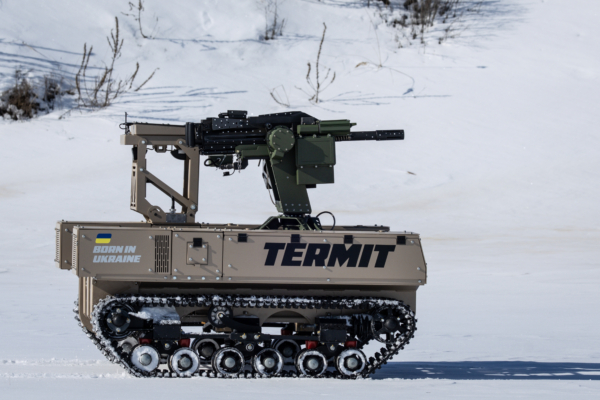
In the past few months, amidst the severe shortage of troops and inadequate Western aid, Ukraine’s war has undergone a significant transformation. The majority of military operations have shifted towards unmanned control. Facing off against the Russian forces, the Ukrainian military’s reliance on robots, drones, and remote-controlled tanks may temporarily turn the tide, although this advantage remains highly fragile.
According to CNN reports, the Ukrainian military has recently conducted six explosive operations on three frontline targets in eastern Ukraine without any ground troops involved. Instead, veteran soldiers sit in gaming chairs, utilizing aerial reconnaissance drones for observation and commanding through specialized live platforms. This new form of warfare, detached from direct human senses, appears even colder and more brutal.
In April of this year, Ukrainian President Volodymyr Zelensky announced that the Ukrainian military has for the first time fully relied on robots and drones to occupy territory.
Since January, unmanned equipment has executed 22,000 missions. To Russian prisoners of war, these explosive-carrying robots are known as the “silent reapers.” The robot combat procedure involves the initial deployment of one robot to conduct two explosions, aiming to divert the attention of Russian forces while the other four robots sneak behind enemy lines.
The Ukrainian military estimates that using robots for 164 assault operations achieves the same combat effectiveness as requiring 2,300 soldiers to participate, with an expected half of the soldiers sustaining casualties during the attack. In other words, using robot soldiers can help avoid massive casualties.
Some Ukrainian commanders expressed regret that if this technology had been available during urban street fights in the past, many comrades could have survived. Past wars relied on the soldiers’ own combat skills and strength, while current warfare emphasizes technology and who can adapt and evolve faster in this unmanned long-distance slaughter.
The Ukrainian military’s transition to unmanned tactics is due to a severe shortage of troops. Since adopting battlefield drones on a large scale and significantly improving drone precision strikes, Ukraine has already achieved its goal of causing 35,000 Russian soldier casualties per month this year, prompting the Russian military to start conscripting urban populations and middle-class individuals. The latest estimates from the UK’s Government Communications Headquarters (GCHQ) indicate that the total number of Russian military deaths has reached 500,000.
The new war has created new battlefield warriors. Today’s warriors are no longer traditional soldiers but software engineers in their twenties, both men and women. A young female software engineer mentioned that the key to winning does not lie within the machines themselves but rather in human thinking and planning, focusing on establishing communication between machines and operators.
As machines enter the battlefield, new challenges are constantly emerging. Some robots are misled, losing GPS navigation; others explode on the way, flip over in trenches, or get intercepted by enemy forces.
Despite numerous issues, robots can still replace infantry in basic tasks. Technicians have mounted heavy machine guns on tank treads, equipped robots with a series of cameras for wide-angle shots, allowing them to hide in thickets for days awaiting targets without the need for water or food, free from muscle cramps. Their only requirement is ammunition resupply – returning to base when running out of 400 rounds.
According to Ukrainian military disclosures, when robots are deployed in front of enemy lines, the enemy often panics, crawling closely to the ground, unsure of how to proceed.
The report indicates that the rapid pace and scale of the Ukrainian military’s automation development have been astonishing, with unmanned equipment becoming standard in the battlefield within a few short months. These robots are responsible for rescuing casualties or providing supplies to frontline forces. For instance, after securing ammunition to the robot, remote pilots miles away in a concealed location take control rapidly, transporting critical supplies to frontline units.
On the other hand, the continuous onslaught of Russian drones is causing Ukrainian troops to be constantly on the run. Coupled with shortages of soldiers and supplies, troops often struggle to build defensive structures, making do with whatever is at hand for cover.
In the Russian-Ukrainian war, unmanned drones from both sides are omnipresent, redefining the nature of this conflict.