
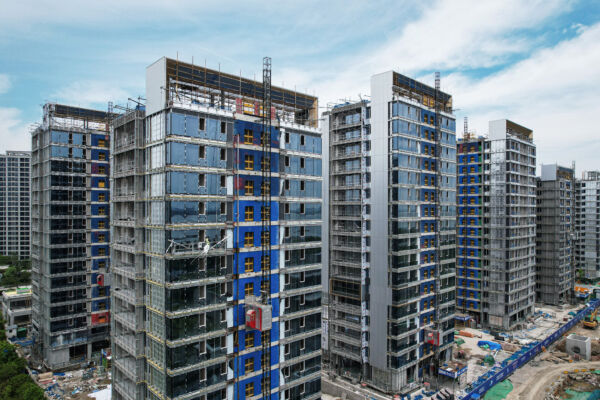
The local finances of the Chinese Communist Party have long been relying on land sales revenue. Now, nationwide land sales revenue has collapsed sharply, leading to a comprehensive escalation of the local debt crisis. Beijing’s money bag is running dry, and the various methods of plundering everywhere have raised concerns.
The budget deficit of the CCP is growing. Official media data shows that in 2025, the general public budget deficit was 7.135 trillion yuan, and the government fund budget deficit was 5.517 trillion yuan, totaling 12.652 trillion yuan, an increase of 2.222 trillion yuan compared to 2024.
In 2026, as the year of the so-called “15th Five-Year Plan” began, national general public budget expenditures exceeded 30 trillion yuan for the first time, and national government fund budget expenditures also reached 1.186 trillion yuan.
The root cause of the financial difficulties of the CCP’s local finances lies in the collapse of the land finance model. For many years, local governments have relied on land sales revenue to support infrastructure, pay salaries, and maintain public services. Local land sales revenue reached a historical peak of about 8.7 trillion yuan in 2021. However, in recent years, with the continued downturn in the real estate market, the land finance has completely collapsed.
In 2025, the land sales revenue of the CCP government dropped to about 4.2 trillion yuan. As we entered 2026, the downward trend in land sales revenue has not changed. Data released by the CCP Ministry of Finance shows that in the first quarter of 2026, local governments’ revenue from land use rights transfer (land sales revenue) was 517.6 billion yuan, a year-on-year decrease of 24.4%.
Data from the National Bureau of Statistics of the CCP shows that in the first quarter of this year, real estate development investment nationwide decreased by 11.2% year-on-year; the sales area of newly constructed commercial residential buildings decreased by 10.4% year-on-year; the in-place funds of real estate development enterprises decreased by 17.3% year-on-year. In March, the sales prices of new commercial residential buildings in first-tier, second-tier, and third-tier cities decreased by 2.2%, 3.3%, and 4%, respectively.
Li Rong, a professor at the School of Finance and Economics of Renmin University of China, said that the reduction in local land transfer revenue in the first quarter indicates that local authorities are facing greater fiscal pressure.
On the other hand, since the beginning of this year, the Chinese local debt crisis has further escalated. In the first four months of this year, local governments of the CCP set a new record in borrowing, issuing bonds worth about 3.92 trillion yuan, an increase of about 10.8% over the same period last year.
According to data from the CCP Ministry of Finance, as of the beginning of 2026, the balance of local government debt was 56.59 trillion yuan. However, official CCP data often conceals unfavorable situations, and the actual data may be even worse, including hidden enormous implicit debts. The International Monetary Fund (IMF) and the Bank for International Settlements (BIS) believe that in 2024, China’s government debt reached 100 trillion yuan.
In the CCP’s Central Economic Work Conference in 2025 and the 2026 budget report, there were rare emphases on “addressing the financial difficulties of local governments.” However, in the face of financial difficulties, the CCP government’s solutions have raised doubts.
The first method is targeting private enterprises. In recent years, law enforcement agencies have conducted more extensive crackdowns on executives of private companies nationwide, with many cases having clear motives of profit-driven law enforcement. These actions have sparked public outrage, with the legal community in China labeling such behavior as “distant fishing.” In the first half of 2024, non-tax revenue in the form of fines in China increased by about 25.2%.
The second method is confiscating the wealth of corrupt officials. In recent years, the CCP’s internal purges have intensified, with the data on anti-corruption by the Central Commission for Discipline Inspection continuing to soar. On April 23, the Central Commission for Discipline Inspection of the CCP reported on the so-called “anti-corruption achievements” in the first quarter of this year, with 56 provincial and ministerial-level officials being disciplined, four times more than the same period last year. The 2025 anti-corruption data shows that the number of officials at the provincial and ministerial level and above who were investigated reached 115 people, an increase of 42 people over the previous year, reaching a historical high.
Insiders from various systems have previously disclosed to The Epoch Times that the number of detainees in prisons and detention centers in some regions of China has noticeably increased, with a rise in the number of officials involved in corruption and bribery issues.
Yuan Hongbing, a legal scholar in Australia, recently told The Epoch Times that facing an extremely severe economic crisis, when the ordinary people have been almost completely plundered, the CCP is now turning to plunder the wealth of businessmen. Having almost exhausted private businesses, it is now targeting the wealth of corrupt officials on a larger scale.
Yuan also mentioned that recently, Xi Jinping’s focus on accumulating wealth has shifted to two groups. One is the temples scattered throughout China, especially those with a thriving incense trade, which have become the focus of scrutiny by the CCP’s tax authorities. The other group is the prevalent underground prostitution in China, with the officials and police targeting them. After catching these prostitutes, the main punishment is fines.
He frankly stated that this is enraging and reflects the severity of the CCP’s fiscal crisis.
A knowledgeable source in the CCP tax system recently revealed to The Epoch Times that religious venues in Zhejiang, Fujian, and other places have been required to submit financial records, close the circulation of religious goods, and report the charging situation and total income of each Dharma assembly. Local national tax authorities have notified internally that they will intensify tax audits on temples, and if tax issues are found, they will rigorously pursue recovery and impose penalties.
As for the underground prostitution, it involves the sex industry. The crackdown on prostitution in China is often a way for local governments to generate revenue. They allow it to flourish for a period, then crack down on it, confiscating the illegal prostitutes’ money, and then relax until the cycle starts over.
A source mentioned that the public security departments in various regions are aware that they will not truly clean up these industries, as it is a way for them to make money. In normal times, the public security serves as protection for these industry bosses, collecting protection fees regularly.
There is no overall data on the income from the CCP government’s crackdown on prostitution.
Commentator Wang He mentioned in an article for The Epoch Times more ways in which the CCP is plundering private wealth to address financial difficulties.
One of them is the recent interpretation by the CCP’s judicial authorities. Since May 1, 2026, employees of private enterprises who commit crimes related to their duties will face the same punishment as public officials, and the threshold for criminal liability has been lowered from 60,000 yuan to 30,000 yuan. This, in itself, is the CCP government using the judicial system to “clip leeks.”
Secondly, the draft Financial Law issued recently mentions that without judicial review and authorization by the court, administrative agencies can directly penetrate citizens’ communication privacy and deprive them of their property disposal rights; regulatory authorities have the power to directly restrict the departure of individuals or responsible personnel of units suspected of violating the law and harming “national security and interests,” and notify immigration management agencies to implement the restrictions. This means that in the future, private enterprises and the wealthy will become completely at the mercy of the CCP.
Since March 2026, tax departments in many places have begun to collect 20% tax on offshore trust funds. Since 2024, the CCP has strengthened taxation on overseas income, and with the formal launch of the fourth phase of the Golden Tax System in 2025, the growth rate of individual income tax revenue in 2025 was as high as 11.5%, while the annual growth rate of national tax revenue was only 0.8%. From the actions of the authorities, it is clear that in 2026, the focus will continue to be on “overseas income taxation” to support the scale of tax revenue for the whole year.
The CCP’s fiscal system has long suffered from structural imbalances, “financial rights up, operational rights down,” making local governments the first to bear the brunt during economic downturns.
Wang He stated that the Xi regime has lost the ability to carry out major reforms. In over a decade since Xi came to power, there have been many small actions in the financial and tax system, but almost no significant moves. The lack of direction in financial and tax system reform, and the inability to establish reasonable goals, is the biggest problem with the CCP’s finances. If there is no clear path for the future, then some specific financial issues – such as the financial difficulties at the grassroots level, short-term behaviors in land finances, hidden local debts, among others – will remain tangled.