
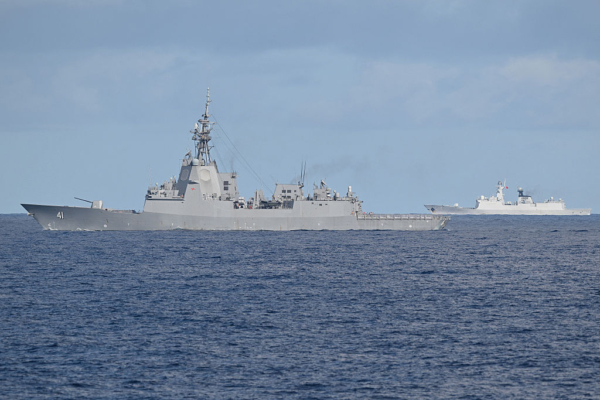
The Armed Forces of the Philippines (AFP) and the United States Indo-Pacific Command (USINDOPACOM) conducted joint exercises around the disputed Scarborough Shoal in the South China Sea on January 25-26 to enhance their collaborative combat capabilities.
President Ferdinand Marcos Jr., who succeeded the pro-China former president Rodrigo Roa Duterte, has returned to a pro-American stance since taking office. This shift has led to multiple joint military exercises with the United States and other allies in order to deter the increasing threats from China in the South China Sea.
This joint exercise, known as the 11th “Maritime Cooperative Activity” (MCA) between the U.S. and the Philippines since November 2023, took place in the waters surrounding Scarborough Shoal, which China also claims sovereignty over. China has conducted risky operations and harassing maneuvers against Filipino vessels in this area.
During this 11th bilateral and multilateral coordinated action, the USINDOPACOM deployed the Arleigh Burke-class guided-missile destroyer USS John Finn and one MH-60R Seahawk helicopter. The Philippines, on the other hand, dispatched the missile frigate Antonio Luna, the Philippine Coast Guard’s Gabriela Silang offshore patrol vessel, as well as two military aircraft – an FA-50PH fighter attack aircraft, an A-29 Super Tucano attack aircraft, and one AW-109 helicopter.
The Philippine Armed Forces stated in a media briefing that the two-day joint maritime and aerial exercise marks the beginning of cooperation between the Philippine and U.S. military forces for this year.
The statement further emphasized, “This exercise highlights the enduring alliance between the Philippines and the United States, and reaffirms our shared commitment to strengthening maritime security, enhancing operational interoperability, and upholding the rules-based international order in the Indo-Pacific region.”
The Philippine Armed Forces stated, “The participating forces conducted a series of joint maritime and aerial operations, including underway replenishment, replenishment at sea, surface warfare exercises, night formation sailing, photo exercises, and rendezvous exercises.”
The completion of these activities enhanced coordination capacity, tactical proficiency, and mutual understanding among the allied forces.
The Philippine military stressed that such training activities further strengthen their ability to respond to maritime challenges and contribute to maintaining peace and stability in the region.
Meanwhile, senior officials of the Philippine Navy confirmed that traces of Chinese naval escort vessels were detected in the exercise area.
Major General Roy Vincent Trinidad, spokesperson for the Western Philippine Sea Command of the Philippine Navy, stated during a media briefing, “A Chinese naval vessel was monitored within the exercise area, but it did not engage in any aggressive or coercive actions.”
He added that the presence of the Chinese vessel did not impact the training activities of both the Philippines and the U.S.