
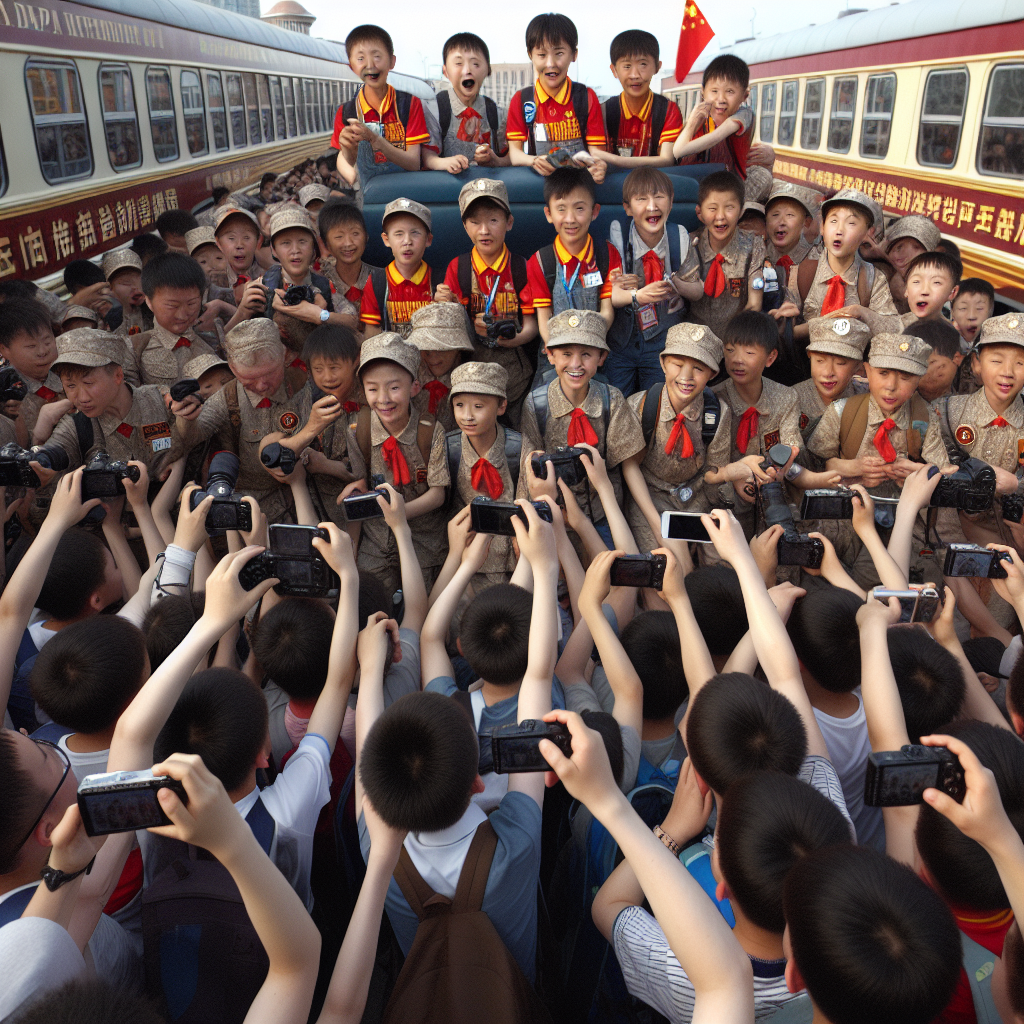
Recently, a group of Chinese elementary school students traveled to Vladivostok, Russia to participate in the “Homeland War” parade organized by the Russian side. The event was extensively promoted by Chinese state media, while some official media outlets surprisingly criticized the nature of the event, acknowledging that Vladivostok was part of Chinese territory occupied by Russia. This incident sparked strong backlash in Chinese public opinion, and related reports were immediately deleted on a large scale.
Experts pointed out that this arrangement was by no means a spontaneous local initiative, but a political gesture by the Chinese Communist regime to consolidate the Sino-Russian alliance, even at the expense of sacrificing national dignity and systematically erasing historical memory.
According to a report from the official Sputnik News Agency in Russia, in celebration of the 81st anniversary of the “Great Patriotic War”, the Russian Far East city of Vladivostok (known as “Vladivostok” in Russian, meaning “Conquer East”) held an international children’s military parade named “Victory Descendants”. For the first time, first-grade students from China and Laos participated in this parade.
Reports and on-site footage showed 47 procession teams consisting of 1,500 Russian, Chinese, and Laotian children, with still tender footsteps, passing through the central square of Vladivostok where the grandstand was set up. Among them, all Chinese elementary school students were dressed in the attire of the Eighth Route Army, led by a middle-aged man resembling a school teacher, participating in the parade.
According to Xinhua News Agency, Liu Hanqi, a first-grade student from Yiwu, said in an interview, “I feel very honored to be able to participate in this military parade. Our ancestors shed blood and gave their lives for the peace we enjoy today.”
After the news spread, criticism swiftly spread on Chinese social media. A video blogger on Bilibili named “Tianjin Dad” compared the event to “someone else taking away your ancestors’ house, and you spending money to take your children to celebrate the successful robbery.” He believed that Chinese children going to Vladivostok to participate in Russia’s celebration was a form of “amnesia” or even “humiliation” regarding historical trauma.
In the video, the blogger mentioned historical events such as the Boxer Rebellion, the Harbin Massacre, the Jiangdong 64 Villages Incident, and the subsequent mass slaughtering and expulsion of Chinese people by Russians during their expansion, emphasizing the atrocities suffered by Chinese people.
On May 6, “Ping An School” under the People’s Daily, a Chinese state media outlet, published a commentary titled “In the streets of Vladivostok, who are Chinese children cheering for?” The article sharply contrasted with Xinhua’s report, suggesting that the sight was reminiscent of parades in Japanese-occupied areas in the 1940s. It criticized the event, questioning why Chinese children were being taken to the land where their ancestors were robbed, to line up, wave flags, chant slogans, and be used as a background.
The article expressed concerns about the blatant and shameless performance, stating that even though diplomacy and international exchanges should be encouraged, sacrificing national dignity and historical memory is unacceptable. It raised questions about how the world would view “us”.
Shortly after being reprinted by media outlets such as Sina, NetEase, and Phoenix, relevant reports, commentary articles, and some user comments were deleted.
Regarding why the Chinese authorities were actively involved in the Vladivostok event, Wu Shaoping, head of the Overseas Human Rights Lawyers Alliance, pointed out in an interview with the Epoch Times that the core purpose of the Chinese Communist Party was to express political support to Russia.
He believed that this event “must have been officially arranged by the Chinese authorities”, at least with the approval and confirmation of the Chinese Communist Party’s Central Committee or diplomatic system, otherwise, these Chinese students couldn’t have participated.
Extension reading:
Chinese singer sings “Katyusha” in Russian-occupied area, Ukrainian side demands explanation from Chinese Communist Party.
He said that to strengthen ties with Russia, the CCP has reached a point where it is “letting the thief be the father, with no bottom line”.
Zeng Jianyuan, a member of the Taiwan Chinese Democratic Academy, shared the same view. He told the Epoch Times that from the current international strategic considerations of the CCP, Beijing is further approaching Moscow. “The global strategic layout by US President Trump has made the CCP and Russia need to huddle together.”
He believed that in this context, the CCP is “no longer avoiding involvement in Russian historical narratives” and is expressing political goodwill to Russia through the Vladivostok event.
Zeng pointed out that Chinese propaganda institutions have long emphasized China’s suffering from imperialist aggression in modern times but deliberately avoided Russia’s role in modern Chinese history. This selective historical narrative is essentially driven by real political needs.
He mentioned that if the Soviet Union had not sent troops to Northeast China, helped the CCP take over Manchukuo, and transferred a large number of Japanese military equipment to the CCP, “the CCP could not have rapidly expanded its strength and eventually seized power on the mainland.” He said that the CCP’s gratitude to the Soviet Union’s assistance has always been accompanied by a sense of deep appreciation.
Wu Shaoping stated that Vladivostok is a place where Russia slaughtered hundreds of thousands of Chinese people, so why is the CCP ignoring the historical pain of the Chinese people? In fact, the CCP is “very clear” about the history of Vladivostok, so this arrangement is intentional.
He believed that through such activities, the CCP intends to instill erroneous historical views in Chinese youths, causing the younger generation to have a distorted perception of the history of Vladivostok’s occupation, and even “lose a judgment capability in society.”
Zeng also pointed out that this is not just a diplomatic move, the CCP is attempting to shape children’s understanding of CCP history and the history of Sino-Russian cooperation through such activities. He warned that if these children only receive single propaganda in a closed information environment, “they are very likely to become the CCP’s party guards in the future.”
He said that the long-term closure of information, control of public opinion, and continued brainwashing by the CCP will ultimately lead to increasing alienation between Chinese society and universal values.
Zeng mentioned that the current global situation is vastly different from a hundred years ago. Countries like the United States, United Kingdom, France, Germany, and Japan are now democratic nations. In contrast, Russia has returned to authoritarianism and become an ally of the CCP, a deeply ironic historical phenomenon.