
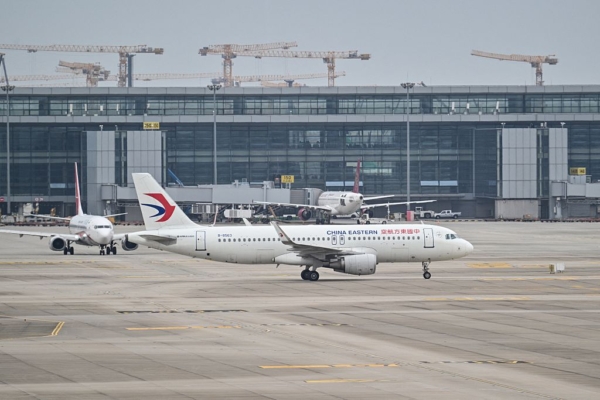
With the approaching May Day holiday, a large number of Chinese netizens have taken to social media to express their grievances. They complained that flights to Southeast Asia that were originally planned for the holiday have been canceled due to soaring fuel prices, with no compensation being offered.
According to reports from mainland Chinese media such as “Jiemian News,” Air China announced on April 7th that flights from Chengdu to Kuala Lumpur would be canceled from now until June 30th. While airlines like Spring Airlines, China Eastern Airlines, and China Southern Airlines have not officially announced flight cancellations, they have cancelled flights to Southeast Asia including those for the upcoming May Day holiday through system notifications, customer service notifications, and agent notifications.
Announcements from airlines and flight data show that as the May Day holiday approaches, there is a widespread cancellation of flights from China to Southeast Asia, affecting popular destinations such as Bangkok, Phuket, and Vientiane. Furthermore, cancellation rates for flights to Oceania are also high, with the cancellation rate for flights from Guangzhou to Darwin reaching 83.3%, from Hangzhou to Auckland at 57.1%, and from Wuhan to Sydney at 50%.
Southeast Asia and Oceania routes have become the hardest-hit areas in this wave of flight cancellations.
It has been reported that the main reason for the large-scale cancellations of flights is the soaring aviation fuel prices. Due to the impact of the Middle East situation, international oil prices have significantly increased since March, with current aviation fuel prices more than doubling from before, reaching an average of $209 per barrel in early April, much higher than the $99.4 per barrel at the end of February. Airlines are facing a situation of “losing more as they fly.” Additionally, tight fuel supplies in some regions and high airport refueling costs have further exacerbated the flight cancellations.
In order to alleviate cost pressures, airlines have not only canceled flights but also implemented price increases, raising ticket prices and fuel surcharges. For example, Cathay Pacific and Hong Kong Airlines have raised fuel surcharges for multiple rounds, with many routes for Cathay Pacific doubling the fuel surcharge.
Many netizens took to social media to complain, with statements like, “Accommodation was booked, attractions tickets were purchased, but the flights were canceled.” “All losses are borne by individuals, with no compensation from the airlines.” “Can airlines breach contracts unilaterally without any punishment?”
Some netizens also expressed, “Promote domestic circulation, prioritize transportation. Earn money domestically, spend domestically, don’t take a single penny out of the country.” “I guess the airlines previously sold tickets at low prices, flying at a loss will only lead to more losses, so they had to cancel all flights and then raise prices to resell tickets, with only the flight changing.” “With inadequate regulations, it’s the weak consumers like you and me who suffer losses.” “Isn’t there any sense of contractual spirit in doing business?”
The frustration and dissatisfaction among travelers caused by these flight cancellations reflect a broader concern about the impact of soaring fuel prices and the need for greater accountability and transparency in the airline industry.