
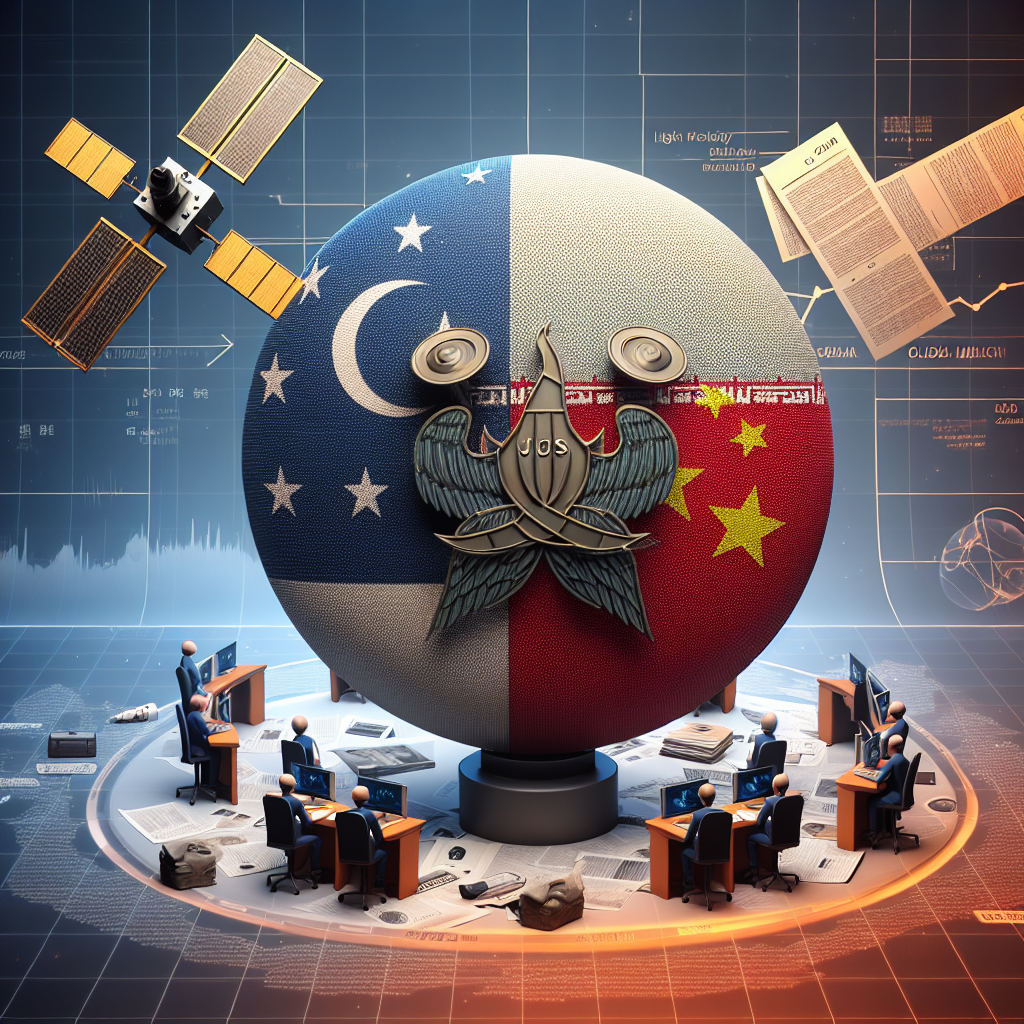
On April 15, 2026, The Epoch Times reported that the Financial Times on Wednesday, April 15, cited leaked military documents revealing that the Islamic Revolutionary Guard Corps (IRGC) of Iran secretly obtained a high-definition spy satellite made in China at the end of 2024. During the US-Iran conflict in March of this year, the Iranian military also used the satellite to monitor and locate American military bases in the Middle East, supporting missile and drone attacks.
The leaked documents show that the satellite named “TEE-01B” was manufactured and launched by the Chinese company Earth Eye Co. After being launched from China at the end of 2024 and entering space, it was transferred to the IRGC Aerospace Force of Iran.
This is a type of export mode called “in-orbit delivery,” where spacecraft launched in China are transferred to overseas customers after reaching orbit.
Records show that the satellite continuously photographed the Prince Sultan Air Base in Saudi Arabia from March 13 to 15. President Trump confirmed on the 14th that five US Air Force tankers stationed at the base were damaged during the attack.
Moreover, Jordan’s Muwaffaq Salti Air Base, the US Fifth Fleet Naval Base in Bahrain, and military facilities such as the Erbil airport in Iraq are all on Iran’s satellite surveillance list.
Experts point out that this satellite significantly enhances Iran’s intelligence capabilities. TEE-01B has an imaging resolution of about 0.5 meters, enough to identify subtle changes in aircraft, vehicles, and infrastructure. In comparison, Iran’s most advanced domestically produced satellite, Noor-3, has a resolution of only about 5 meters.
Nicole Grajewski, an Iran expert at Sciences Po, stated, “This satellite is obviously being used for military purposes because it is operated by the Revolutionary Guard’s Aerospace Force, not Iran’s civil space program.”
She further explained, “Iran desperately needs this foreign-provided capability during times of conflict, allowing the Revolutionary Guard to identify targets in advance and assess the results of their strikes.”
In addition to the satellite itself, Iran has been granted the use of the global commercial ground station network operated by Emposat, a subsidiary of Beijing Aerospace Control Technology. This allows Iran to remotely control satellites from around the world and receive images.
Jim Lamson, a senior researcher at the James Martin Center for Nonproliferation Studies and former CIA analyst, believes this is a form of “space asset dispersal strategy.”
He said, “Satellite ground stations in Iran were attacked in 2025 and 2026, and missiles launched from miles away could easily destroy them. But it is not easy to directly target a Chinese ground station located in another country.”
The White House, CIA, Pentagon, Chinese Ministry of Foreign Affairs and Ministry of Defense, Earth Eye Co., and Emposat did not immediately respond to Reuters’ requests for comments.
Last weekend, President Trump publicly warned that if China provides Iran with air defense systems, they will face “big problems.”