
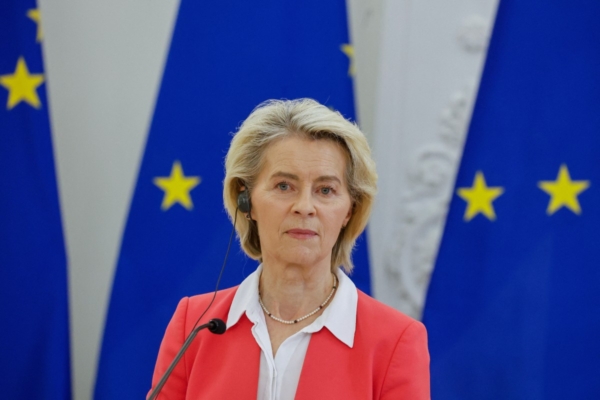
The European Commission stated on Friday that the trade and investment relationship between the European Union and China is “unsustainable” and vowed to take stronger measures in response. Commission members are discussing how to better protect European industries from the significant increase of Chinese goods in the European market.
Currently, Western governments are trying to reverse the trend of outsourcing to China that peaked in the early 2000s, leading to a significant loss of domestic industrial technology and industry centers, especially in the United States and EU member countries.
Trade data shows that the trade deficit between the EU and China has widened from 312 billion euros in 2024 to 360 billion euros last year, and further significantly expanded in the first quarter of 2026.
The EU will hold a European Council summit on June 18-19. The Commission stated that members are preparing various proposals for this summit, which may include: forcing EU companies to diversify their supply chains or introducing new trade mechanisms to restrict China’s opportunities to enter the EU market in sectors such as chemicals, metals, and clean energy technology.
“As economic interests and security interests become increasingly intertwined, there needs to be a stronger and more coordinated response on both fronts,” the European Commission said.
Commissioners of the EU met on Friday to discuss the future direction of EU-China relations. Governments of several countries led by France are calling for action to protect their industries from hostile trade practices, while export powerhouse Germany suggests caution, fearing potential loss of access to the vast Chinese market. However, Germany is also increasingly concerned that the influx of Chinese goods is weakening its once dominant manufacturing sector.
According to three officials familiar with EU internal dynamics who spoke to Politico, EU Commission President von der Leyen and her Chief of Staff Bjorn Seibert are advocating for a tougher stance against Beijing, leveraging the current economic challenges to strengthen their arguments and garner support.
EU Minister for Industry Stephane Sejourne told Politico on Friday, “Today’s debate is likely to solidify the growing European consensus that action must be taken on ‘China Shock 2.0’.”
“I believe there is still room for constructive dialogue with China, but we cannot allow Europe to become a victim of predatory strategies that are destroying our industries. We need new tools, new measures, and new political will,” Sejourne said.
After hearing the opinions of EU Commissioners, von der Leyen will meet with other leaders at the Group of Seven (G7) summit in France on June 15 to discuss issues related to the influx of excess Chinese goods into foreign markets and Beijing’s restrictions on critical raw material supplies. She will then seek support for the EU’s China policy from presidents and prime ministers at the EU Council summit in Brussels on June 18-19.
Earlier this year, the EU introduced a new “Buy European” policy and the “RESourceEU” plan aimed at accelerating the development of key mineral supply chains in the EU, as well as establishing partnerships with resource-rich countries from Central Asia to Australia and Brazil.
The Chinese Ministry of Foreign Affairs has criticized the EU for selectively using trade data to justify its claims of trade imbalance and has threatened several times that if the EU adopts a “Buy European” policy and modifies its technology sovereignty policy, Beijing will take “strong countermeasures.”
(Partially referenced from Reuters)