
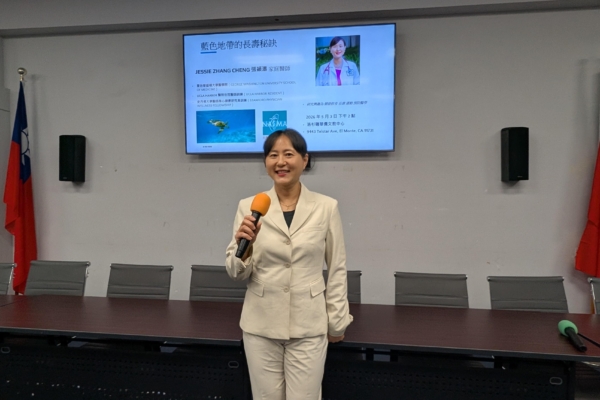
Celebrating Taiwan Heritage Week, the North American Taiwanese Medical Association (NATMA) Southern California Chapter held a “Community Medicine Health Lecture” at the Los Angeles Chinese Center on May 3. The event brought together multiple professional doctors, medical researchers, and young student teams to share the latest medical knowledge in various aspects such as longevity research, elderly care, medication safety, and cutting-edge biotechnology, attracting numerous overseas compatriots and community members to listen in.
Dr. Jessie Zhang Cheng delivered a keynote speech on “The Longevity Secrets of Blue Zones.” “Blue Zones” refer to five regions globally with the highest density of long-living populations. She mentioned that research has found residents in these areas primarily consume a plant-based diet, emphasizing the intake of vegetables and legumes while reducing red meat consumption.
Dr. Zhang emphasized that longevity is not only about diet but also closely related to lifestyle. Residents of Blue Zones generally incorporate natural activities into their daily routines rather than relying solely on high-intensity workouts. More importantly, they have stable social circles, strong family support systems, and regular routines, all of which are core keys in delaying aging and promoting overall physical and mental well-being.
Kaitlin Blam, a Pennsylvania University graduate who has long been devoted to elderly welfare services in Southern California, provided a detailed explanation of elderly service programs in the greater Los Angeles area. She mentioned that in recent years, besides medical needs, elderly individuals in the area also face challenges such as transportation assistance, home modifications, nutrition delivery services, and a lack of Chinese-language medical resources. Due to language barriers, Chinese elderlies often do not know how to apply for government benefits.
Kaitlin Blam’s team specially organized various application information and contact channels, aiming to assist families and elderly individuals in smoothly accessing referral services to ensure they receive the necessary support.
Vivian Lan, a pharmacy student from the University of Southern California (USC), shared insights on medication safety. She reminded the public that everyday consumables like coffee, tea, Chinese herbal medicine, as well as vitamins and dietary supplements, may interact with prescription drugs.
Some foods can enhance drug effects, leading to overdosing, while others may counteract drug effects or trigger severe side effects. Using the common example of “do not eat grapefruit with certain medications,” Vivian Lan urged chronic patients to always consult a pharmacist before taking new drugs or supplements.
The iGEM team composed of high school students from Diamond Bar presented their research findings on synthetic biology and infectious diseases. Though still in the stage of scientific exploration, their innovative thinking and societal contribution intentions garnered praise from attending medical professionals and overseas compatriots.
iGEM delved into the application potential of the IL-10 (Interleukin-10) protein in probiotics for chronic gastrointestinal inflammation issues such as ulcerative colitis. The students explained that while IL-10 possesses immune regulatory and anti-inflammatory functions, its stability is poor and easily affected by temperature, leading to limited absorption. Through biotechnology techniques, the team is trying to enhance the stability of this protein, hoping it can be applied in probiotics or new types of health products in the future.