
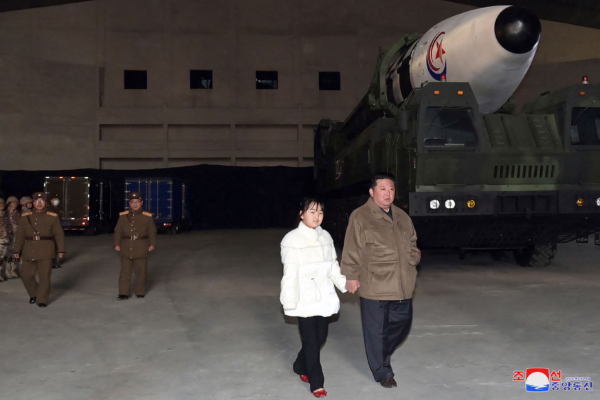
North Korea has recently amended its constitution, introducing new territorial clauses for the first time, completely removing hostile references to South Korea such as “homeland reunification”, and explicitly stating that State Affairs Commission Chairman Kim Jong Un holds the authority to use nuclear weapons. Many analysts believe that this move signifies a significant shift in North Korea’s strategic direction, with Kim Jong Un aiming to consolidate his power, establish a legal foundation for family succession, and potentially lay the groundwork for negotiations with the United States in the next stage.
According to reports from Yonhap News Agency and the Chosun Ilbo, the South Korean government announced the full text of North Korea’s new constitution on May 6. Pyongyang has comprehensively eliminated all references related to nationality and reunification, such as “northern part”, “homeland reunification”, and “complete victory of socialism”, from the preamble and main text of the constitution.
The new Article 2 of North Korea’s constitution introduces territorial provisions for the first time, stipulating that “the territory of the Democratic People’s Republic of Korea borders China and the Russian Federation to the north, the Republic of Korea to the south, and includes territorial waters and airspace based on territorial demarcation.”
In late 2023, Kim Jong Un declared that North and South Korea have “hostile bilateral relations”, and in January 2024, he announced plans to amend the constitution to redefine territorial boundaries.
Notably, the new version of the North Korean constitution does not designate the South as an “enemy state”, and the previous hostile expressions such as “imperialist aggressors”, “liberating the exploited and oppressed people”, and “domestic and foreign hostile elements conspiring to sabotage” have also disappeared.
Following the constitutional amendment, North Korea significantly strengthened Kim Jong Un’s powers. The constitution has redefined the role of the Chairman of the State Affairs Commission from the highest leader to the head of state, granting him national representativity. In the hierarchy of state organs outlined in the constitution, the position of the Chairman of the State Affairs Commission is now placed ahead of the Supreme People’s Assembly for the first time.
Kim Jong Un currently holds various positions in North Korea, including General Secretary of the Workers’ Party, Chairman of the Central Military Commission, Chairman of the State Affairs Commission, and Supreme Commander of the armed forces. His military rank is Marshal of the Republic, making him the third-generation highest leader of North Korea.
In the amended constitution, North Korea explicitly states the nuclear authorization of the Chairman of the State Affairs Commission, providing a legal basis for granting him authority over the command of nuclear weapons.
Additionally, unrealistic welfare provisions such as “free healthcare” and “tax-free nation” have been removed from the North Korean constitution.
The revision of the North Korean constitution has garnered significant attention from the international community. On the program “Good Morning China”, veteran media analyst Shishan believes that Kim Jong Un’s actions represent a major strategic shift for North Korea, aiming not simply at legal adjustments but at a fundamental change in its strategic direction.
Shishan points out that Kim Jong Un’s move is essentially preparing for the “permanence” of the Kim regime. He said, “He is laying down a complete sovereign state for the ‘Baekdu Mountain bloodline’. First, he legally establishes North Korea as a fully independent entity and then moves on to negotiate with the United States and South Korea.”
He states that North Korea’s true concern has never been ideology, but rather “regime security”. Since the dissolution of the Soviet Union, North Korea has faced intense security anxieties.
In this context, North Korea has chosen to fully develop its nuclear weapons. Shishan explains, “Its logic is simple: with nuclear weapons, others dare not touch me. It relies on this to preserve its life.”
He also mentions that in the early years, during the Six-Party Talks, North Korea had sent signals to the United States. “North Korean diplomats directly told Americans that as long as a peace treaty is signed, North Korea might even become more pro-American than South Korea. Its missiles may not necessarily be aimed east but could also be aimed west (targeting China).”
Shishan believes that with the constitutional amendment and the abandonment of the reunification narrative, North Korea is likely setting the stage for future negotiations with the United States and South Korea.
The analysis perspective of Professor Zhang Tianliang from the University of America’s Space is even more unique. In his self-media program “When the Sky is Bright”, he points out that North Korea’s move sends an important political signal that Kim Jong Un’s power is now quite firmly established.
He states, “He no longer needs an external enemy to rally internal support, nor does he need to rely on ‘reunification of Korea’ to maintain the legitimacy of his regime.”
Zhang Tianliang believes that North Korea’s long-standing emphasis on “reunification” has essentially been a mobilization tool to maintain its highly tense political structure internally. However, now Kim Jong Un appears to be more concerned with the practical aspects of governance and regime continuity.
He explains, “If Kim Jong Un’s goal is to ‘own the world’, then it is most important to close the doors and live his own life. As for socialism, unified Korea, they are no longer important.”
Zhang Tianliang specifically mentions that Kim Jong Un’s constitutional amendment may be related to the succession plan of his daughter, Kim Joo-ae. He says, “Kim Jong Un is preparing to pass the baton to his daughter. His own health is not particularly good.”
He analyzes that if a young woman inherits power in the future, the risks of continuing the path of “military unification of Korea” would be extremely high.
“A young woman cannot bear the responsibility of starting a war. Because once a war breaks out, it could mean the end of the dynasty.” Therefore, Zhang Tianliang believes Kim Jong Un is essentially “dealing with the most dangerous problem in advance.”
Just as the outside world is still grappling with the impact of North Korea’s new constitution, a sports news quietly shifted the atmosphere on the peninsula.
According to the Korea Football Association and the South Korean Ministry of Unification, the North Korean women’s football club “My Hometown Women’s Football Team” will play a semi-final match against “Suwon FC” at Suwon Sports Complex on the 20th.
North Korea’s delegation visit is the first since the conclusion of the Incheon International Table Tennis Federation (ITTF) World Tour Finals in 2018, after approximately 8 years. It is also the first visit since North Korean State Affairs Commission Chairman Kim Jong Un defined inter-Korean relations as a “hostile war-engaging country relationship” at the end of 2023.
Regarding North Korea’s decision to participate in the tournament, South Korean analysts believe that Kim Jong Un’s rare decision to visit South Korea may have been influenced by factors such as the $1 million prize money for the championship. If the North Korean women’s football team defeats the South Korean women’s football team, they will receive at least $500,000 as the runner-up prize money. Conversely, if they do not participate in the competition, according to AFC regulations, they will face a fine of at least $100,000.
As for whether North Korea’s future might gradually change, Zhang Tianliang believes that now may be a point worth observing.
He says that if relations between North Korea and the United States ease and the economy gradually opens up in the future, “it may move towards a direction with a touch of ‘owning the world’, but not as extreme as it is now.” However, he admits that such a judgment “may be somewhat wishful thinking.”