
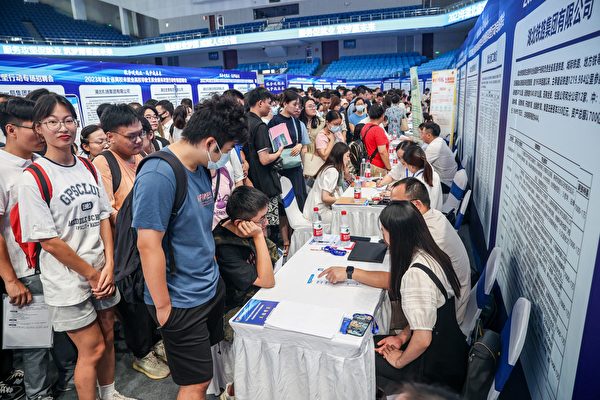
Recently, a Chinese netizen raised a question: “How can unemployed college graduates respond to the call of the new era?” Some scholars believe that this question exposes the collective anxiety of contemporary Chinese youth about the future.
On May 6th, a Chinese netizen posed a question on a social media platform: “Assuming a college student can’t find a job, how should he/she respond to the call of the new era?” This sarcastic question quickly sparked numerous reposts.
Many netizens pointed out that current Chinese youth are facing multiple pressures such as difficulty in finding employment, delayed retirement, AI substitution, and rising living costs. There is a noticeable gap between the official propaganda of the Chinese Communist Party about “struggle” and “positive energy” and the harsh realities they are facing.
Platforms like WeChat and Douyin have been flooded with videos recently, with titles like “Unemployed college students, the country will help you.” However, more content reflects the harsh reality, such as “Where should fresh graduates go?” and “Graduates delivering takeout.”
One netizen commented, “I don’t understand. College students can’t find jobs, retirement is delayed, encouraging more childbirth, promoting AI to replace humans, not allowing ‘lying flat’ – how can all of these be happening at the same time?”
A prominent online figure from Guangxi, Aqian, told Dajiyuan that for college students unable to find jobs, how to respond to the authorities’ call in the new era remains a pressing issue. She mentioned that many young people graduate from university only to face unemployment and rely on their parents for survival, feeling trapped. The government continues to demand that young people keep striving and serve the country, leaving students uncertain about what policies the state can provide. Aqian criticized the conflicting messages from the government, which discourages “lying flat” but also encourages delayed retirement, potentially entrapping the youth.
Aqian, a 2023 graduate of Wuhan University of Science and Technology, shared her personal experience of job hunting struggles, including misrepresentations by potential employers offering low salaries and the prevailing trend of undervaluing recent graduates in the job market.
Since 2023, the number of graduates from Chinese universities has been increasing annually. Data released by the Ministry of Education of the Chinese Communist Party shows that in 2025, the total number of university graduates is expected to surpass 12 million, reaching 12.7 million in 2026, and estimated to further increase in 2027, nearing 14 million.
A retired educator, Mr. Gu from the education system in Shijiazhuang, Hebei province, pointed out to reporters that the authorities are struggling to address the employment challenges faced by the massive numbers of graduates. Some young people’s growing feelings of “lying flat” are being attributed to being “manipulated by foreign forces,” which he finds absurd.
He revealed, “At a recent education department meeting, a friend who attended relayed that the focus was not on how to arrange job placements for graduates but on urging communities to assist in managing the expectations of this year’s graduates and advised them to be patient in finding their paths. The message was that job opportunities are limited in state-owned enterprises, government departments, and private companies, and opportunities may arise in the Xiong’an New Area.”
Mr. Gu also stated that most recent graduates are not interested in the Xiong’an New Area, and many parents are opposed to their children pursuing opportunities there.
In recent years, the Chinese authorities have been avoiding terms like “unemployment” and “layoffs,” using alternatives such as “slow employment” and “flexible employment.” Zhang Liang, a retired teacher from China Agricultural University, commented, “No matter what euphemisms the government uses, it cannot hide the reality of economic decline.”
He mentioned that some schools have proposed sending graduates to Xinjiang, Tibet, or Inner Mongolia to teach for three years, with arrangements coordinated with the local education authorities. However, many students are reluctant to take up these opportunities, and parents are also against the idea due to concerns about the uncertain future.
Lately, terms like “lying flat,” “slacking off,” and “low desire” have become widespread among Chinese youth. Phrases like “Kong Yiji literature” and “take off the long gown” frequently appear online to describe the psychological state of highly educated young adults struggling to secure ideal jobs or accept low-paying work. Some netizens expressed, “It’s not that young people don’t want to strive; they just don’t know where to direct their efforts.”