
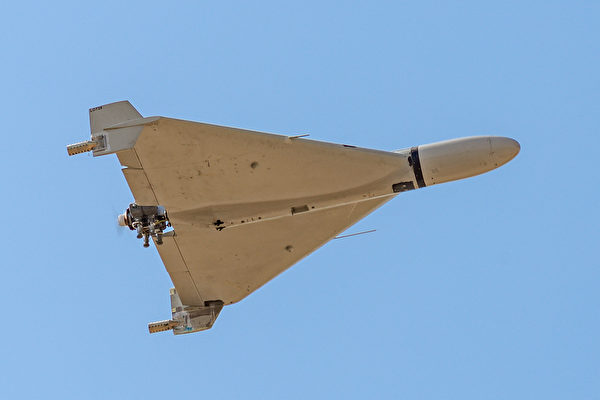
According to media reports citing customs data and analysis, despite US sanctions, the Chinese Communist Party continues to deliver drone-related parts and other dual-use military and civilian items to Iran and Russia, and is increasingly open in its actions, no longer attempting to conceal them.
The Wall Street Journal reported on Tuesday, citing Chinese customs data, former US officials, and weapons analysts, that as the US and Israeli military intensively strike Iranian targets and Tehran launches attacks towards Tel Aviv and Gulf countries hosting US military bases, Xiamen Victory Technology in China sent a marketing email to Iran offering to sell German-designed Limbach L550 engines for drones.
The US has banned the export of these engines to Iran and Russia because they are core components of Iran’s Shahed-136 attack drone. The Shahed-136 is Iran’s primary attack drone with a range of about 1,000 miles, estimated production cost per unit ranging from $20,000 to $50,000, serving as a low-cost alternative to cruise missiles. Russia is also using an improved version of this drone on a large scale in Ukraine.
The email from the Chinese company also stated: “We are deeply shocked and indignant by aggression against Iran; our hearts are with you!”
This email was mistakenly sent to Iran Watch, a tracking program of the Wisconsin Project on Nuclear Arms Control monitoring Iran’s weapons proliferation network, which then forwarded it to The Wall Street Journal.
The Wall Street Journal pointed out that US officials are increasingly concerned about the effectiveness of sanctions. Many drone parts are now produced by smaller Chinese companies with limited ties to the US financial system, making them almost fearless of sanctions.
Citing Chinese customs data, hundreds of containers containing engines, computer chips, fiber optic cables, and gyroscopes, among other dual-use items, are continuously being shipped to Russia and Iran.
Former Treasury Department official in charge of the Office of Foreign Assets Control sanctions, Miad Maleki commented on this, saying, “China (CCP) turns a blind eye to these supplies, despite their role and consequences being repeatedly exposed in public reports and sanction lists. They either show indifference or choose not to intervene.”
The Chinese Ministry of Foreign Affairs has maintained its usual stance, claiming that Beijing restricts the export of dual-use items in accordance with its domestic laws, regulations, and international obligations.
Data monitored by Joseph Webster, senior researcher at the Atlantic Council’s Global Energy Center, shows a sharp increase in the export of fiber optic cables from China following Russia’s successful utilization of these drones to reclaim the Kursk region in the fall of 2024 and after Ukraine destroyed a major fiber optic supplier in Russia in April 2025.
The export of lithium-ion batteries to Russia also continues to rise as the Russian military expands its production of quadcopter drones. Webster stated, “Other than military purposes, there is no other reasonable explanation; it’s too blatant.”
Conflict Armament Research in the UK also confirmed a “significant increase” in the use of components manufactured by Chinese companies in Shahed-style drones.
With the difficulties of directly intercepting drone components, US officials stated that they are simultaneously increasing efforts to target buyers and carriers of Iranian oil to cut off Tehran’s sources of funding.
A US official said, “We focus on their revenue because by severing the head of this snake, we can cause lasting damage.”
Former Assistant Director of Counterproliferation at the Office of Foreign Assets Control of the Treasury Department, Kerri Bitsoff, mentioned that forcing adversaries to rely on low-quality Chinese parts is part of disrupting their operations.
She pointed out that some Russian-made Shahed drones crash mid-flight, a clear demonstration that this tactic has had battlefield effects.
She said, “You have to do a cost-benefit analysis – would you rather have 100 drones that can fly for two hours or 50 that can fly for 20 hours?”