
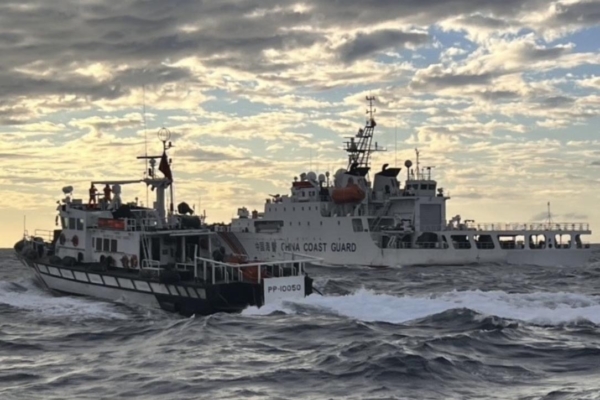
The United States think tank, the Center for Strategic and International Studies (CSIS), has released a new report stating that the Chinese Communist Party (CCP) has significantly increased military pressure on Taiwan’s air and sea since 2020. The report highlights that the Chinese Coast Guard (CCG) has seen a daily average activity surge of over 500% in the waters adjacent to Taiwan. CSIS recommends that the U.S. should establish a “Taiwan Pressure Observatory” to strengthen monitoring and military support in the Taiwan Strait with its allies.
This research highlights that the CCP’s continuous intrusions and harassments aim to normalize aggressive behavior through a “gray zone” strategy, ultimately wearing down Taiwan’s military capabilities and psychological resilience.
The report, released on Tuesday (May 5th), utilized innovative spatial analysis methods to monitor the sea areas around Taiwan through a “Three-Ring Security Framework”.
The “Three-Ring Security Framework” is not an official maritime demarcation by Taiwan but a framework established by CSIS to quantify military pressure from the CCP on Taiwan. The think tank divided the waters surrounding Taiwan into three key security rings to analyze the proximity, frequency, and strategic depth of intrusive behaviors.
The First Ring:
Comprising the median line of the Taiwan Strait and the Air Defense Identification Zone (ADIZ), further divided into five sub-regions – northeast, east, south, southwest, and median line – as the initial spatial basis for monitoring Chinese military activities.
The Second Ring:
This ring serves as a defensive buffer zone delineated based on the activities of the Chinese Coast Guard (CCG). Starting from the northern waters of Taiwan along the median line, it extends about 33 nautical miles eastward and surrounds the adjacent zone about 5 nautical miles from the 24 nautical mile contiguous zone, then extends about 15 nautical miles south back to the median line.
The Third Ring:
Refers to the boundary of Taiwan’s strictly guarded 24 nautical mile contiguous zone. The report notes that Taiwan’s military takes a “hard defense” stance in this area, often dispatching naval vessels to intercept and prevent Chinese incursions.
Data shows that not only has the CCP increased pressure in terms of quantity, but also shows more aggression in spatial infiltration. The frequency of daily incursions into Taiwan’s “Second Ring of Security” increased by over four times on average between 2020 and 2025.
The report emphasizes that “the CCP is leveraging all of its military branches to strategically pressure Taiwan…to normalize its coercion and norm-violating behavior.”
There has been a significant growth in aerial threats as well. From 2022 to 2025, Chinese military activities at dual-use airports near Taiwan increased by more than double, with a notable rise in the frequencies of unmanned aerial vehicles (UAVs) and transport aircraft.
The report highlights that these airborne activities directly support maritime pressure operations and significantly increase the burden on Taiwan’s armed forces to maintain surveillance and military readiness.
The report delves into the strategic purpose of this “drip” threat. This long-term and sustained harassment is evolving into an “invisible war of attrition,” placing a dual pressure on Taiwan’s material and psychological well-being.
According to investigations, since 2022, Taiwan’s navy has had delays in routine maintenance schedules for some vessels due to urgent maritime situations. Moreover, being in a prolonged high-pressure reactive state has led to sleep deprivation and mental exhaustion among military personnel.
The report warns that these factors are gradually weakening Taiwan’s readiness capabilities, aligning with CCP’s tactical means to alter the status quo in the Taiwan Strait and advance reunification goals.
To assist Taiwan in coping with this new form of challenge, CSIS provides several policy recommendations in the report.
Firstly, the establishment of the “Taiwan Pressure Observatory” is proposed. The report suggests that the U.S. Department of Defense and State should establish a permanent observatory to monitor Chinese “gray zone” activities openly and transparently through commercial data and data science.
The design of the observatory should be alliance-based, inviting Australia, Japan, and the Philippines to station liaison analysts to contribute to data collection and analysis.
Secondly, the report recommends the establishment of a “Taiwan Military Relief Plan” to reduce emergency response costs.
“The U.S.’s competitive goal should be to make Taiwan’s daily detection, tracking, and continuous combat capabilities lower in cost and more sustainable to avoid CCP’s harassment forcing the U.S. (or Taiwan) to deplete resources long-term,” the report stated.
Experts suggest that the U.S. should prioritize assisting Taiwan in acquiring or developing systems that can “directly reduce U.S. long-term, high-cost close surveillance needs,” such as helping Taiwan obtain E-2D “Advanced Hawkeye” early warning aircraft or equivalent-grade airborne early warning systems to enhance wide-ranging maritime and aerial surveillance capabilities and alleviate Taiwan’s aging fleet of E-2K aircraft.
Further recommendations include the enhancement of Taiwan’s air refueling capabilities to increase aircraft endurance and reduce reliance on U.S. refueling aircraft during routine high-pressure situations.
Experts also call for the strengthening of Taiwan’s data link, ground sensor, and space-based sensing capabilities to enhance the resilience and reliability of Taiwan’s intelligence, surveillance, and reconnaissance capabilities.
Lastly, the report urges the establishment of a “pre-authorized response ladder” system.
This proposal advocates linking observed specific provocation behaviors (such as cutting submarine cables, infiltrating certain sensitive sea areas, or collisions involving coast guard vessels) with pre-set diplomatic, financial, or military consequences. When a certain threshold is crossed, pre-set sanctions and visa restrictions or the release of certain funding and aid packages should be automatically enforced, making CCP’s coercion come with predictable political and economic costs.
The core of this framework is not to increase the frequency of U.S. military deployments around the Taiwan Strait but to establish a long-term monitoring and enduring combat system centered on Taiwan to reduce the efficiency of CCP’s pressure on Taiwan.