
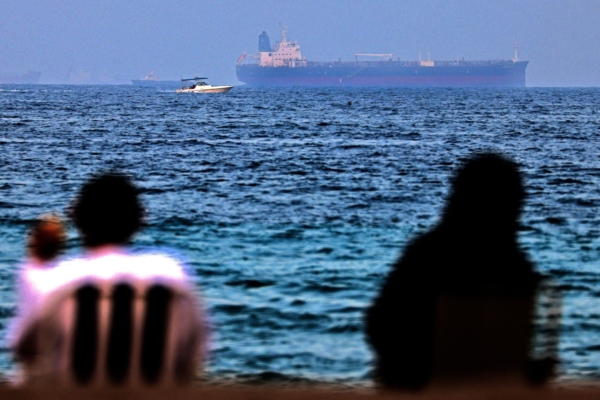
Egypt and the Gulf Cooperation Council (GCC), composed of six Arab Gulf countries, jointly issued a statement on Monday condemning Iran for attacking a United Arab Emirates commercial ship in the Strait of Hormuz on Sunday.
According to reports, the MV Barakah, a crude oil tanker operated by the Abu Dhabi National Oil Company (ADNOC), was targeted by two Iranian drones at around 19:40 on Sunday, about 78 nautical miles north of Fujairah, UAE, as it crossed the strait.
The UAE Ministry of Foreign Affairs condemned Iran’s “piratical behavior” against commercial shipping, stating that using the strait as an economic threat and targeting business shipping constituted a “piratical behavior” by the Iranian Islamic Revolutionary Guard Corps (IRGC). The ministry confirmed that no injuries were reported in the incident.
The Egyptian Ministry of Foreign Affairs swiftly released a statement in support of the UAE, strongly condemning the “blatant attack on the UAE oil tanker passing through the Strait of Hormuz.” Egypt emphasized that the security of Gulf countries is closely linked to Egyptian national security, reiterating that the UAE’s security is an integral part of Egypt’s national security.
Egypt pledged full solidarity with the UAE and supported any necessary measures the UAE takes to safeguard its national interests.
Secretary-General of the Gulf Cooperation Council (GCC) Jasem Mohamed Albudaiwi strongly condemned the “treacherous” attack with “the strongest terms.” He stated that the brutal attacks on vessels passing through the strait constitute piracy and pose a serious threat to maritime routes and strait security, flagrantly violating relevant UN resolutions.
The UAE officials have not disclosed whether the tanker sustained any damage, nor have they confirmed whether the vessel sought escort coordination under the U.S.-led “Operation Epic Fury” within the “Project Freedom” initiative during the incident.
Since the military strikes on Iran by the U.S. and Israel on February 28, Iran has been using the Strait of Hormuz as a bargaining chip, imposing navigation restrictions on most non-Iranian vessels and threatening attacks on unauthorized vessels entering the strait.
The Strait of Hormuz handles approximately 20% of the global oil and natural gas trade transport, making the safety of the waterway crucial to the global economic lifeline.
(Information sourced from Reuters and AFP)