
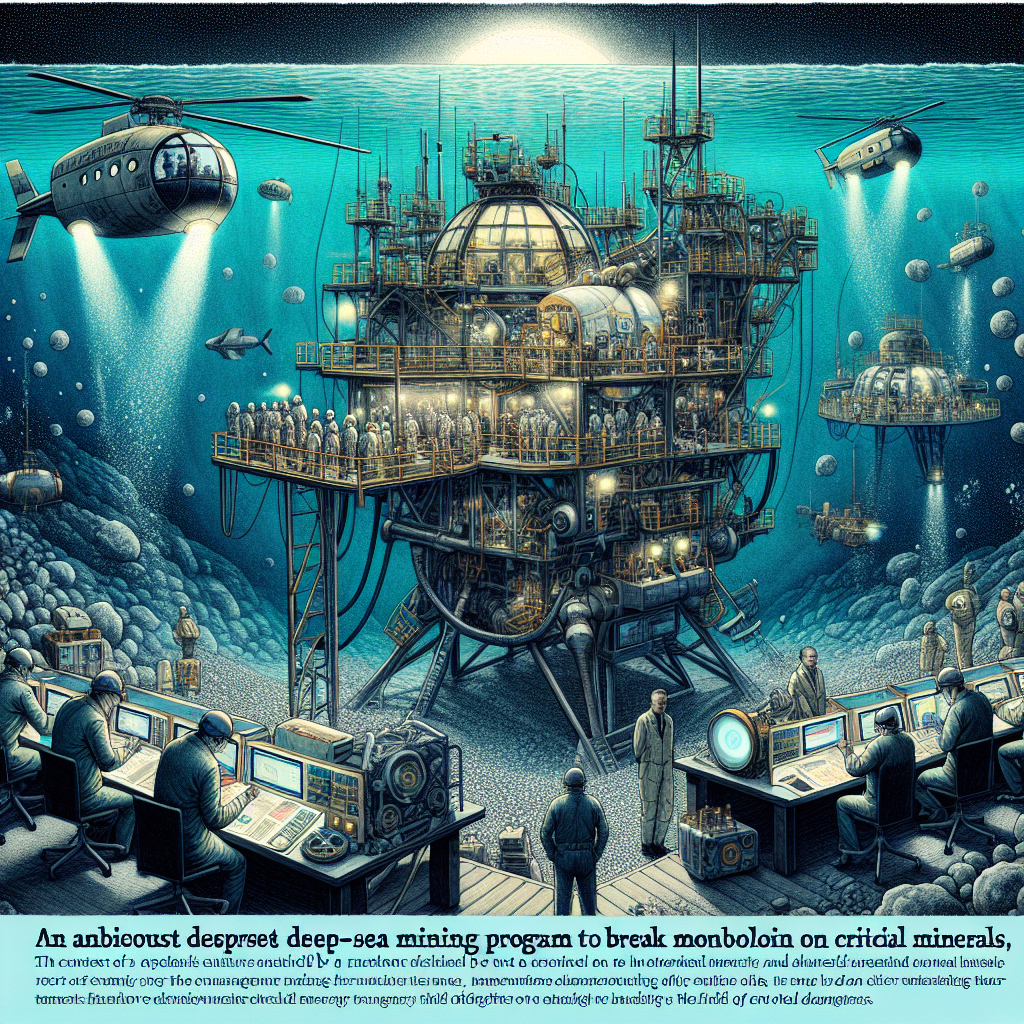
To ensure national energy security and break the monopoly of the Chinese Communist Party on critical minerals, the U.S. government is preparing to launch a historic deep-sea mining program. According to the latest research released on Tuesday (April 14th) by the U.S. think tank RAND Corporation, the polymetallic nodules found in the deep Pacific Ocean have enormous mining potential, enough to meet America’s future mineral needs for electric vehicle batteries and defense industries for decades to come.
The Trump administration has pledged to take “immediate action,” bypassing slow-moving international mechanisms and utilizing existing domestic laws to accelerate exploration and extraction of seabed resources. Tom LaTourrette, a senior physicist at RAND Corporation, emphasized the need to find alternative sources of critical minerals that do not rely on China, stating that seabed mining could be a way to achieve this goal with comprehensive government and stakeholder involvement.
Experts have long known about the presence of polymetallic nodules on the seabed. In the 1870s, the British Navy’s HMS Challenger recovered hundreds of these nodules during exploration voyages. A scientist on the expedition described them as looking like “dirty potatoes” rolling on the deck.
These “dirty potatoes” contain significant amounts of nickel, cobalt, manganese, and copper – crucial raw materials for batteries, electric engines, advanced weapons, and various other products. The current global market for these minerals is heavily reliant on China, which has used supply restrictions as a geopolitical lever in the past.
Therefore, seabed mining could provide the United States with a new and much more secure source. The efficiency of seabed mining is highlighted in RAND Corporation’s research report in PDF format, which suggests that with a fleet of just a few dozen seabed mining vessels, the production could meet the total demand for nickel and cobalt in the U.S. by 2040.
President Trump has emphasized that seabed resources are critical for strengthening the U.S. economy and ensuring future energy independence, emphasizing the immediate need for mapping seabeds and collecting minerals. At the policy level, as the U.S. is not a signatory to the United Nations Convention on the Law of the Sea (UNCLOS), it cannot directly participate in the International Seabed Authority (ISA) to make formal decisions on international seabed development agreements.
Therefore, the Trump administration intends to utilize the Deep Seabed Hard Mineral Resources Act of 1980 to issue permits and drive development projects in international waters. Experts caution that simply salvaging ores ashore is only half the battle, as polymetallic nodules cannot be directly used for batteries or industrial products and must undergo processing and refining, a sector currently dominated by China.
There is evidence suggesting that China has expressed interest in taking over the processing of polymetallic nodules and has been actively engaging with mining companies. LaTourrette stressed that it would be pointless to mine extensively if all the resources are ultimately sent to China for processing, stating the urgent need for the U.S. to develop its processing industry as a priority on par with mining. Villalobos from RAND Corporation warned that failure to strategize on entering this market and handling these nodules could result in them falling under Chinese control in the coming years.
The RAND Corporation report indicates that most mining companies prefer to develop or invest in processing and refining capabilities for nodules, viewing processing as the core of industrial value. Currently, the federal government is considering supporting the construction of domestic processing plants through subsidies, loans, and procurement agreements to ensure full control of the supply and value chain from the seabed to factories.
Apart from its economic benefits, deep-sea mining also poses complex geopolitical implications. The entrance of seabed minerals into the market could lead to a drop in global mineral prices, potentially putting significant financial pressure on developing countries reliant on land-based mining, such as the Democratic Republic of Congo.
In addition, deep-sea development technologies have dual-use potential, impacting future maritime security monitoring and underwater communication network development, thus increasing the demand for Maritime Domain Awareness. Though deep-sea mining is considered to be more environmentally and socially responsible compared to land mining with issues like child labor and severe ecological damage, scientists urge a stronger research focus on the ecological impacts of deep-sea ecosystems.