
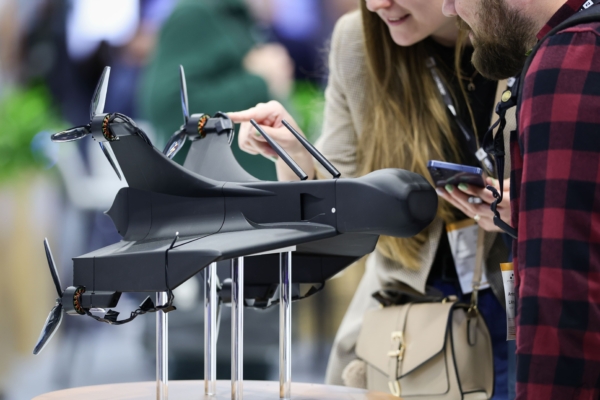
The U.S. Department of Defense officials have announced that the U.S. Army is planning to sign a long-term agreement with RTX to ensure a stable supply of the “Coyote” drone interceptor under RTX’s subsidiary, Raytheon, amidst the ongoing conflicts in Russia-Ukraine and Iran wars, highlighting the urgent need for cost-effective measures to intercept threats.
Responsible for the acquisition and deployment of military missiles and ammunition, Lieutenant General Frank Lozano stated in an interview that the U.S. Army intends to request funding in the fiscal year 2027 to propel a framework agreement and a multi-year contract, though the detailed terms of the contract are still being formulated.
While the aim is to finalize the agreement within the next 90 days, Lozano mentioned that it “might happen sooner.” The specific amount involved in this potential contract has yet to be determined. RTX company spokesperson declined to comment on this matter.
Reportedly, this framework agreement will be the first agreement specifically targeting “anti-drone interception capability.” Throughout this year, the U.S. Department of Defense has achieved several significant agreements to swiftly enhance the manufacturing capacity of critical missiles and ammunitions.
The “Coyote” is a ground-launched, radar-guided anti-drone interceptor designed to counter threats like the Iranian “Shahed” drones. It can be launched from both mobile and fixed platforms in all domains – land, air, and sea.
Unlike the “Patriot” missile system, with a unit cost reaching up to $4 million, used for intercepting missiles, this interception system costs approximately $120,000 per launch, providing higher cost-effectiveness.
Previously, the Pentagon has procured “Coyote” systems worth billions of dollars and deployed them in the Middle East region to safeguard U.S. forces and their allies from Iranian missile and drone attacks.
According to RTX’s official website, the “Coyote” interceptor series, when coupled with KuRFS (Ku-Band RF Sensor) radar (providing 360° scanning capabilities, capable of detecting drones, rockets, mortar shells, etc., and distinguishing multiple incoming small objects simultaneously), offers advanced detection and defensive capabilities, effectively countering threats from single drones to swarm attacks.
This integrated system is a key component of the U.S. Army’s “Low Altitude, Slow, Small Unmanned Aircraft Defense System” (LIDS). Compared to similar interceptors, it can engage various types of drones at further distances and higher altitudes.
The “Coyote” family primarily includes two types:
– “Coyote” Block 2 (Kinetic), a disposable anti-drone system that uses kinetic projectiles to directly hit targets, capable of accurately bringing down drones of various sizes.
– “Coyote” Block 3NK (Non-Kinetic), a reusable anti-drone system with loitering capability, using non-kinetic payloads to disrupt drone swarms.
This indicates that the system does not rely on impact or fragmentation to destroy targets but rather uses electronic warfare or other countermeasures to make enemy drones lose control, crash, or abort missions, thus minimizing collateral damage (unlike traditional air defense missiles intercepting drones, where the explosion-generated fragments often cause secondary harm to ground personnel or facilities).
The system can be recalled and redeployed for other combat missions after engagement.
In addition to the “Coyote” system, RTX’s Collins Aerospace company has secured multiple contracts from Bell Helicopter for providing five sets of systems for the U.S. Army’s future long-range assault aircraft – the MV-75 tiltrotor.
These contracts encompass main power systems, interconnecting drive systems, SmartProbe integrated airspeed/weather data measurement systems, cockpit seats, and ice protection systems, with the company set to provide the aforementioned systems through commercial procurement authorization.
MV-75 is the U.S. Army’s first entirely new rotorcraft design in decades, aiming to offer double the speed and range of existing models, incorporating digital engineering and modular open systems design.
The construction of this system will be completed in seven states: Colorado, Illinois, Iowa, Minnesota, New York, Ohio, and West Virginia.
Moreover, RTX’s Pratt & Whitney company recently secured a $6.6 billion contract to produce F135 engines for the F-35 “Lightning II” fighter jets. The contract includes full-rate production engines, initial spare parts, and engineering resources.
Furthermore, under the DARPA “Proving Non-runnable Network Deployment and Detection” (PWND2) program funding, BBN Technologies, a subsidiary of Raytheon under RTX, has launched an open-source toolkit named Maude-HCS to assist network defense teams in modeling and verifying the performance and detectability of Hidden Communication Systems (HCS). It was officially released in April 2026 and can be accessed on the software source code hosting platform GitHub.
On April 13, 2026, Raytheon publicly showcased an “Event-Driven Mid-Wave Infrared” (MWIR) camera, a new infrared sensing architecture fundamentally different from traditional infrared cameras. This technology is one of the outcomes of the DARPA “Fast Event-based Neuromorphic Camera and Electronics” (FENCE) program.
This architecture originates from neuromorphic sensing technology, where each pixel operates independently, only outputting events when it detects “brightness changes,” enabling tracking of high-speed objects – such as fast aircraft, vehicles, particularly suitable for military applications like tracking high-speed missiles or drones, battlefield situational awareness, base protection, etc.