
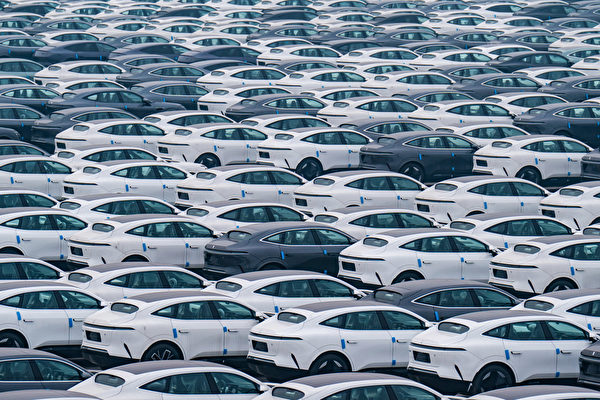
The losses in China’s automotive distribution sector continue to expand. The financial reports of eight listed car dealership groups in 2025 show that only one of them made a slight profit, while the rest are mostly in the red; industry surveys also indicate that over half of the 4S stores operated at a loss throughout the year. Some media outlets openly question how long can the dealers hold on.
According to the released financial reports of the eight listed car dealership groups in 2025, seven of them operated at a loss, with one barely turning a profit. The leading company, “Zhongsheng Holdings,” generated revenues of about 164.4 billion yuan but recorded a net loss of 1.673 billion yuan; “Yongda Automobile” went from profitability the previous year to a loss exceeding 300 million yuan; and “Zhengtong Automobile” saw its losses further widen to 2.49 billion yuan.
A report from the China Association of Automobile Manufacturers (CAAM) indicates that the gross profit margin for new car sales in the entire industry plummeted to -21.5% in 2025, with luxury car brands even dropping to -26.2%. This means that for every car sold, dealers are subsidizing more than one-fifth of the car’s price on average.
The data in the report shows that in 2025, 55.7% of 4S stores across the country were in a state of loss, while only 23.5% of stores were profitable, and another 20.8% were basically breaking even. At the same time, 81.9% of dealers faced the situation of new cars being priced lower than existing inventory, with over half of these stores experiencing a drop of more than 15%.
The “Huaxia Times” quoted automotive industry observer Zhao Yongqi as saying, “The increasing degree of price inversion is eroding the profit margins of dealers, and this is one of the reasons why there have been successive closures of dealership stores in recent years.”
Cui Dongshu, Secretary-General of the China Passenger Car Market Information Joint Council, stated, “The current situation of widespread cash flow deficits and exacerbated risks of funding chain disruptions in automotive dealerships have made it increasingly difficult to escape the dilemma of survival.”
Moreover, the price competition in new cars has a cascading impact on the second-hand car market. Many companies mentioned in their financial reports that the fluctuation in new car prices has led to unstable residual values of used cars. At the same time, the policy of trading in old cars for new ones has brought a large number of low-priced sources of vehicles, further squeezing profit margins.
Some Chinese media bluntly ask, “The more they sell, the more they lose. How long can dealers hold on?” “Where is the future of automobile sales terminals headed?” Autohome also raised the question, “With 80% selling at a loss, is 2026 the ‘life or death moment’ for dealers?”
There are also car owners who wrote on Autohome, saying, “Although 2025 has ended, the ‘aftermath’ of the survival crisis of 4S car dealerships has just begun. In an industry transition period, the dilemma of distribution channels has not only exposed the false prosperity based on quantity over price but also marked the end of the traditional dealership system. In the short term, the price war will continue in 2026, and the subsequent channel clearance will further accelerate, with weak stores and brands being rapidly phased out in this competition.”