
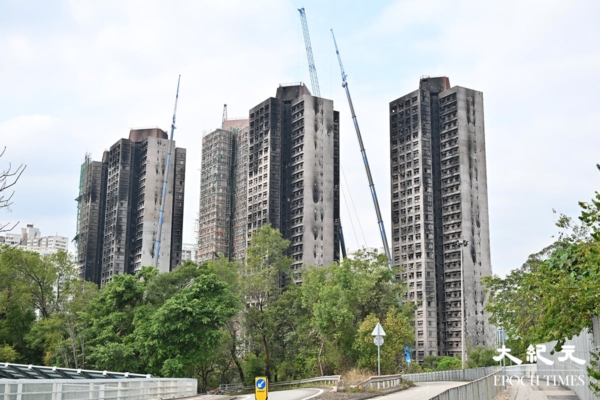
Over four months have passed since the Hong Kong Wang Fook Court fire, and authorities had previously announced a long-term relocation plan. Today, a group of Wang Fook Court residents sent a letter to Chief Executive Carrie Lam and multiple high-ranking officials, along with a thick 47-page proposal for rebuilding on the original site, urging the authorities to explore the feasibility of constructing 3 to 4 new residential buildings on the same location.
The displaced residents emphasized that this proposal aims to provide a supplementary option that runs parallel to the current acquisition plan, giving residents a genuine choice between “starting anew” and “waiting to return home.”
The two joint letters submitted today were signed by the “Wang Fook Court fire victims who only want to return to their roots for the rest of their lives” and “Wang Fook Court affected residents.” Quoting a survey of residents’ intentions, the letters indicated that up to 427 affected neighbors have expressly stated that they “do not seek compensation, do not wish to relocate,” and their sole request is to “return to their roots” on the same site.
In the letters, the victims recounted their deep emotional connection to the community, stating that moving to a new, unfamiliar neighborhood may provide new walls to shield them from wind and rain, but it cannot replace the sense of belonging cultivated over the past forty years, nor the familiar “good mornings” exchanged with neighbors. The letters expressed, “Home is a place of memories,” temporary housing holds no memories and pleaded with the government not to let this group of people, clinging to memories in the cold wind, wait too long, urging them not to let the forty-year-old community roots ultimately turn into silent ashes.
Regarding the technical and financial aspects, the proposal put forward two specific plans: to build 3 to 4 residential towers of 40 stories each on the original site, providing an estimated 2,640 to 3,020 units. The victims believe that by slightly increasing the plot ratio, the additional revenue from the extra units could offset most, if not all, of the acquisition and relocation costs.
According to the victims’ estimates, if the additional units are sold at HK$7,000 per square foot, after deducting the reconstruction costs of approximately HK$3.8 to 4.3 billion and fire insurance compensation, the project could potentially bring in a net profit of around HK$6.39 billion for the government. The victims urged the government to consider this proposal as a “financially feasible” option and pointed out that if the “prefabricated construction” method is adopted, the project could be fully delivered by 2031.
Furthermore, the joint letters questioned the current government’s “acquisition of ownership rights” proposal, which does not include Wang Chi House, potentially leading to “forced severance” for estates under the same land title and causing long-term legal rights confusion. The residents emphasized that the 8 buildings of Wang Fook Court have been “from the same roots” for 40 years and should be viewed as a holistic redevelopment.
Lastly, the victims stated that the first batch of public housing in Hong Kong is entering middle age, and if Wang Fook Court can successfully explore a path that balances human sentiment and benefits, it could serve as a “beautiful example” for the government to address the aging public housing issue across Hong Kong. They stressed that these 427 neighbors are not just cold statistics but living families eager to return home.