
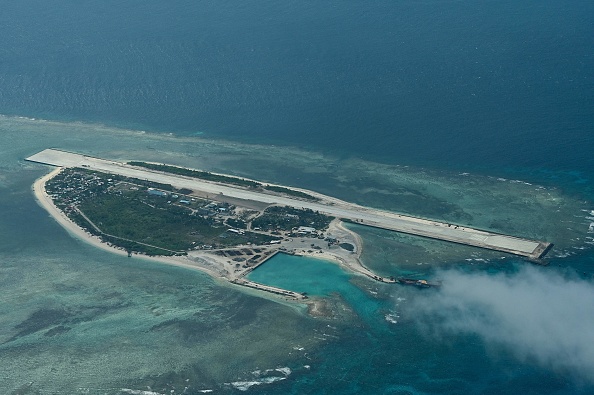
The Philippines established a new coast guard base on Thitu Island, the second largest natural island in the Spratly Islands, on April 9th. The island is located in a disputed area of the South China Sea where conflicts between Chinese and Filipino vessels have occurred multiple times.
On Thursday, the Philippines accused the Chinese military of conducting a deliberate act of bullying by firing flares directly at their unarmed coast guard aircraft during patrols in the Spratly Islands. They claimed this action violated established international aviation safety standards and regional peace, posing a direct threat to the lives of personnel onboard.
The inauguration of the coast guard zone headquarters on Thitu Island was attended by several government officials on April 9th. The delegation included Giovanni Lopez, Acting Secretary of Transportation, Senator Erwin Tulfo, Philippine Coast Guard Admiral Ronnie Gil Gavan, and Coast Guard spokesperson Major General Jay Tarriela.
The ceremony coincided with the Day of Valor, a national holiday in the Philippines commemorating the fall of Bataan Peninsula and the Battle of Corregidor during World War II against Japanese invaders.
The newly established coast guard headquarters, led by a brigadier general, will be responsible for enforcement, monitoring, environmental protection, and search and rescue missions. The measures also include dredging deeper ports for coast guard vessels to dock as currently, personnel traveling to Thitu Island rely on small boats.
Tarriela stated that the activation of the coast guard in the Kalayaan (Spratly) Islands area had full support and approval from Philippine President Ferdinand R. Marcos Jr., aligning with his commitment to not yield an inch of territory.
Lopez affirmed it as a permanent initiative to demonstrate the readiness of the coast guard to defend Philippine interests, fishermen’s livelihoods, and most importantly, sovereignty in the relevant maritime areas.
Moreover, the Philippines plans to establish smaller coast guard outposts on their occupied smaller reefs.
On the afternoon of April 9th, Major General Tarriela reported that while on routine patrols over Mischief Reef and Subi Reef, Philippine Coast Guard units were attacked with flares by the Chinese military. The Chinese allegedly claimed “indisputable sovereignty” over these maritime areas via radio signals.
Major General Tarriela condemned the Chinese actions as blatant bullying that jeopardized Filipino safety. Mischief Reef and Subi Reef are areas under Chinese control. Flares, essentially high-speed projectiles with incendiary devices, could cause structural damage or loss of control to small patrol aircraft if they hit the wings, propellers, or engines. The bright and dazzling effect of flares may also pose a flight hazard affecting pilot visibility.
Over a decade ago, China began converting the seven disputed reefs in the Spratly Islands into island bases, including Subi Reef. Subi Reef, located approximately 24 kilometers southeast of Thitu Island, has now become an important island base with military-grade runways.
Thitu Island has been under Philippine military control along with eight other islands, reefs, and atolls in the region since the 1970s. Administratively part of Palawan province, the island is home to about 400 Filipino residents and has facilities such as a runway and a pier. Locally known as “Pag-asa” Island (Island of Hope).
Thitu Island holds symbolic and strategic significance in the South China Sea dispute, potentially encompassing fisheries and oil and gas resources. Situated in the central part of the Spratly Islands in the South China Sea near strategic shipping lanes, it has been a long-standing point of sovereignty dispute. Apart from the Philippines, China, Taiwan, and Vietnam all claim sovereignty over Thitu Island.