
With the ceasefire agreement reached between the United States, Israel, and Iran for a two-week period, the world’s attention is on the reopening of the Strait of Hormuz.
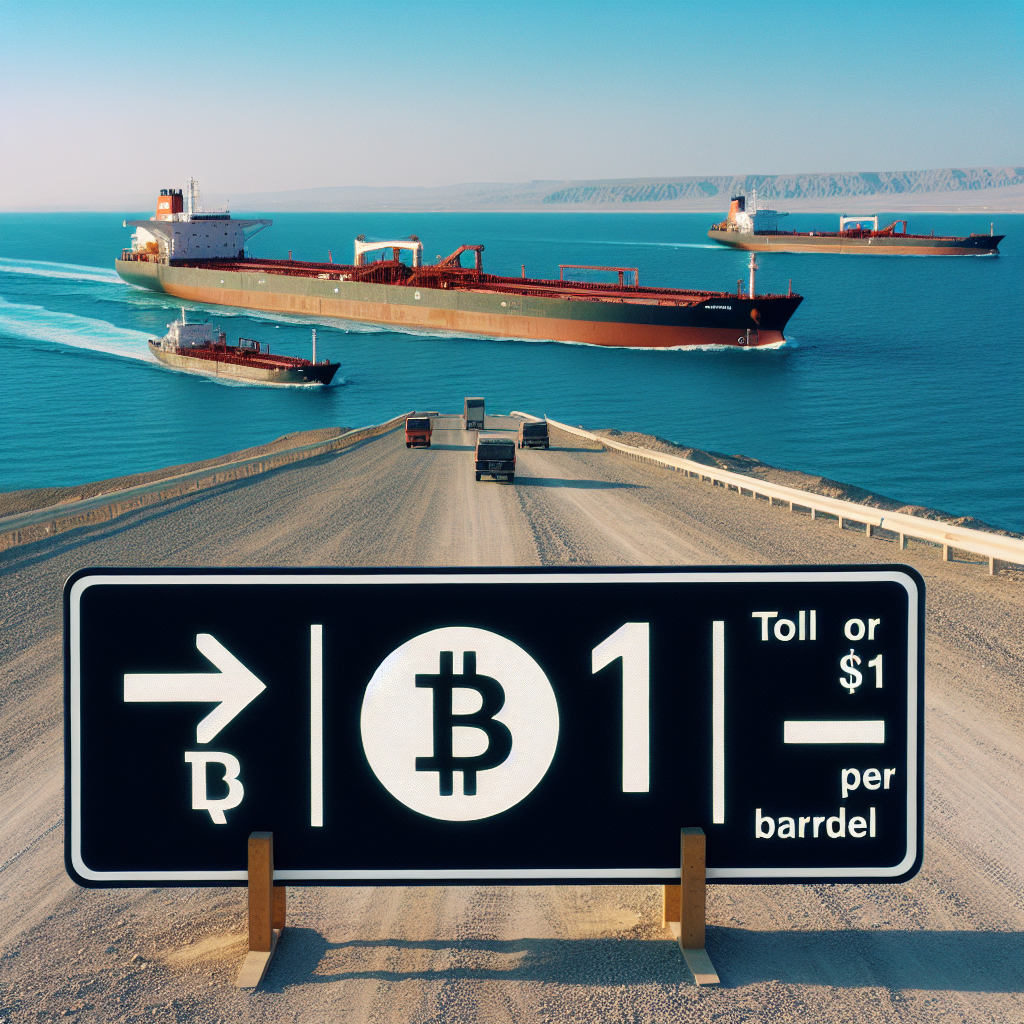
Iran has proposed charging a toll of $1 per barrel for oil tankers passing through the strait and requested payment in cryptocurrency. US President Trump has disclosed that both sides are considering a joint venture to collect fees, with the US responsible for traffic management, and the substantial funds collected will be used for Iran’s reconstruction.
According to data compiled by Bloomberg, since Tuesday morning, a total of 7 ships have left the region, while 3 have entered. Currently, over 800 cargo ships are stranded in the Gulf, mostly waiting to depart.
A senior Iranian official told Reuters on Wednesday, that if the ceasefire agreement is reached, Iran may reopen the Strait of Hormuz on Thursday or Friday, just before the meeting between Iran and the US in Pakistan.
Throughout the war, Iran’s blockade of the Strait of Hormuz disrupted the global oil and natural gas markets. In the process of trying to turn the temporary ceasefire into a long-term peace, the issue of passage rights through the Strait of Hormuz has become one of the most challenging issues faced by negotiators. Iran hopes to continue to control this critical waterway, while the US allies in the Gulf region strongly oppose it. The Strait of Hormuz is a key passage for about 20% of global oil transportation.
As part of the ceasefire agreement reached with the US, Iran has agreed to allow ships to safely pass through the Strait of Hormuz.
The official told Reuters that the reopening of the strait will be coordinated with the Iranian military.
On Wednesday, President Trump stated that following the two-week ceasefire agreement with Iran, he is considering establishing a “joint venture” with Iran to set up toll stations in the Strait of Hormuz.
In an interview with ABC News reporter Jonathan Karl, when asked about supporting Iran’s collection of fees from ships passing through the Strait of Hormuz, the President said, “We are considering doing so in the form of a joint venture”, adding that “this is a way to ensure the safety of the strait – and prevent other countries from interfering with it. This would be a good thing.”
However, any “joint venture” did not appear in Iran’s ten-point peace plan.
On Wednesday, earlier, Trump posted on the Truth Social website that the US would assist in the “traffic management” of the Strait of Hormuz and take many proactive measures.
“Huge funds will flow into Iran. Iran can start the reconstruction process,” he wrote, “We will transport various goods, then ‘stand by’ to ensure everything goes smoothly. I believe it will go smoothly.”
Iran’s leader stated last week that Iran would establish a “toll system” to charge ships attempting to safely pass through the strait.
Iran’s previously proposed toll scheme was criticized by US Secretary of State Marco Rubio. He denounced the potential “toll system” as “illegal” and a “threat to the world,” adding that the US and European partners must devise a response plan. However, Rubio pointed out that the US would not lead this initiative.
A regional official told the Associated Press that the funds raised from Iran’s toll system would be used for national reconstruction. Some of the revenue will also be handed over to Oman, but how Oman will use these funds is unclear.
President Trump tweeted late Tuesday on social media that the premise of the ceasefire is that “Iran agrees to fully, immediately, and safely open the Strait of Hormuz.”
The Financial Times interviewed Hamid Hosseini, a spokesperson for the Iranian Association of Oil, Gas, and Petrochemical Products Exporters, on Wednesday. During the two-week ceasefire period, Hosseini said Iran is requesting shipping companies to pay passage fees in cryptocurrency to pass through the Strait of Hormuz.
Iran’s supreme National Security Council is responsible for determining the conditions under which oil tankers can pass through the strait. However, Hosseini’s industry association has a close relationship with the Iranian government.
Hosseini stated that each oil tanker must report cargo information to Iranian authorities via email, after which Iran will inform them of the passage fee required.
He mentioned that the passage fee is $1 per barrel of oil and added that empty oil tankers can pass freely.
Furthermore, Hosseini stated, “Once the email is received, after Iran completes the assessment, ships will be given a few seconds to pay the fee in Bitcoin to ensure they are not tracked or detained due to sanctions.”
He also said, “Iran needs to monitor ships entering and exiting the strait to ensure that this two-week ceasefire is not used for weapons transportation.”
He added, “All ships can pass through, but the passage process for each ship will take time, and Iran is not in a hurry.”
The report stated that Hosseini’s remarks indicate that Iran will require all oil tankers to use the northern route near its coastline, raising questions about whether Western or Gulf state-related ships are willing to risk passing through.
Western ship owners are cautious about the latest developments in the Strait of Hormuz, stating that they are waiting for details on how and if the strait will be reopened.
From the announcement of the ceasefire on Tuesday night to Wednesday’s deadline, public reports show that apart from two ships related to Iran, no other ships have ventured through the Strait of Hormuz.
On Wednesday, the oil tankers stranded in the Gulf region received broadcast warnings from Iranian authorities, stating that unless approved in advance by Iran, they could become targets for military strikes.
The world’s second-largest shipping company, Maersk, stated that they are working diligently to clarify the terms.
The company said, “The ceasefire may create transit opportunities, but it does not fully guarantee the certainty of maritime navigation.” The company also added that it will continue to take a “cautious approach” to cargo transportation and is not currently adjusting specific services.
According to data from the commodity tracking company Kpler, about 187 oil tankers are currently stranded in the Gulf region, carrying 175 million barrels of crude oil and refined oil products. The transport of these goods will depend on the development of the strait situation.
Industry insiders estimate that 300 to 400 vessels are currently waiting to leave the Gulf, ready to depart once safe passage is possible.
Several traders believe that the situation in the coming days may still be similar to the past two weeks, where only a few ships approved by Iran can pass through specific routes.
Martin Kelly, consulting director of the maritime intelligence group EOS Risk, told the Financial Times that it is “fundamentally impossible” to clear all waiting ships within two weeks.
He stated that due to the “time-consuming” clearance process, only about 10 to 15 ships can pass through the strait each day, whereas before the conflict, the number of ships passing through per day was 135.