
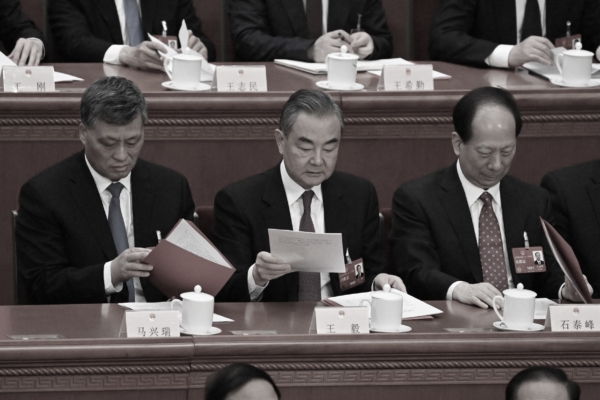
After disappearing for nearly half a year, Chinese Communist Party (CCP) Central Political Bureau Member Ma Xingrui was reported to have fallen from grace on April 3rd. There are multiple versions circulating regarding the insider details of Ma Xingrui’s downfall, including speculation of a coup. Scholars suggest that Ma Xingrui, along with other CCP “tigers” like He Weidong and Miao Hua, who were close to the CCP leader Xi Jinping, were involved in anti-Xi factional activities. The consecutive revelations of such “political disloyalty” cases have left Xi feeling despair.
The focus of attention in the Ma Xingrui case has been on his corruption issues during his stints in the aerospace system, Guangdong, and Xinjiang. However, Yuan Hongbing, a scholar with ties to the CCP system, told Epoch Times that the Ma Xingrui case is actually a major case of political disloyalty towards Xi Jinping. Ma Xingrui’s troubles are said to have stemmed from the cases involving Miao Hua and He Weidong.
Former Vice Chairman of the Central Military Commission, He Weidong, and former Military Commission Member and Political Work Department Director, Miao Hua, were considered part of Xi Jinping’s Fujian clique. On October 17, 2025, the Chinese Ministry of National Defense announced the expulsion from the party and military of nine senior generals including He Weidong and Miao Hua.
Yuan Hongbing stated that one of the key reasons He and Miao faced Xi’s crackdown was their efforts to establish contacts beyond the military system with CCP officials, which was something Xi Jinping, as a dictator, strongly disapproved. One of their contacts included Jiang Zemin’s son, Jiang Mianheng, as well as Ma Xingrui. Yuan also claimed that the private communication among them revealed strong criticisms of Xi Jinping.
According to Yuan Hongbing, Xi Jinping was determined to eliminate Miao Hua, He Weidong, and Ma Xingrui because they were reportedly preparing to take control of China in the event of a potential overthrow of Xi’s regime, especially post a military conflict with Taiwan.
Yuan Hongbing believed this was the fundamental reason behind Ma Xingrui’s fall from grace, rather than issues related to his wife, connections to the military-industrial complex, or corruption.
In December of last year, Yuan Hongbing disclosed in an interview with “Watching China” that according to a source from within the CCP’s second-generation, after He Weidong’s arrest, he revealed during interrogation that he and Ma Xingrui had a political agreement through Ma Xingrui’s brother, Ma Xingquan. This agreement involved forming a political alliance in the event of a regime-changing event with He providing military support and Ma providing political and economic power to control China. The existence of this political alliance, constituting a betrayal of Xi Jinping, caught Xi off guard.
Ma Xingquan is a member of the Standing Committee of the People’s Congress in Shuangyashan, Heilongjiang Province, and serves as the Chairman of Beijing Zhan Ying Xingye Information Technology Co., Ltd. He is involved in multiple industries such as real estate, coal, municipal services, labor services, and construction in his local area.
Yuan Hongbing maintained that the Ma Xingrui case has left Xi Jinping feeling a sense of despair regarding the loyalty of his subordinates, akin to the crisis of widespread betrayal faced by Mao Zedong in the past. Following the 20th CCP Congress, a series of cases involving political disloyalty and corruption has emerged within the party, military, and affiliated defense industries. These officials have been accused of transferring significant amounts of illicitly gained wealth overseas to secure an exit strategy in times of crisis.
The details disclosed by Yuan Hongbing remain unverified to date.
Chinese affairs expert Wang He told Epoch Times that at the level of Central Political Bureau members, such incidents go beyond merely corruption or economic issues. The authorities have admitted that economic and political issues are intertwined. The case of Sun Zhengcai, for instance, undertook the core charge of “disregarding political rules,” which essentially highlighted Sun’s significant political ambitions. However, there can be discrepancies between internal and external announcements.
Wang He remarked that the extended period from rumors to the official announcement of Ma Xingrui’s downfall indicates a deep underlying situation. The alleged collusion and plotting between Ma Xingrui and He Weidong against Xi Jinping may sound surprising, but the severity of the issue can be gauged from the fact that Ma Xingrui was not addressed as a comrade in the official report of his downfall, an anomaly considering the customary practice within the CCP. It remains unclear if there are latent connections present in these events.
“The current political situation within the CCP is highly complex, with intense internal struggles within Xi’s faction and a prominent opposition. Anything is possible, so we must wait and see,” he concluded.