
Recently, four military aircraft from China and Russia flew to the Alaskan waters for joint exercises and were intercepted by the North American Aerospace Defense Command (NORAD). This marks the first time Chinese military aircraft have flown to this region, with military experts analyzing it as a move by China to intimidate the United States and enhance its presence in the North Pacific and the Arctic Circle.
NORAD announced on July 24 that they detected, tracked, and intercepted two Russian Tu-95 and two Chinese H-6 military aircraft flying in the U.S. Alaskan Air Defense Identification Zone (ADIZ). Although the aircraft were flying in international airspace without entering the sovereign airspace of the U.S. or Canada, NORAD stated that they would continue monitoring the activities of their competitors near North America to ensure readiness.
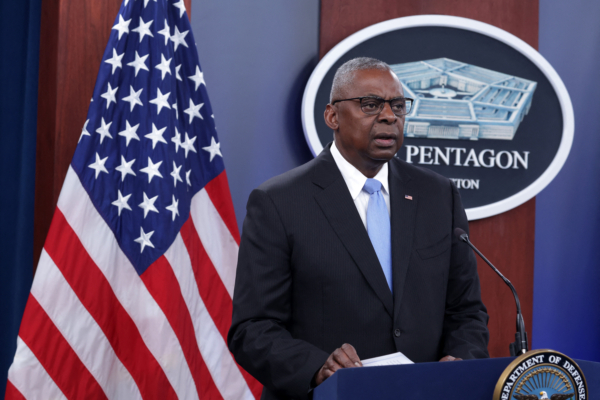
U.S. Secretary of Defense Lloyd Austin stated on the 25th that this incident was not unexpected and did not pose a threat to the U.S. “We closely monitored, tracked, and intercepted these aircraft, demonstrating that our military is always ready.”
The Russian Ministry of Defense released a statement on the 25th, stating that the joint patrol exercise conducted by Russian and Chinese aircraft in the Chukchi Sea, Bering Sea, and the northern Pacific did not violate any other country’s airspace. The Chinese Ministry of Defense spokesperson also mentioned during a regular press conference that the exercise was not aimed at any third party and was unrelated to the current international and regional situation.
In response to the joint visit of Chinese and Russian bombers to the Alaskan waters, Su Ziyun, Director of the Strategic Resources Institute at the Taiwan Institute of National Defense and Security Studies, expressed to Epoch Times that this move was intended to send a message that China and Russia may act against the U.S. in the future if necessary.
Su Ziyun further highlighted that China’s recent joint military exercises with Russia and other nations around the world have raised concerns internationally as their frequency and intensity increase, with the U.S. perceiving China’s behavior as its biggest threat and challenge.
Regarding the significance of the joint flight of Chinese and Russian military aircraft to the Alaskan waters, Liu Xiaoxiang, Deputy Researcher at the Taiwan Institute of National Defense and Security Studies, believes that it reflects China’s attempt to exert pressure on the U.S. and express dissatisfaction through this kind of “gray zone tactics.”
Liu pointed out that the potential for China to take military action against Taiwan is a tangible threat, with escalating intensity in recent times. He noted China’s strategic moves including stockpiling strategic resources like food and energy, seen as dangerous signals indicating preparedness for conflict.
Despite China’s declining economy, there has been a sharp increase in the import of commodities last year. Although China has stopped disclosing inventory data for many commodities, the U.S. Energy Department predicts significant increases in China’s wheat and corn inventory, crude oil reserves, and natural gas reserves.
Su Ziyun, however, assesses that the likelihood of China instigating military actions against Taiwan is currently low due to economic weaknesses and uncertainties in naval operations without assured victory. He also emphasized that regardless of the outcome of the upcoming U.S. election, the approach towards China is expected to remain steadfast, given the bipartisan consensus on China’s threat.
In light of these circumstances, Su Ziyun emphasized the importance of unity among free nations and continuous reinforcement of military capabilities to deter China from military adventures. Maintaining strong military readiness is crucial to preventing specific regions or countries from becoming vulnerable targets for Chinese aggression.
In this vein, Su Ziyun stated, “The military force becomes the most realistic pillar to maintain regional peace.”