
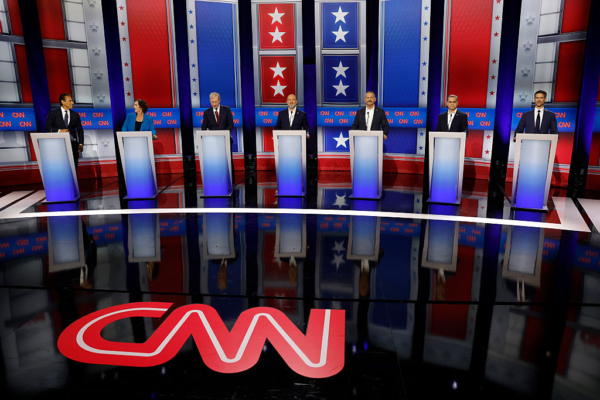
As the primary election day on June 2 approaches, the seven main candidates for California Governor engaged in a heated debate on the final stage, expressing sharp differences on hot topics such as the billionaire tax, immigration policy, and universal healthcare proposal.
The seven participants in the debate were: two Republican candidates – former Fox News host Steve Hilton and Riverside County Sheriff Chad Bianco, as well as five Democratic candidates – former Health Secretary Xavier Becerra, billionaire Tom Steyer, San Jose Mayor Matt Mahan, former Congresswoman Katie Porter, and former Los Angeles Mayor Antonio Villaraigosa.
According to the New York Post, as only two candidates will advance in the end, the leading candidates in the polls, Hilton and Bianco, had a friendly performance during the debate; they knew that only if the other also advanced, there would be an opportunity for both. In contrast, the Democratic party’s strength is divided, making the outcome unpredictable; the two leading candidates in the party, Becerra and Steyer, were on the defensive during the debate.
The article mentioned that although Becerra behaved decently, his defense of California’s high fuel tax position put him in a passive stance; scandals of misappropriation of funds and corruption such as telecom and banking fraud exposed by his former chief of staff also made him a target of attacks. Mahan, despite his good political record, gave the impression of lacking experience and being unwilling to reduce government size.
The “billionaire tax” initiative has met the signature threshold and is expected to be included in the November ballot. This initiative proposes a one-time 5% tax on the total wealth of California billionaires for use in healthcare, education, and other projects, prompting some top billionaires to leave California.
Steyer believes that the tax on billionaires is not strong enough. His Democratic competitors Porter and Villaraigosa, on the other hand, oppose it. Porter supports taxing the wealthy but emphasizes it as a temporary measure; Villaraigosa believes that the proposal will drive billionaires out of California.
Hilton countered Steyer by saying that under Steyer’s leadership, taxes in California would be higher, gasoline prices would soar, and all living costs would increase.
Regarding federal immigration enforcement, Steyer stated that Immigration and Customs Enforcement (ICE) deliberately violates the law and should be abolished; he also proposed prosecuting federal agents and immigration leaders who discriminate against or use violence against Californians. Mahan argued that many immigrants are afraid to leave home, causing business owners in San Jose to lose customers.
Bianco refuted the Democrats’ stance. He cited an example from Riverside County where a 14-year-old male high school student was killed in a hit-and-run drunk driving accident last year, and the Mexican illegal immigrant responsible had been arrested for drunk driving twice in California but was protected.
He believes that policies protecting criminal immigrants make California less safe, and illegal alien criminals should be deported; California law restricts police cooperation with federal immigration authorities, making law enforcement more difficult.
Hilton, an immigrant himself, praised the federal government’s immigration policy, stating that gubernatorial candidates should not confuse legal immigrants with illegal immigrants. He stated that while formulating and implementing immigration policies is the responsibility of the federal government, all laws should be enforced peacefully; if elected, he will ensure state-federal cooperation.
California tried to expand healthcare coverage a few years ago but due to budget deficits, ended up cutting a project that would benefit all low-income adults, including those without legal status. In February of this year, 20 Democratic state assembly members launched a California “CalCare” proposal aimed at establishing a “single-payer” healthcare system covering everyone. Republican lawmakers criticize this as a move to allow government takeover of healthcare and ban private operations.
During the debate, Steyer stated that we have “no choice” but to move towards a single-payer healthcare system, but it is “devouring” California’s budget. Villaraigosa also considered the costs to be too high. Porter also supported CalCare.
Becerra emphasized the most crucial significance of a single-payer system is to cover everyone and efforts must be made to achieve that goal.
Mahan criticized candidates vying for the single-payer system for not knowing how to fund it. He proposed using technology to reduce administrative costs in healthcare, and incentivizing doctors and healthcare systems that promote people’s health.
Both Republican candidates considered “universal healthcare” to be impractical.
Hilton said that he is the only one on stage with experience in a “single-payer” healthcare system, and if implemented, the result would be the lowest patient satisfaction, unbearable high costs, all backed by skyrocketing taxes. He believes the solution is to stop providing “free healthcare” to “those who should not even be in this country”.
Murray Ross, then director of the Kaiser Family Foundation’s Health Policy Research Institute, clarified in an article: “Most other countries do provide universal healthcare…their system ensures affordable healthcare services for everyone.” But she also stated that a single-payer system is not the only way to achieve that.