
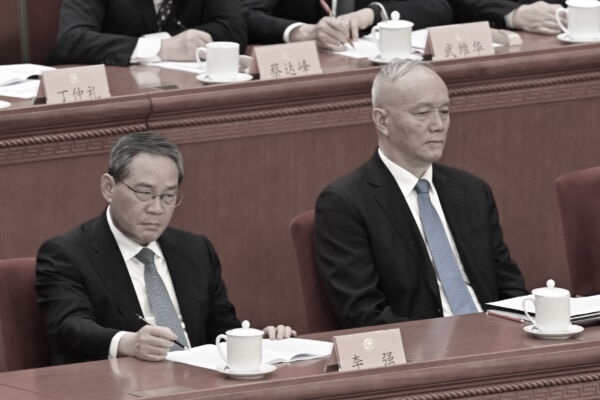
As the countdown to the 21st National Congress of the Chinese Communist Party (CCP) begins, internal struggles over succession and power configuration within the party have intensified. Recently, CCP Politburo Standing Committee member Cai Qi suddenly emerged as a focal point, being exposed as the “number two figure” within the CCP, with power surpassing that of Premier Li Keqiang. Analysts point out that this may be a signal of the political maneuvering within the party on the eve of the 21st National Congress, with Cai Qi’s increasing power indicating higher political risks.
According to a recent article in The Economist, Cai Qi, the Director of the CCP Central Office and a member of the Politburo Standing Committee, is officially ranked fifth among the Standing Committee members, but his actual power has soared to second place.
The article highlights that besides overseeing the CCP Central Office and being in charge of dispatching the Central Guard Bureau, Cai Qi also serves as the Secretary of the Central Secretariat (ranked first), responsible for implementing CCP leadership decisions and managing the party’s daily operations.
Cai Qi controls President Xi Jinping’s schedule and the individuals and information he interacts with. He usually accompanies Xi on domestic or foreign visits and may even supervise Xi’s medical care. Cai Qi is also responsible for Xi’s personal security, with the Central Guard Bureau under his command likely involved in the operation to capture former Vice Chairman of the Central Military Commission, Zhang Youxia.
At the same time, Cai Qi is a key figure in CCP’s internet surveillance, overseeing the party’s propaganda system, and serving on the secret organization National Security Commission. The breadth and depth of Cai Qi’s power are extremely rare in CCP party history.
The article quotes former China analysis expert from the CIA, Jonathan, saying, “When people ask me, if Xi Jinping suddenly passed away without a succession plan, who would take on the highest position? Cai Qi seems to be the most obvious choice.”
In response, current affairs commentator Honghe, in an interview with “Fuyao Club” on May 5th, said, “I personally think that someone within the party deliberately put him in such a prominent position. The publication of this article itself reflects the intense internal struggles currently happening, with someone hoping to push Cai Qi into such a prominent position to disadvantage him.”
Honghe cited the exposure of corruption within the family of former Premier Wen Jiabao by overseas media as an example, indicating that the leaks often have traceable sources from within the political sphere, suggesting a strategic move against Cai Qi.
Senior media figure Guo Jun stated on the “Elite Forum” program that the recent high-profile naming of Cai Qi as the CCP’s number two figure by foreign media is a standard operation of the CCP’s external propaganda, possibly orchestrated by Beijing. She highlighted that behind-the-scenes maneuvering is at play to send a signal within the party.
The Economist article mentioned that Cai Qi’s dual role of wielding both the pen and the sword resembles the power structure of the Mao Zedong era with Wang Dongxing. However, Wang Dongxing collaborated with Hua Guofeng and Ye Jianying to apprehend Mao’s wife, Jiang Qing, and the Gang of Four after Mao’s death.
Honghe noted that Cai Qi’s current situation differs fundamentally from that of Wang Dongxing. While Wang Dongxing was only head of the General Office and was in charge of the 8341 troop, beyond that, he had no other power. On the other hand, the depth of Cai Qi’s power concentration is “extremely rare” in CCP party history, making him a more prominent target.
Regarding the dual political pressure on Cai Qi, Honghe considered this to be the situation Cai Qi is likely attempting to avoid. Using the example of Zhou Yongkang, she explained that even though Zhou was ranked last among the nine Politburo Standing Committee members during the Jiang Zemin and Hu Jintao era, his power was the greatest. This led to resentment from other committee members, eventually resulting in his arrest.
Guo Jun pointed out that as a “tough official,” Cai Qi has both a political function and significant risks. She emphasized that in times of crisis in Chinese history, emperors required two types of people by their side: those who were loyal to maintaining order, and those who dared to take drastic actions at critical moments. Cai Qi exemplifies both.
She illustrated this point by referring to an incident during Cai Qi’s tenure as the Beijing Municipal Communist Party Secretary, where under Xi Jinping’s directive, a large number of lower-class individuals were expelled overnight in harsh conditions. Guo Jun emphasized that Cai Qi’s execution of such directives without hesitation earned him a reputation for undertaking tasks others wouldn’t dare to do.
Guo Jun highlighted that Cai Qi holds many of Xi Jinping’s secrets, which serve as both his protection and a potential threat. Being in charge of Xi’s personal security through the Central Guard Bureau, Cai Qi has become someone Xi trusts the most but also someone he might find difficult to dispose of. Each action taken by Cai Qi on behalf of Xi is a double-edged sword, as it safeguards Xi while also holding his most sensitive secrets.
She argued that the characteristic of a “tough official” implies a readiness to turn against anyone, including the emperor.
She raised an unresolved core mystery: whether the Zhang Youxia incident was orchestrated by Xi Jinping himself, authorizing Cai Qi to act, or if Cai Qi had to some extent already taken control, knowing that once Xi Jinping gracefully exits the stage, he could be the first to be purged. Guo Jun noted that even insiders in Zhongnanhai are uncertain about who the true master is, a chilling uncertainty.
Guo Jun summarized the current power dynamics within the CCP as “three scenarios and one opposing card.” She explained that all three scenarios emanate from Xi Jinping’s own strategic layout, with only one being a candidate put forward by other forces within the party to challenge Xi Jinping.
Guo Jun mentioned the first scenario, where Xi Jinping continues the “triumvirate” and seeks re-election by holding the positions of General Secretary, President, and Chairman of the Central Military Commission. However, with increasing internal resistance, this path is becoming more challenging.
The second scenario involves Cai Qi succeeding Xi Jinping. Guo Jun believes that Cai Qi is practically the second most important figure within the CCP, but at nearly eighty years old and with close proximity in age to Xi Jinping, there is notable opposition within the party to his long-term succession.
The third scenario suggests Ding Xuexiang as the successor. Guo Jun emphasized that as the only “post-60s” member among the Politburo Standing Committee and lacking an independent faction, Ding Xuexiang is considered the most trustworthy by Xi Jinping. Ding Xuexiang’s succession resembles the “tandem system” of Putin and Medvedev, where a confidant temporarily assumes power while still influenced by Xi Jinping.
Guo Jun presented the fourth scenario involving another faction within the party advocating for Hu Chunhua. Supported by the “Central Decision-Making Consensus Coordination Organization” dominated by senior party members, Hu Chunhua’s candidacy relies on reformist factions to promote policy adjustments.
Furthermore, Guo Jun analyzed that Xi Jinping is currently facing triple crises in the military, economy, and foreign affairs, and his political capital from using the Taiwan issue to secure re-election is dwindling.
“Internal party elders and factions are beginning to settle scores – you used the Taiwan issue for re-election, and now it is backfiring due to the failure of the Taiwan policy. This is his fundamental dilemma and the reason for the emergence of names like Cai Qi, Ding Xuexiang, and Hu Chunhua,” she said.
Guo Jun argued that Xi Jinping’s carefully planned political posturing during the foundational research seminar in Shanghai on April 30th was significant. She highlighted several key details, such as Cai Qi standing side by side with Xi Jinping in the official footage, signaling in CCP’s political aesthetics that Cai Qi is almost on par with Xi Jinping in power within the party-governing system.
Simultaneously, Li Keqiang was sent to Guangxi, Zhao Leji, and Wang Huning stayed in Beijing, each viewed with suspicion by Xi Jinping. The absence of three more individuals, Yang Jiechi, Chen Min’er (Guo Jun pointed out that they have private ties with Ma Yun and Xu Jiaying, leading to their marginalization), and Li Ganjie, was particularly intriguing, symbolizing that these individuals are not part of the plans for the 21st National Congress.
Guo Jun expressed that the true decisive battle window will be from the end of this year to the beginning of next year, during local leadership changes and central ministries personnel adjustments, marking the real prelude to the 21st National Congress. The Central Inspection Team has been stationed at the Ministry of Public Security for over half a month. “If Wang Xiaohong is taken down, the Fifth Plenum’s dynamics will undergo a significant change.”
“The CCP is like a ‘One Ring,’ whoever holds it will be ground into pieces,” Guo Jun concluded. “Every stage going forward is filled with uncertainties, the common bottom line has been lost, the common trust has been lost. From the end of this year to the beginning of next year will be the time window that requires close attention.”