
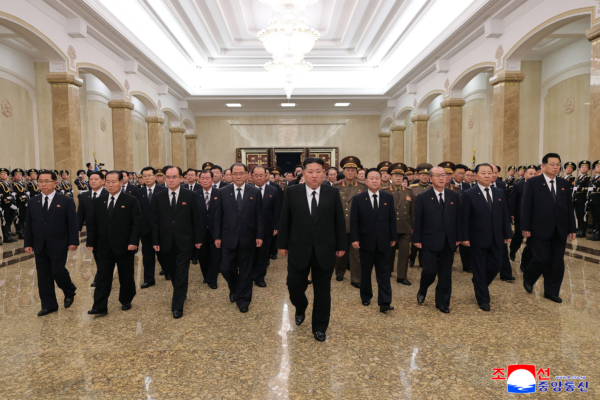
According to South Korean experts revealed on Wednesday (May 6th), North Korean authorities have revised their constitution, officially abandoning the goal of reunification with South Korea that they had been pursuing for years. This marks the first time in over 70 years that the Pyongyang regime has legally defined itself as an independent country separate from the southern part of the Korean Peninsula.
Reportedly, the updated version of the constitution, which was introduced in March, includes a new territorial clause stating that the territory of the Democratic People’s Republic of Korea “includes the territory bordering China and the Russian Federation to the north, the territory bordering the Republic of Korea to the south, and the territorial waters and airspace determined on the basis of this.” The official name of South Korea, “Republic of Korea,” is directly mentioned in the provision.
Experts have indicated that this move signifies Pyongyang’s formal acknowledgment of the existence of two independent countries on the Korean Peninsula, effectively ending the decades-long pursuit of reunification policy promised since 1948.
The revised constitution also officially establishes Kim Jong Un as the head of state under the title of Chairman of the State Affairs Commission and grants him the highest authority over the use of nuclear weapons, empowering him to delegate relevant decisions to the “National Nuclear Command Authority,” while categorizing North Korea as a “responsible nuclear weapon state.”
Additionally, the historical references to the “Kim Il-sung – Kim Jong-il Constitution” and sentences regarding the “inheritance of the glorious revolutionary struggle in Korea” have been removed from the constitution.
Christopher Green, a senior advisor at the International Crisis Group, commented that this constitutional revision aligns with North Korea’s long-standing efforts to redefine itself as a “normal country” within the global context.
He pointed out that a normal country would define its adversaries in defense white papers, not in its constitution, suggesting that this revision helps reinforce the stance of North-South divisions and lays the groundwork for potential future conflicts.
Green also noted that the preamble of the new constitution expresses intent to adhere to international norms on territorial border issues, which is particularly sensitive against the backdrop of the Northern Limit Line (NLL) dispute in the Yellow Sea.
The NLL is a de facto maritime boundary established by the United Nations Command in 1953 after the ceasefire, which Pyongyang has never formally acknowledged, considering it a violation of international maritime law.
Lee Jung Chul, a political scientist at Seoul National University, expressed a relatively optimistic view in an interview with Yonhap News Agency, suggesting that Pyongyang’s new policies may lay the foundation for “peaceful coexistence” between the two Korean states. He noted that the constitution does not clearly delineate specific boundaries, implying that Pyongyang is currently seeking to avoid direct confrontation.
This constitutional amendment is the latest step in Kim Jong Un’s years-long systemic policy transformation. At the end of 2023, he categorized Seoul as the “main enemy,” ordered the dismantling of the Arch of Reunification monument in Pyongyang, and renamed the Tongil subway station.
In January 2024, he called for a constitutional amendment defining South Korea as the “main enemy and unchanging primary enemy.”
Meanwhile, in April this year, North Korea conducted four missile tests, setting a monthly record in over two years. Kim Jong Un has vowed to expand the nuclear arsenal. He had previously relaxed North Korea’s nuclear doctrine, allowing preemptive nuclear strikes in response to conventional military aggression.
Additionally, North Korea continues to strengthen its relationship with Russia, providing troops and artillery support for its military actions in Ukraine.