
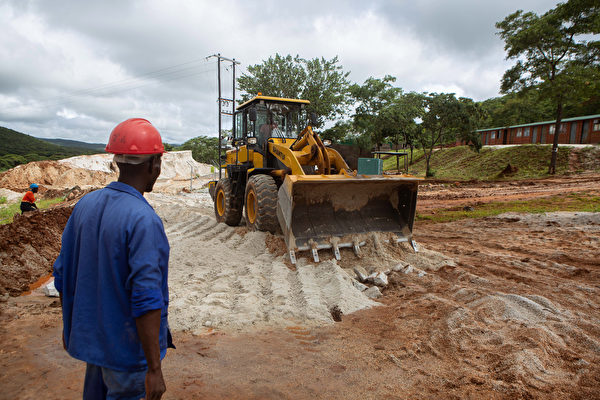
The United States House of Representatives’ Special Committee on China released an investigation report stating that Chinese enterprises currently control about 90% of the mining industry in Zimbabwe. The report exposed how, in an environment lacking competition and governance capabilities, Chinese enterprises have systematically caused damage to the local environment, human rights, and cultural heritage through corruption and “plundering-style development.”
The report, titled “Minerals Mafia of China,” describes Zimbabwe as a “cautionary tale.” It details numerous egregious human rights abuses.
In 2024, the Chinese manager of the Makanka mine allegedly bound two local workers to the bucket of a front-end loader and hoisted them into the air as punishment for suspected diesel theft. Although the Chinese owner involved was expelled from the country, local residents believe they should have been prosecuted in Zimbabwe.
Additionally, in 2020, a Chinese mine owner reportedly shot and injured two local employees during a wage dispute, with one employee sustaining five gunshot wounds to the legs.
Zimbabwean civil organizations informed the investigative team that Chinese-owned mines commonly have issues such as low wages, excessively long working hours, and systemic disregard for labor safety regulations.
The report cited investigations by the local media outlet “New Zimbabwe,” which revealed dire living conditions of workers at the Arcadia Mine under the Chinese battery giant Huayou Cobalt Industry. Workers were reported to live in extremely dirty environments, staying in wooden huts without ventilation where sewage often flowed. The temporary toilets at the site were said to be blocked, and the newly constructed toilet facilities featured two rows of toilets facing each other with no privacy barriers.
In terms of environmental and cultural impact, the behavior of Chinese enterprises has stirred strong anger within the local community. Subsidiary of the China National Minerals Corporation, Bikita Minerals, was accused of discharging toxic waste into local dams, leading to rotting crops, fish deaths, and residents deprived of clean water for two years.
Further controversy arose when MaxMind Investments, a subsidiary of Chengxin Lithium Group, forcibly evicted 41 families to expand the Sabi Star mine, allegedly desecrating 30 ancestral graves without proper consultation or respect for cultural rituals, inflicting emotional distress upon the families of the deceased.
These displaced families were forced to leave their ancestral lands, relocating to cramped and substandard new residences, consequently losing their access to crucial natural resources.
According to the Zimbabwe Environmental Law Association (ZELA), between 2022 and 2024, over 1,000 people in the Goromonzi and Bikita regions were displaced or suffered losses due to lithium mining expansion and exploration.
The investigation pointed out that such sacrifices of environmental and local community interests often occur with the complicity of “widespread corruption and incompetence at all government levels.”
The report further exposed how Chinese enterprises evade Zimbabwe’s export ban. Despite the Zimbabwean government’s efforts to ban the export of raw minerals to retain economic value, Chinese enterprises were accused of smuggling on a large scale by falsifying permits or hiding high-quality lithium ore beneath low-grade ore to deceive inspectors.
Due to these illegal practices and underreporting of production, the Zimbabwean government was forced to abruptly terminate all lithium concentrate exports a year earlier in February 2026.
The investigation process itself revealed the extent of political interference in Zimbabwe. When staff from the US House of Representatives Special Committee visited for on-site investigations, Zimbabwean government officials not only refused to meet with them but also assigned intelligence personnel to shadow and monitor the investigative team throughout. The authors of the report speculate that this action was to ascertain whom the staff members met with during their time in Zimbabwe.
The report states, “These Chinese mining companies, under the guidance of Beijing, operate like a ‘Minerals Mafia,’ engaging in a range of criminal activities including extortion, smuggling, usury, contract manipulation, and exploiting intimidation and violence to extract maximum profit and exert control… in an attempt to assist Beijing in controlling the global supply of critical minerals.”
“What we have heard and received through dozens of public reports confirms a consistent narrative: Chinese companies practice ‘unchecked extractivism,’ sacrificing the environment, local communities, and the people of Zimbabwe.”