
In 2026, China’s economy is entering a crucial starting point for the Communist Party’s “15th Five-Year Plan”. However, official data reveals a deep crack, with a growing trend of “southern strength and northern weakness”. Analysts point out that this is not just due to geographical differences, but also the result of the development logics of “market evolution” and “administrative directives”.
Currently, the northern regions are facing challenges of population loss and stagnant industrial structure. As a typical example, Beijing has seen a nearly halved number of young people in the past decade, with Xiong’an New Area caught up in “administrative city construction”. Experts warn that market rules cannot be shifted by political will alone. The North-South contest, spanning across latitudes, is becoming the heaviest stress test for the Communist system.
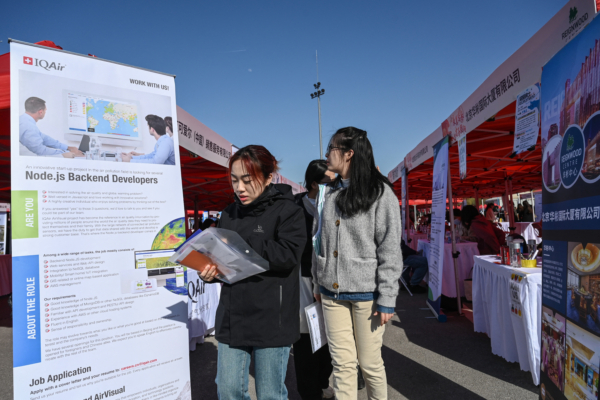
Beijing, once seen as the “first choice” for young people nationwide to pursue their dreams, is now witnessing a remarkable talent migration. According to a recent report by the Economic Observer, the number of young people aged 20-29 residing in Beijing dropped from 4.618 million in 2015 to 2.489 million in 2024, a cumulative decrease of 2.129 million, a sharp decline of 46%.
Data indicates that in 2015, there were about 21 young people among every 100 residents in Beijing; however, by 2024, there were only 11 young people among 100 residents, and 24 people aged 60 and above.
Wang Mingyuan, a researcher at the Beijing Institute for Reform and Development, stated that the retention rate of Peking University graduates in Beijing in 2024 had dropped significantly from 72% a decade ago to 42%.
The phenomenon mockingly referred to as the “peacock flying to the southeast” is attributed not only to the rising living costs in northern metropolitan areas but also to the rigid institutional environment, according to experts.
Senior media figure Mike Li, in an interview with Dajiyuan, mentioned that “economic theory suggests that people and capital flow to places with high returns and low transaction costs.” Although Beijing boasts a complete industrial chain, its rigid urban management and high residential thresholds are undermining its long-term competitiveness.
Wang Mingyuan analyzed that there exists “overly strict administrative isolation” and “complex entry-exit inspection system” between Beijing and its surrounding regions like Yanjiao and Langfang. This prevents satellite cities from serving as buffers for daily life, leading many young people to choose to relocate to the south or return to their hometowns.
He further pointed out that in sharp contrast to Beijing, Shanghai and Hong Kong have significantly eased their settlement requirements. Shanghai’s settlement quota has been raised from around 100,000 per year to about 300,000, while Beijing maintains the strictest household registration requirements, with only about 6,000 people granted residency through talent point systems.
The migration of population and the high differentiation in economic aggregate are interdependent causative factors. Official data shows that in 2025, the cumulative GDP of the “top ten provinces” in China reached 8.55 trillion yuan, accounting for 60% of the national total, with eight of the ten provinces located in the southern regions. Guangdong maintained its top spot with 14.58 trillion yuan for the 37th consecutive year, followed closely by Jiangsu at 14.24 trillion yuan.
Beijing has slid out of the top ten list. Shandong and Henan are the only two northern provinces remaining. Despite Shandong officially surpassing the 1 trillion yuan mark in 2025, becoming the first “trillion-yuan province” in the north, its growth momentum mainly depends on heavy industries like petrochemicals and equipment manufacturing.
In 2024, among the 27 “trillion-yuan cities” in China, the south occupied 19, accounting for over two-thirds of the total.
Mike Li analyzed that the essence of the north-south disparity lies in the structure of industries and the success of transformation. The “strength” in the north exhibits a clear island effect. The northern economy has long been constrained by a high proportion of heavy industries and a high dependency on resources. With the advancement of carbon neutrality goals, the pressure for transformation is immense.
In contrast, regions like the Yangtze River Delta and the Pearl River Delta have taken the lead in strategic emerging industries such as new energy vehicles, low-altitude economy, and semiconductors, thanks to a high level of activity in the private economy, leading to a stronger adaptability to market fluctuations.
To explain the deep-rooted reasons behind the north-south disparity, Mike Li bluntly pointed out that the north is directive and resource-oriented, relying heavily on administrative directives and large state-owned enterprises for economic growth, while the south is market-oriented and driven by private enterprises, which thrive on spontaneous growth.
He highlighted the success or failure of regional integration as a battleground for these two development logics. Mike Li observed that the promotion of the “Beijing-Tianjin-Hebei integration” for over a decade has not been successful in reality. He stated, “For over ten years, the ‘Beijing-Tianjin-Hebei integration’ has been promoted. Beijing and Tianjin, two major direct-administered cities, are only 120 kilometers apart, with an intercity express that can reach each other in 27 minutes. But it has not succeeded! No one chooses to go to Tianjin, let alone Hebei.”
He mentioned that the disconnect between administrative interventions and economic rules has prompted the top echelons to adopt more radical “reverse operations” – exemplified by the establishment of Xiong’an New Area.
Comparing it with the south, Mike Li emphasized how in the Yangtze River Delta region, with Shanghai at its core, many people are willing to reside in cities like Suzhou and Kunshan, connected to Shanghai through an hour’s intercity rail. This simple example illustrates how the development directions of the north and south align but with vastly different approaches.
In March of this year, Xi Jinping inspected Xiong’an New Area for the fourth time and explicitly stated that “the Central Committee’s decision on building Xiong’an New Area is completely correct”.
However, since its announcement in 2017, this city defined as a “millennial grand plan” has been accompanied by doubts about low occupancy rates, insufficient population density, and a lack of organic business incentives.
Mike Li views Xiong’an as a newly built city in a “reverse” manner, not relying on so-called “economic rules”. In other words, it doesn’t rely on land finances or natural population shifts, creating a model city for the “Beijing-Tianjin-Hebei” integration.
Nearly a decade later, Xiong’an remains desolate. In February this year, Beijing media documented the commuting scene of Xiong’an’s workers: more and more people choose to stay in Xiong’an on workdays and return to Beijing on weekends. They are referred to as “weekend Beijing-Xiong migratory birds”.
BBC reported that the primary reasons driving their behavior are almost the same: children’s schools, spouses’ workplaces, and family activities, all tied to Beijing.
The report pointed out, “This phenomenon is likely to become one of the core challenges that Xiong’an development must face and resolve for a considerable period in the future.”
Mike Li also expressed similar concerns, stating that Xiong’an currently relies on administrative orders to boost its development; whether it is the relocation of central enterprises or the dispersal of universities, there is a lack of internal driving force.
Mike Li gave a pessimistic assessment of such “contrary rule” policies, criticizing Xiong’an essentially as “using the rent of the national system to hedge the risk of northern economic collapse”.
In the interview, he warned, “The rules are ruthless. Administration can move mountains and reclaim seas, but it is difficult to grow a forest where there is no soil. This ‘contrary rule’ game may become the most crucial variable for China’s future national destiny in the next thirty years.”
Beyond the population exodus from Beijing, City Finance cited data reports that the population in the “Four Provinces of Mountain and River” – Shandong, Shanxi, Henan, and Hebei, which were once prosperous regions in the Yellow River basin, decreased by a total of 1.4 million in 2023 during the decade from 2010 to 2020, sounding an alarm for further differentiation.
Although “coordinated development between the north and south” is included in the State Council’s “15th Five-Year Plan” recommendations, the overall decline in the north is an undeniable fact, with experts attributing the core issue to the system itself.
Mike Li predicted that if the north-south gap crosses a critical point, China may enter an “internal cold cycle,” dividing into two parallel worlds: one centered around Beijing, highly reliant on administrative directives and political order, forming a “hardcore north”; while the other centered in the Yangtze River Delta and the Greater Bay Area, pursuing efficiency and profit, forming a “flexible south”.
He straightforwardly stated that once the southern market cannot support the massive administrative expenditures in the north, the system may resort to more rigid administrative measures to target southern wealth, further damaging economic vitality.
Mike Li concluded with a clever analogy, “When a country’s ‘brain’ (administrative control) and ‘feet’ (market dynamics) deviate in logic, persistent divergence can inevitably lead to self-harm.”
The “population reduction” in Beijing and the “administrative city construction” in Xiong’an fundamentally represent the system’s attempts to forcibly introduce a “new engine” in the north to avoid repeating the mistake of a “unbalanced center”.
He believes that this north-south divide is becoming the most severe stress test for the Communist system.