
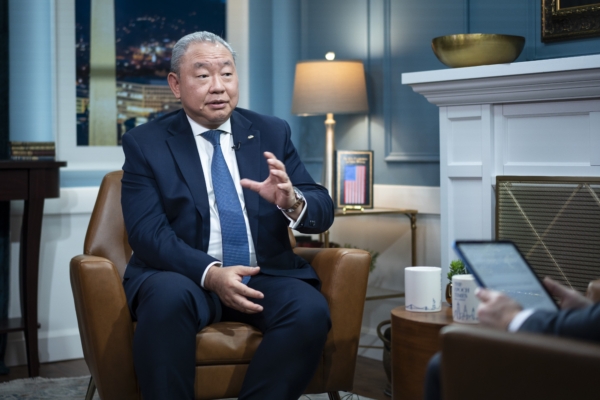
Taiwan’s representative to the United States, Yu Dawei, stated in an interview with the English-language Epoch Times that the Taiwan-US relationship is currently at one of its “best moments.” He emphasized that Taiwan has successfully achieved economic derisking and reinforced its self-defense capabilities, forming a “rock-solid” partnership with the United States.
He highlighted that in a recent interview on Sunday, Yu Dawei pointed out that Taiwan surpassed traditional trade allies such as the United Kingdom in 2025, becoming the fourth largest trading partner of the United States. He also underscored that the Communist regime in China represents the biggest risk factor to peace and stability in the Taiwan Strait and the Pacific region.
“They are the aggressors,” Yu Dawei warned, “Should a conflict arise in the Taiwan Strait, it would trigger a crisis far greater than the current situation in the Strait of Hormuz with Iran. Several studies have indicated that the potential impact could reach hundreds of billions of dollars.”
Yu Dawei mentioned that the impact would extend beyond Taiwan to affect China, Japan, South Korea, and even the United States and European countries, emphasizing that they would also be unable to remain unaffected.
Over the past decade, Taiwan’s economic and trade landscape has seen drastic changes. Twelve years ago, 85% of Taiwan’s foreign direct investment (FDI) was concentrated in mainland China, but last year this figure plummeted to less than 4%.
Conversely, Taiwan’s businesses shifted about 40% of FDI to the United States two years ago, including a significant investment project by Taiwan Semiconductor Manufacturing Company (TSMC) in Phoenix, Arizona.
“China (the Communist Party) is an unreliable partner; they weaponize various issues and exert pressure on us,” Yu Dawei pointed out in the interview, highlighting reasons for Taiwan’s accelerated divergence from China in recent years and turning towards the United States and other markets.
He stressed that Taiwan and the US are progressing towards establishing a “non-red supply chain,” particularly in the field of AI hardware, where Taiwanese enterprises produce over 95% of high-end chips globally and more than 90% of AI servers, serving as a core partner for the US to maintain its technological leadership.
Yu Dawei also mentioned that Taiwan’s authorities would provide $250 billion in credit guarantees to support Taiwanese companies investing in establishing facilities in the US. He stated that Taiwan would fully assist the US in promoting the “revival of manufacturing.”
Facing the threat of the Communist Army being required to prepare for invading Taiwan before 2027, Yu Dawei emphasized that Taiwan fully acknowledges and practices the principle of “Peace through Strength.” Accordingly, Taiwan’s defense budget has nearly doubled over the past decade, with efforts to seek approval for an additional $40 billion budget to procure more weapons. At the same time, Taiwan continues to promote local production of more missiles, weapons, aircraft, submarines, strengthening asymmetric warfare capabilities.
Yu Dawei explicitly stated, “We desire peace, we are willing to negotiate, and we are ready to engage in discussions with the Chinese side regarding peace and stability in the Taiwan Strait; however, negotiations must be based on strength rather than portraying oneself as weak.”
“Therefore, possessing a strong defense is the best way out and the optimal way for self-defense when facing powerful aggressors or enemies,” he emphasized.
He reiterated that Taiwan is committed to enhancing societal resilience and reserve combat capabilities, emphasizing that Taiwan’s security directly affects the US’s security, crucial for global stability.
“We are part of the first island chain, forming a democratic defense line against aggression from mainland China,” Yu Dawei said. “Just as NATO upholds alliance security on one side of the Atlantic, we are also guarding the line on the Pacific side. Hence, the US borders are kept secure, which I believe is crucial for the United States.”
In the legal and information warfare aspect, Yu Dawei criticized the long-term misuse by the Communist regime of UN Resolution 2758, attempting to establish a false legal basis for China’s sovereignty claims over Taiwan.
“Their claims regarding Taiwan are fictitious because they have never truly controlled Taiwan,” Yu Dawei stated.
Regarding the Communist Party’s united front and cognitive warfare, he specifically named the social media platform TikTok as “Cyber Fentanyl,” asserting that the platform’s spread of false information is corroding trust within democratic societies while attempting to sow seeds of doubt regarding the US in Taiwanese society.
Despite facing multiple threats in gray areas, Yu Dawei is confident in Taiwan’s democratic resilience and pointed out that Taiwan celebrated the 30th anniversary of direct presidential elections this year, proving that a democratic system can flourish even under threats.
Yu Dawei mentioned that there is still one piece of the Taiwan-US economic and trade cooperation puzzle to complete, which is avoiding double taxation-related bills. He mentioned that the bill was passed in the US House of Representatives last year with 423 votes to 1 and is currently awaiting approval in the Senate.
“We are the only major trading partner of the US that has not yet enjoyed the benefit of avoiding double taxation,” he said, stating that this situation is “unreasonable and unfair” for Taiwanese businesses and employees facing double taxation in the US.
If the bill can be successfully passed, it will relieve the burden of double taxation on Taiwan-US enterprises and employees, expected to drive another wave of Taiwanese investment in the US, further deepening bilateral economic integration.