
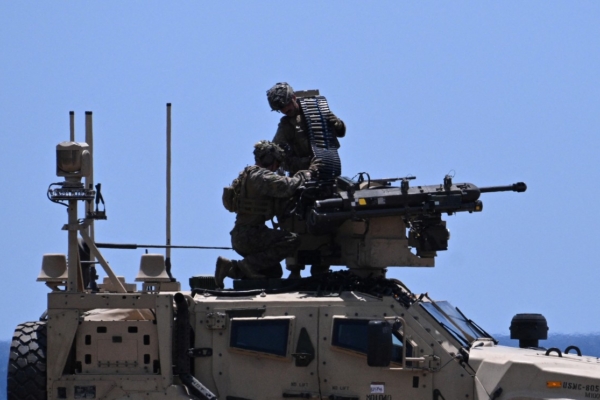
During the annual Balikatan joint military exercises between the United States and the Philippines, the two countries showcased the NMESIS anti-ship missile system on Saturday (May 2) near the Batanes Islands, close to Taiwan, reshaping the defense posture of the First Island Chain.
Approximately 17,000 soldiers participated in the Balikatan exercises, including around 10,000 American troops.
Batanes Province is the northernmost province of the Philippines with about 20,000 residents, located approximately 100 miles south of Taiwan in the Luzon Strait. The strait is one of the most strategically important maritime passages in the Indo-Pacific region, representing a frontier for the competition between the United States and China for regional dominance.
NMESIS is a highly mobile coastal anti-ship missile system used to target surface vessels from land-based positions, with a range of approximately 185 kilometers (115 miles).
According to Reuters, the system was transported to Batanes by U.S. C-130 transport planes and deployed in the provincial capital of Basco.
“Training in Batanes allows us to experience an environment different from our usual training environment,” said U.S. Army Staff Sergeant Darren Gibbs.
Gibbs further explained that NMESIS is designed for remote operation, stating, “The system is intended for fully autonomous operation, with no need for drivers or passengers inside the vehicle.”
Philippine exercise commander Francisco Lorenzo told Reuters that the deployment of NMESIS and other U.S. weapons to Batanes was to test the feasibility of conducting operations in remote areas.
Lorenzo stated that this is part of the training to assess the feasibility of deploying this equipment locally. He also mentioned that one of the objectives of the U.S.-Philippines joint exercises is to “practice defending the territory with allies.”
The Chinese Communist Party often criticizes the U.S. deployment of weapons in the Philippines, claiming that it exacerbates regional tensions.
Chester Cabalza, founder and chairman of the Manila-based think tank International Development and Security Cooperation, told Reuters that NMESIS may trigger extremely sensitive tensions for Beijing and provide an asymmetric deterrence capability for the Philippines and Taiwan in the Luzon Strait and the Bashi Channel.
Cabalza noted that the system could be airlifted and deployed to any coastline in the Philippine archipelago within hours. The deployment in Batanes is likely to be viewed by China as part of U.S.-led efforts to “encircle” it.
The Philippines and U.S. forces also conducted maritime combat exercises in Itbayat, Batanes. Itbayat is located approximately 155 kilometers from Taiwan, at the northernmost point of the Philippines.
Recent Chinese activities in the South China Sea and Taiwan Strait, including increased naval deployments around Taiwan and the passage of an aircraft carrier through the Taiwan Strait, have heightened tensions in the region. Satellite images reviewed by Reuters this month showed barriers erected at the entrance to Huangyan Island.
Philippine President Ferdinand Marcos Jr. has warned that in the event of war erupting in Taiwan, Filipinos working and living in Taiwan must be evacuated, pulling the Philippines into the conflict.
Dennis Wilder, a professor at Georgetown University and former Senior Director for East Asia Affairs at the U.S. National Security Council, commented on the joint U.S.-Philippines military exercises on social media platform X, saying that the U.S. Indo-Pacific Command is steadily advancing a new strategy, deploying small, highly mobile missile units to deter Chinese military actions against Taiwan. By shifting to smaller but more lethal combat units, the U.S. military is beginning to counter China’s missile advantage.
According to Army Recognition, the deployment of the NMESIS system to the Philippines by the United States aims to reshape the defense posture of the First Island Chain. This deployment showcases the capability of U.S.-Philippines joint forces to perform precise coastal strikes in strategic locations, enhancing deterrence and complicating the operational plans of any hostile naval forces.
This operation reflects a shift in defense posture from traditional large base defense to dispersed, mobile, and survivable strike nodes that can support maritime denial missions along the First Island Chain.
Army Recognition believes that this deployment conveys a clear strategic message to the U.S. and its partners: deterrent forces in the Indo-Pacific are becoming more dispersed, more mobile, and more deeply integrated with the geographical locations of allies. The advancement towards Itbayat by NMESIS demonstrates the ability of the U.S. to rapidly deploy precise coastal strike capabilities in critical maritime passages within a legal alliance framework. Together with broader attention to land-based firepower, shore-based defense missiles, HIMARS, Typhon, BrahMos, and allied anti-ship capabilities, the deployment of the Balikatan 2026 joint military exercises demonstrates the gradual establishment of a layered deterrent posture along the First Island Chain. This further reinforces that the U.S.-Philippines alliance is no longer just a treaty commitment but a combat framework aimed at maintaining freedom of navigation in the Indo-Pacific, allied channels, and regional stability.
In last year’s joint military exercises, the U.S. and the Philippines also deployed the NMESIS to Batanes. With the NMESIS system, the U.S. Marine Corps can launch these precision missiles from land, including from remote and mountainous islands like Batanes. On these islands, launch devices are far easier to conceal than in open waters. The main launch vehicle for the missiles is an unmanned vehicle operated remotely by personnel.
The Wall Street Journal quoted Lieutenant Colonel John Lehane, the commanding officer of the U.S. Marine Corps unit in Hawaii, saying that the mere deployment of the NMESIS system on strategic Pacific islands could make adversaries hesitate, forcing them to weigh the threat posed by the system to any ships entering its strike range.
“Once deployed on the ground, this system is there. It can move and is hard to detect,” Lehane said.
Rommel Ong, former Deputy Commander of the Philippine Navy and current Senior Researcher at the Ateneo School of Government in Manila, likened the deployment of NMESIS on the Western Pacific islands to a “shell game.”
“Keeping the other side guessing creates uncertainty, and uncertainty generates a degree of deterrence,” he said.
Eurasia Times commented that NMESIS can strike targets 115 kilometers away with sea-skimming precision and radar-evading stealth, designed not just for coastal defense but also for dynamic maritime denial. Therefore, it can defend not only beaches but also entire sea areas. This is why its deployment in this strategic location is so crucial.