
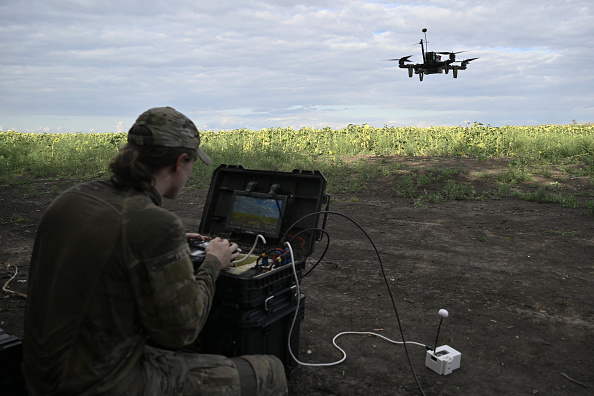
Ukraine Expert on Beijing’s Dual Support to Russia and Ukraine in Drone Supply
A Ukrainian expert, speaking on a well-known podcast on Wednesday, stated that the Chinese Communist Party (CCP) is simultaneously providing drones to both Russia and Ukraine. This is because Beijing does not want Russia to win the war; it wants the ongoing Russian-Ukrainian conflict, which weakens Moscow, to continue.
The popular podcast “ChinaTalk” featured an article on its website on Wednesday, discussing how the Ukrainian drone manufacturing industry has rapidly grown amidst the conflict and shifted away from relying on Chinese products. The discussion also touched on the dynamic between China and Russia, highlighting Beijing’s assistance to Ukraine against Moscow.
Jordan Schneider, a prominent American expert on China issues, podcaster, and founder of independent media, participated in the podcast. He frequently discusses topics related to Sino-American tech competition, supply chains, geopolitics, and national security. Schneider is the founder and editor-in-chief of the “ChinaTalk” podcast and communications, as well as an Adjunct Fellow at the Center for a New American Security’s Technology and National Security Program. He holds a BA in History from Yale University and an MA in Economics from Peking University’s Yenching Academy.
The dialogue brought together two experts: Cat Buchatskiy, co-founder and head of analytics at the Snake Island Institute (SII), an independent defense analysis and innovation center in Ukraine, and Chris Miller, a renowned American scholar specializing in international relations, history, and geopolitics. Miller’s expertise lies in Russian affairs, tech geopolitics, and the semiconductor industry.
After the Russian invasion, Ukraine’s drone industry quickly emerged and shifted from dependence on foreign, especially Chinese, products to establishing local assembly and production capabilities. By 2026, nearly all combat drone systems were assembled in Ukraine, with a significant increase in production capacity.
Buchatskiy noted that Ukraine’s development in the drone industry is exceptional on a global scale. At the start of the full-scale warfare in February 2022, Ukraine had approximately 3,000 drones, with 99% of them being fully imported systems from China.
By 2026, 99% of the combat drone systems were locally assembled in Ukraine, with an annual production capacity of up to 5 million first-person view (FPV) drones. This transformation also included heavy bombing drones, intelligence surveillance and reconnaissance (ISR) units, long-endurance loitering munitions, among others.
The rise of the Ukrainian drone industry experienced significant challenges and obstacles despite the country’s industrial past from the Soviet era. The collapse of the Soviet Union led to a decline in Ukraine’s defense industrial capabilities due to insufficient funding, aging facilities, and Russian pressure.
Before the war, Ukraine was known for its expertise in information technology, software, and computer science, but lacked focus in defense sectors. However, post-Russian invasion, government policies encouraged a shift towards defense in various industries, paralleling the mobilization seen in the US during World War II.
The influx of software engineers, consumer product workers, gamers, and even taxi drivers into drone manufacturing in Ukraine showcased the nation’s adaptability and resourcefulness during the conflict.
Currently, Ukraine has over 40 parts manufacturers and numerous drone companies, reflecting a significant social mobilization and transformation for a nation with at about 30 million people during wartime.
Ukrainian experts highlighted that the growth of Ukraine’s drone industry was demand-driven from the battlefield, where drones initially purchased from the market were disassembled, modified, and locally assembled near combat zones to meet specific mission requirements.
This adaptive approach allowed Ukrainian drones to quickly respond to frontline needs, accumulating combat experience, and updating product designs and manufacturing processes accordingly.
Ukrainian experts emphasized that the country’s drone production no longer resembles small-scale operations but has evolved into an extensive manufacturing system, employing a workforce, operating in large facilities, and even underground to mitigate risks from potential Russian airstrikes.
Furthermore, as Ukraine reduces its reliance on direct drone imports from China, the country’s focus has shifted to localizing production by importing key components for assembly. By 2025, the percentage of Chinese components in Ukrainian drones had decreased significantly.
Although the Ukrainian drone industry still depends heavily on Chinese parts, efforts are underway in Kyiv to address this issue by diversifying import channels and establishing import alternatives from countries like South Korea, Japan, and Taiwan.
Despite portraying a “limitless friendship” with Moscow publicly, CCP discreetly supplies drone systems and parts to both Russia and Ukraine simultaneously.
Buchatskiy highlighted that while Beijing does not wish for Russia to lose the war completely, it also does not want Ukraine to lose, as this dynamic ensures Moscow remains reliant on Beijing, diverting America’s attention away from Asia.
For example, a report from the Financial Times revealed that Chinese drone suppliers were serving both sides of the Russia-Ukraine conflict.
Ukraine’s TAF Industries founder, Oleksandr Yakovenko, recounted encounters in a Chinese drone factory where meticulous measures were taken to prevent Ukrainian and Russian customers from coinciding, reflecting delicate geopolitical balancing by suppliers.
Unveiling these complexities, Buchatskiy underscored how China seeks to maintain a strategic equilibrium by playing both sides to curb Ukraine’s independent drone production. Additionally, Ukraine has managed to establish alternative import routes from countries like South Korea, Japan, and Taiwan to decrease reliance on Chinese parts.
Looking ahead, Ukraine’s focus is on enhancing local production of critical components like rare earth, magnets, printed circuit boards, and fostering expertise in chemical materials and electronics among the younger generation to bolster self-sufficiency and resilience in times of conflict.