
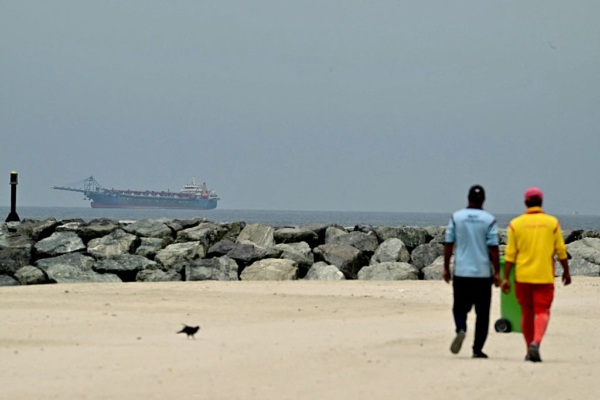
The United States Central Command began blocking all ports along the Iranian coastline starting at 10 a.m. Eastern time on Monday, April 13, causing a ban on ships entering or exiting. Analysts believe that the blockade will inflict significant damage on Iran’s economy.
Iranian ports are primarily used for exporting oil and natural gas. Shortly after the United States and Israel launched a war against Iran on February 28, the Iranian regime effectively closed the Strait of Hormuz, through which 20% of global oil and natural gas supplies must pass.
The Iranian blockade of the strait has led to a surge in global oil and gas prices, with only a few countries that have reached individual agreements with the Iranian regime being allowed to pass through. During the war, Iran was still able to profit from exporting energy products through the strait.
Approximately 80% of Iran’s total oil exports pass through the Strait of Hormuz. Data from the trade intelligence company Kpler shows that Iran exported 1.84 million barrels of crude oil per day in March, with a daily export volume of 1.71 million barrels so far in April, compared to an average daily export volume of 1.68 million barrels in 2025.
Even with a conservative estimate of $90 per barrel, Iran’s oil export revenue last month reached $4.97 billion. In contrast, before the outbreak of the war in early February, Iran’s daily revenue from crude oil exports was approximately $115 million, totaling $3.45 billion per month. In summary, Iran’s oil export revenue last month increased by 40% compared to pre-war levels.
Experts suggest that following the U.S. military blockade of Iranian ports and the Strait of Hormuz, Iran’s ability to export oil has been severely impacted, with significant force.
Mohamad Elmasry, a professor at the Doha Graduate Institute, stated in an interview with Al Jazeera, “Iran will not be able to export oil at the same level as before.”
It has been reported that the Iranian regime also charged tolls to non-Iranian ships. Elmasry noted that after the blockade, “Iran will also be unable to collect passage fees.”
Frederic Schneider, a senior researcher with the Middle East Global Affairs Committee, also told Al Jazeera that over the past six weeks, Iran’s oil revenue has been lucrative, but with the U.S. blockade, the situation will change.
“Iran has some buffer, mainly in terms of stored crude oil in floating storage tanks (i.e., anchored oil tankers), estimated at around 127 million barrels in February. However, this does not mean the blockade will not harm Iran,” he stated.
In addition to oil, the U.S. blockade of Iranian ports may also impact Iran’s trade in other commodities.
Iran’s main exported commodities through its ports include petrochemical products, plastics, and agricultural products, largely destined for China and India; while the main imported commodities include industrial machinery, electronics, and food, primarily from China, the UAE, and Turkey.
According to a report by Tehran Times on February 18, data released by the Iranian Customs Administration showed that from March 21, 2025, to January 20, 2026, Iran’s non-oil trade totalled $94 billion, with imports surpassing exports, resulting in a trade deficit.
The blockade will affect Iran’s overall trade and damage its economy. Schneider mentioned that if non-oil and gas trade is disrupted, it will not only impact tax revenues but also affect the supply of goods, leading to worsened shortages domestically.
Before the outbreak of war, Iran’s economy was already under immense pressure due to sanctions.
Miad Maleki, a sanctions strategy expert and former U.S. Treasury official, estimated that cutting off maritime trade could result in Iran losing approximately $435 million per day in economic activity, equivalent to around $13 billion per month.
Without Beijing, Iran’s black market for oil would not exist. Prior to the war in Iran, Beijing purchased 95% of Iran’s crude oil through a network of sanctioned oil tankers, mysterious traders, and secretive financial relationships. Therefore, the U.S. blockade will also impact Beijing.
If the U.S. Navy enforces a blockade on ships entering and exiting Iranian ports, as well as the area east of the Strait of Hormuz, the Gulf of Oman, and along the coast of the Arabian Sea, Iran will be unable to export a single barrel of oil.
According to data from the maritime intelligence agency Windward, as of Monday, Iran’s total offshore oil inventory is approximately 157.7 million barrels, with 97.6% destined for China.
Windward warned that all of this oil could potentially be affected by the U.S. blockade.
If the U.S. continues to enforce the blockade, Iran’s economy will suffer severe damage on top of the destruction caused by the war. In the coming days or weeks, as oil storage tanks gradually fill up, authorities may have to start shutting down oil wells. However, whether this economic impact will prompt Iran to adopt a more moderate negotiation strategy remains uncertain.
Before the conflict erupted, over 11% of Beijing’s oil imports came from Iran, second only to Russia’s 20% and Saudi Arabia’s 14%. Iran’s continuous oil supply provided Beijing with relative abundance compared to neighboring countries. However, following the U.S. blockade of Iranian ports, despite Saudi Arabia and the UAE implementing bypass measures for the Strait of Hormuz, China’s oil imports have already decreased by at least 20%.
(This article draws on reports from Al Jazeera)