
Recently, the Chinese Communist authorities issued a document calling for the “rectification” of over 100,000 industry associations and chambers of commerce, emphasizing the need to “strengthen the overall leadership of the CCP.” The Ministry of Social Work of the Central Government stepped forward to provide explanations. Experts believe that this extreme measure is another step by the Chinese Communist Party to control society, leading to a stifling atmosphere. Additionally, the release of this document is seen as possibly connected to power struggles at higher levels.
The official Xinhua News Agency of the Chinese Communist Party issued the “Opinions on Promoting the Deepening Reform of Industry Associations and Chambers of Commerce by the General Office of the Central Committee of the CCP and the General Office of the State Council” on April 13th. The document outlined 18 points, including the requirement for the cleaning up of industry associations and chambers of commerce, emphasizing the need to “uphold and strengthen the overall leadership of the CCP,” “straighten out the management system of party building work,” establish a sound working mechanism of “managing industry and managing party building,” and strengthen the handling of leadership transition issues, among others.
According to information released by the Ministry of Civil Affairs of the Chinese Communist Party, as of 2024, there were over 100,000 industry associations and chambers of commerce in mainland China, with over 800 national industry associations and chambers of commerce. The total number of corporate members in these associations and chambers exceeded 7.7 million.
The aforementioned document requires “all relevant departments in various regions” to implement the “centralized and unified leadership of the CCP,” and at the end, it mentioned that “social work departments of various levels of party committees should strengthen overall coordination and supervision to ensure implementation,” and “major issues should be promptly reported to the CCP Central Committee and the State Council according to procedures.”
This document was dated November 1, 2025.
On the same day, April 13th, Xinhua News Agency released a statement by the head of the Central Ministry of Social Work regarding the above-mentioned document, mentioning that “the comprehensive regulatory system established during the decoupling reform period has been in operation for nearly 10 years and urgently needs to be strengthened and improved in light of the new situation and new tasks.”
The term “decoupling” refers to the Chinese Communist Party’s 2015 initiative to separate industry associations and chambers of commerce from administrative organs, known as de-administration, making them supposedly “autonomously run and legally self-governing” social organizations. This work was initially overseen by the Ministry of Civil Affairs under the State Council.
In 2023, the Chinese Communist Party established the Central Ministry of Social Work’s enhanced stability arm, with its subordinate institutions spread throughout the country. Recently, the Chinese Communist Party’s community worker force has significantly expanded, extensively monitoring people’s lives.
Official information reveals that this department is responsible for controlling petitioners and is also in charge of the CCP’s so-called party building and grassroots political structure construction, with their work targets including various industry associations and chambers of commerce in various regions, mixed-ownership enterprises, non-state-owned enterprises, new economic organizations, new social organizations, new employment groups, and volunteer groups.
Zhao Ziyang’s adviser and scholar Wu Guoguang, once referred to the Central Ministry of Social Work as the “autocracy patch.”
Regarding the CCP’s latest actions targeting industry associations and chambers of commerce, Chinese affairs expert Wang He told Dajiyuan that since Xi Jinping came to power, there has been a gradual shift to the left, promoting “national advance, private sector retreat,” advancing the so-called “leadership of the party.” This is because Xi Jinping has never trusted the private sector, fearing that they may not align with his interests. The previous wave of rectification aimed to have private enterprises and foreign companies establish party organizations to enhance control, and now there is further control over industry associations and chambers of commerce formed by enterprises.
He said that in Western countries, many things are not governed by the government but are self-regulated by industry associations and chambers of commerce, which are essential pillars of a democratic system. However, in the eyes of the CCP, this is seen as deviating from party leadership, leading to the need for control. This is also an important aspect of Xi Jinping’s so-called establishment of a new type of political-business relationship.
Wang He noted that these associations and chambers of commerce were originally transformed from government departments and institutional bodies, and the so-called “de-administration” was initiated under the premiership of Li Keqiang, followed by the “streamlining administration, delegating power, and improving services” reform, which delegated authority to these chambers and associations. Normally, this was about industry self-governance to align with international practices and engage with the West, as having the government intervene all the time was inappropriate. Now, while the CCP is promoting “de-administration,” it also fears losing control and thus extends its tentacles into these entities, seeking to control everything.
“You must work under my leadership; you represent my party in your work, not these enterprises to confront me. This is the starting point of the CCP’s policy,” he said.
Wang He believes that this crackdown on industry associations and chambers of commerce by the CCP signifies the extreme control exerted over society. These associations and chambers, if not advocates for corporate interests, cannot confront the CCP, leading to a further stifling and silent atmosphere across society.
He also noted that the CCP’s current crackdown on industry associations and chambers of commerce is consistent with its past actions in clearing out non-governmental organizations (NGOs), both being acts to eliminate civil society. “Most international NGO organizations have been cleared out, and now it’s the turn of domestic industry organizations.”
He expressed that since Xi Jinping came to power, it has been a continuous purge of civil society by the CCP. The resilience and strength of civil society were fully demonstrated during the Hong Kong “anti-extradition” movement, which deeply angered the CCP. Now, the Central Ministry of Social Work aims to further stifle the development of civil society in China.
It’s worth noting that official information shows that the current member of the CCP’s Politburo Standing Committee concurrently serving as the director of the General Office is in charge of party building, also leading the Central Ministry of Social Work. However, the development of enterprises falls under the purview of the State Council Premier Li Keqiang, who oversees the economy.
The official documents released by the CCP’s General Office and the State Council are directly responded to by the Central Ministry of Social Work.
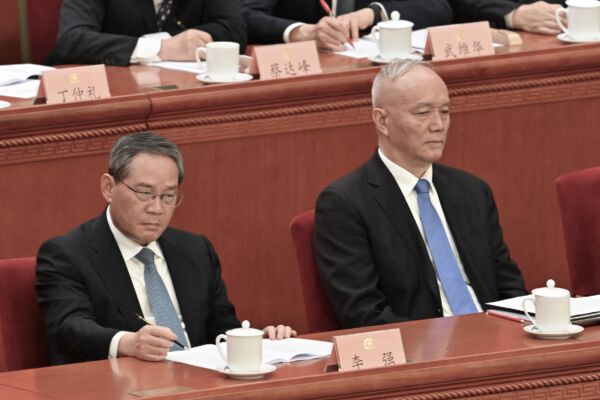
Commentator Li Linyi stated that the current head of the General Office, Cai Qi, has long been in charge of the core institution of the State Council, as the documents issued by the General Office and State Council are essentially directives from Cai Qi. The social work departments at all levels reporting to the CCP Central Committee and the State Council are essentially reporting to Cai Qi, diminishing the central role of Li Keqiang in the State Council. The document was already introduced at the end of last year but is only now publicly released, likely involving power struggles between Cai Qi and Li Keqiang.
On September 13th to 14th, 2023, a national Party Committee and governmental Secretaries Summit of the Chinese Communist Party were held in Beijing, unprecedentedly merging the party and governmental secretaries conference, led by the party committee system. Cai Qi, as the highest authority present, conveyed Xi’s instructions. The government secretaries, usually overseen by the Premier, now follow Cai Qi’s lead. Attendees include Li Keqiang’s key assistant and State Councilor and Secretary-General Wu Zhenglong, a first-time occurrence.
Wang He pointed out that the CCP itself prioritizes the party over the government, with various administrative departments generally operating under CCP control. However, Li Keqiang’s ranking is higher than Cai Qi’s, leading to a delicate relationship between the Central Ministry of Social Work and the various ministries of the State Council. “From the central level to local levels, it’s unclear who has the final say. For example, the administrative department overseeing the activities of the chamber and industry associations would have to approve, but the Central Ministry of Social Work wants to interfere and compete for power. It’s not just at the high levels; conflicts will exist from top to bottom. If there’s no vested interest, everyone will defer, but if there is interest, there will be competition.”