
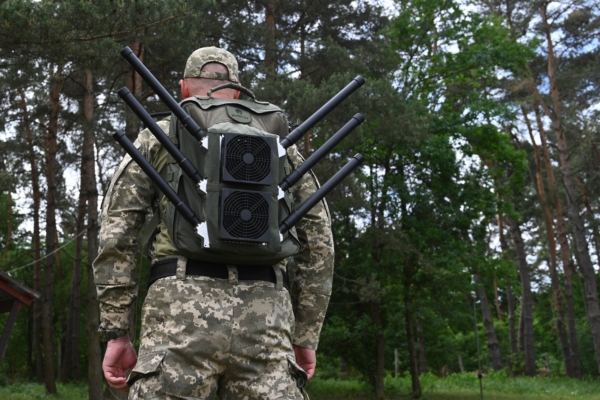
In a report from the Russian military, it is claimed that Chinese-made electronic warfare (EW) jamming devices are of poor quality and have a heap of flaws, reaching a frustrating level.
Electronic warfare involves a series of measures and tools that utilize the electromagnetic spectrum to gain advantages in combat, including protecting one’s own communication and control systems while disrupting or interrupting the opponent’s communication, navigation, and radar systems.
Russian technicians found a series of defects in this type of jamming equipment manufactured by Chinese suppliers. For instance, the power supply device of this equipment is poorly designed, with gaps in the casing leading to inadequate cooling systems.
Another issue is aluminum debris remaining inside, posing a risk of short circuits, along with poorly welded electrical wires. A power supply device marked as outputting 25 amperes actually only provides 5 amperes of current.
Other problems include incorrect drilling causing misalignment of assembled parts and short circuits found in power amplifiers. Cooling failures also render many devices inoperable under battlefield conditions.
It is reported that at least half of the unmanned drone jammers delivered to the Russian forces have quality defects. In a scenario where modern warfare increasingly relies on electronic warfare, this is a serious issue.
Russian military personnel have expressed growing dissatisfaction with Chinese suppliers, accusing them of selling poor-quality equipment and unreliable components despite signing large-scale procurement contracts.
A Russian soldier said, “These devices are unreliable at best and dangerous at worst.”
This issue reflects two things: Russia’s pursuit of Chinese-made military equipment and doubts about the reliability of Chinese military technology. Russia is seeking to continue providing equipment to its forces in the ongoing Russia-Ukraine conflict, and reliance on imported equipment of questionable quality poses operational risks.
Russia and Ukraine engaging in electronic warfare on the battlefield is no longer a secret. Both sides deploy a large number of drones to attack each other, using electronic warfare jamming devices to disrupt the operation of each other’s drones.
The New York Times previously reported that Ukrainian troops described the competition between the two sides in this aspect as a back-and-forth dance. When one side makes technological improvements, such as using different frequencies or jamming devices for drones, the other side catches up within weeks or months, weakening the opponent’s brief advantage.
Sergeant Babay, in charge of a drone platoon on the eastern front of Ukraine, said, “It’s an ongoing arms race. We are improving our technology to address these new realities on the battlefield. After a while, the Russians will once again have to invent new things to defend against our attacks.”
In 2023, Ukraine gained the upper hand in drone warfare by deploying a large number of First Person View (FPV) drones.
During the fall and winter of that year, with the depletion of Ukraine’s artillery stockpile, FPV drones capable of serving as guided munitions effectively suppressed and disrupted Russian trenches and vehicles, while precious ammunition was reserved to repel Russia’s ground attacks.
However, the Russian military subsequently enhanced its jamming capabilities and utilized the advantage of harsh weather to advance in the misty rain where drones were difficult to fly.
Samuel Bendett, a Russian military drone expert at the Center for Naval Analyses, a non-profit organization in the United States, said, “Both sides quickly grasped their opponents’ crucial FPV developments and tactics. Now these technologies are evolving rapidly for both sides.”