
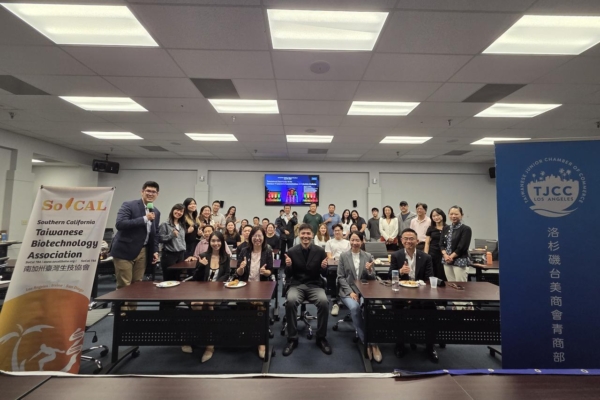
The Southern California Taiwan Biotech Association (SoCalTBA) and the Taiwan Junior Chamber of Commerce of Los Angeles (TJCCLA) jointly organized a biotech industry seminar on the morning of April 4th (Saturday), featuring Professor Xianrong Zeng from the University of California, Los Angeles (UCLA) and Dr. Xiaoru Jiang, head of the software development department at Lena Labs. The seminar delved into the forefront of nanoscale precision medicine starting from the basics of biotechnology, attracting nearly a hundred participants from the academic and industrial sectors in Southern California.
President Yang Ruyao of the Taiwan Junior Chamber of Commerce of Los Angeles expressed that the genesis of this event stemmed from an informal exchange between himself and Dr. Xiaoru Jiang. The chamber has primarily focused on social activities in the past, with fewer opportunities for professional knowledge sharing. Therefore, by fostering interdisciplinary collaboration, linking talents from the business, legal, and biotech fields, they aim to facilitate dialogue and cooperation opportunities that inspire diverse perspectives.
Dr. Xiaoru Jiang’s presentation centered around medical imaging and artificial intelligence, introducing the application of AI in the biotech industry. She noted that traditional drug development typically spans 10 to 15 years, with costs ranging from $1 to $3 billion, and a success rate of only about 15% in reaching the market. Through deep learning technology, drug screening processes can be automated, significantly reducing development time and costs. She also discussed the advancement of digital pathology, indicating that AI can now automatically identify and calculate tumor cells with accuracy surpassing that of experienced pathologists. By integrating multiple data sets such as genomics and proteomics, personalized medicine in the future can tailor treatment plans based on individual DNA and lifestyle.
Professor Xianrong Zeng shared over 20 years of research achievements, focusing on the development of “nanoscale devil felt” liquid biopsy technology. This technology utilizes fuzzy structures on cancer cell surfaces measuring about 100 to 200 nanometers, designed to capture these structures on chips of similar nanoscale fibers, significantly enhancing the detection efficiency of circulating tumor cells. Testing can be performed through a blood sample, with approximately 10 units of equipment already deployed in China and the U.S., accumulating tracking data from over 400 prostate cancer patients.
To further enhance detection sensitivity, the team is also researching extracellular vesicles (EVs) released by cancer cells. Professor Xianrong Zeng pointed out that each cancer cell can release 1,000 to 10,000 vesicles daily, a quantity far exceeding the cells themselves, with a short duration in the bloodstream allowing for real-time reflections of internal changes.
This technology has been applied in clinical trials for early-stage liver cancer diagnosis, earning recognition as a “Breakthrough Medical Device” by the U.S. Food and Drug Administration (FDA). Additionally, it can detect fetal cells in pregnant women’s blood, aiding in early screening for high-risk pregnancy complications, with a clinical trial sensitivity of 0.95. The results have been published in “Nature Communications.”
The seminar took place at the Los Angeles Overseas Community Center. During the Q&A session, participants engaged in in-depth discussions on topics such as academic patents, clinical AI applications, and FDA submission processes. Director Peizhen Zhong of the Overseas Community Center announced that the Overseas Community Affairs Council will host a “Taiwan Biotech Technology Industry Visiting Group” in July to coincide with the Asia Biotech Expo in Taiwan, welcoming enthusiastic participation from the overseas community.