
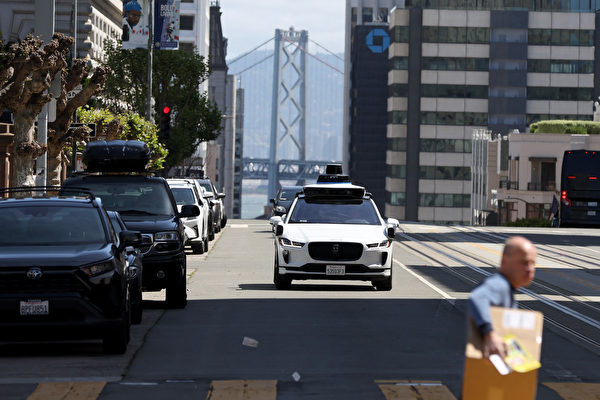
According to the new regulations on autonomous vehicles (AV) approved by the California Department of Motor Vehicles (DMV) on April 28th, self-driving cars like Waymo taxis may also receive traffic tickets if they violate traffic rules. The aim of the new regulations is to strengthen safety, supervision, and enforcement requirements.
The new regulations allow law enforcement agencies to issue fines to companies owning autonomous vehicles that violate traffic rules. Based on the California AB1777 bill, this new regulation also requires related companies to respond to calls from police, firefighters, and other emergency responders within 30 seconds.
Furthermore, the new regulations authorize emergency response personnel to issue “electronic geofencing” instructions to autonomous vehicle manufacturers, requiring their fleet to leave or avoid specific areas within two minutes. A DMV press release stated that autonomous vehicles violating these restrictions may face license restrictions or operational qualification suspensions.
Ahmed Banafa, a professor of engineering at San Jose State University, stated in an email to The Epoch Times that the new regulations send a clear message: automation does not mean the disappearance of responsibility. He emphasized the importance of autonomous vehicles seamlessly integrating into the real-world environment, including law enforcement officers, pedestrians, and various unpredictable situations.
Prior to this, law enforcement officers often did not know how to handle autonomous vehicles. The new regulations aim to establish more standardized procedures, clearer communication channels, and enhance better coordination between autonomous vehicle fleets and law enforcement agencies. Banafa noted that while this may increase compliance costs and delay some deployment progress, it provides companies with a clearer operational framework.
Autonomous vehicle companies must meet the relevant compliance requirements by July 1, 2026, including establishing a dedicated emergency response hotline and equipping each vehicle with a two-way voice communication device to allow emergency personnel to communicate with remote human operators.
The update to these rules stemmed from previous issues with autonomous vehicles in San Francisco, including incidents where Waymo vehicles blocked intersections during a large-scale power outage in December last year. The San Francisco Fire Department also complained of dozens of incidents in 2023 where autonomous vehicles disrupted emergency response operations.
To comply with the new regulations, autonomous vehicle manufacturers need to increase human involvement but in a different manner, according to Banafa. He mentioned that humans now become part of a centralized support system rather than physically being in the vehicle.
During a hearing at the Senate Commerce Committee on February 4, 2026, Waymo’s Chief Safety Officer Mauricio Peña testified that when the robot taxis encounter abnormal situations, remote human operators may intervene. Peña stated that these operators are partially located within the United States and some are distributed overseas, including in the Philippines.