
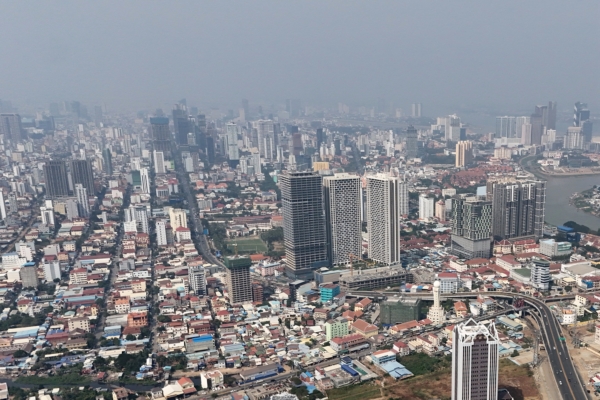
Thousands of foreign laborers from China, Indonesia, and Africa have flooded into Phnom Penh after escaping from a telecom fraud ring near the Cambodia border, hoping to return to their home countries. Anti-trafficking organizations have warned that many of these escaped foreign laborers may be victims of the telecom fraud ring and are currently in dangerous situations.
Under increasing pressure from the international community, the Cambodian government has stepped up efforts to crackdown on the telecom fraud network, leading to the arrests of several foreign masterminds. Subsequently, thousands of foreign laborers have broken free from the clutches of the fraud ring and poured into Phnom Penh.
According to a report by Nikkei Asia on Friday, Mark Taylor, an independent consultant and former manager of a USAID-funded project combating human trafficking in Cambodia, stated that “in the past two weeks, at least several thousand foreign laborers have escaped from these fraudulent dens, likely reaching tens of thousands, with the majority of them currently stranded on the streets, facing extremely difficult living conditions.”
Videos on social media show foreign laborers fleeing from fraud sites across Cambodia.
Currently, hundreds of Chinese citizens gather daily at a crossroads on Mao Zedong Avenue in Phnom Penh, where the Chinese Embassy is located. Many of them have escaped from fraud areas but are unable to return home due to lack of passports.
Some Chinese individuals appear fatigued, dressed inadequately, and sleeping directly on the ground in front of the embassy, in dire circumstances.
A hotel owner named Lei, who opened a hotel in Cambodia last year, told that there are people everywhere at the embassy’s entrance. He mentioned that those sleeping outside the embassy at night are likely broke, while those who have some money stay at hotels. Hotels are fully booked at night, prices have spiked, and airfare has gone up as well.
“I wonder why the country can’t just arrange for these people to go back together? If they have committed any crimes, they can deal with it after returning home. Leaving them here to fend for themselves is not a solution,” Lei said.
He added that there are over a hundred Chinese individuals sleeping in front of the embassy at night, and the Chinese authorities do not intervene.
Several Chinese individuals waiting in line in front of the embassy told Cambojanews that they escaped from the Xigang telecom fraud area and wish to return home to celebrate the Lunar New Year with their families.
Sam, a 24-year-old Ugandan man (pseudonym), told Nikkei that he escaped from the “Wo Casino” located in a coastal area near the Vietnam-Cambodia border on January 15. He revealed that the casino was a fraudulent hub.
Sam was trafficked from Vietnam to Cambodia by human traffickers. His passport shows entry into Vietnam in March 2025 but lacks entry records for Cambodia.
He disclosed that Chinese and Malaysian supervisors in the compound mistreated them to such an extent that when they witnessed the supervisors destroying computer hard drives and fleeing, they initially hesitated to leave.
“We thought there were still security guards outside, so we were very afraid,” he said. Eventually, he had to convince others to leave by shouting.
Sam and other foreign workers in the building broke into offices, opened a locked office door, then cracked open a safe to retrieve their passports. Subsequently, they rushed to Phnom Penh, trying to find a way back to Uganda.
“I thought I was free at that moment,” Sam said. “But now I have to endure this moment to go home, to truly achieve freedom. So now, I can’t sleep well; only when I am back home with my family, can I have a peaceful sleep.”
Moreover, hundreds of Indonesian citizens are waiting for assistance outside the Indonesian Embassy and in nearby parks. Embassy staff stated that they had handled 1440 cases within five days by Tuesday.
A senior Cambodian official revealed to Nikkei Asia that the Cambodian government is emphasizing the need to “eradicate online fraud.” The official had just attended a four-hour-long Cabinet meeting and a special committee meeting to combat online fraud.
Deputy Prime Minister and First Vice President of the Council for the Development of Cambodia, Sun Chanthol, expressed during an interview with Nikkei that the government recognizes how online fraud has tarnished Cambodia’s reputation.
“We need to reshape the national image because as a country, we do not benefit from online fraud,” he said.
Simultaneously, the Cambodian Ministry of Interior issued a directive, stating that landlords will face legal consequences if found renting properties to foreign individuals with criminal records. If landlords are found to harbor foreign individuals intentionally, they could be fined up to $1000 per person.
Ling Li, an expert on combating human trafficking at the EOS Collective who has conducted research on online fraud issues in Cambodia and surrounding areas, mentioned that the country’s only official shelter is currently overcrowded.
She noted that the new law has made guesthouse owners hesitant to accommodate overstayed guests. Some hotels have reportedly undergone surprise inspections by the government due to the concentration of Chinese or African nationals.
“If you go to the riverside in Phnom Penh now, you will see people sitting on benches with plastic bags; they are all from the same scam ring,” she said.
Ministry of Interior spokesperson, Touch Sokhak, stated that the Cambodian government aims to improve temporary accommodations provided to foreigners who are victims or unable to leave the country. However, he added, “If other countries can support… these residences, shelters, or safe havens, that would be even better.”
Sokhak mentioned that for foreigners to obtain permission to depart without penalties for overstaying, they need to contact their respective embassies and then the Cambodian immigration authorities.
However, Ling Li, the expert on combating human trafficking, highlighted the challenges in coordinating solutions for African nationals, as their embassies are mostly located in Malaysia or China.
Chen Zhi, the head of the Telecom Scam Prince Group, is currently under arrest in Cambodia and is being sent back to China. Cambodian Deputy Prime Minister Sun Chanthol, in an interview with Xinhua, the Chinese state news agency, mentioned that this is just the first step.
Chen Zhi obtained Cambodian citizenship in 2014 for a sum of money and even served as an advisor to Prime Minister Hun Sen and was conferred with a title of nobility.
When the US and UK sanctioned Chen Zhi, Cambodian authorities attempted to whitewash his image. However, following Beijing’s extradition request, Cambodia promptly repatriated Chen Zhi and two other Chinese nationals back to mainland China.
According to the US indictment, Chen Zhi had close ties with the Chinese Ministry of Public Security. Chen had assigned an associate to contact officials of the Chinese Ministry of Public Security to “dispel legal threats.” Additionally, this associate instructed a Chinese law enforcement official to extort other businesses on behalf of the Prince Group.