
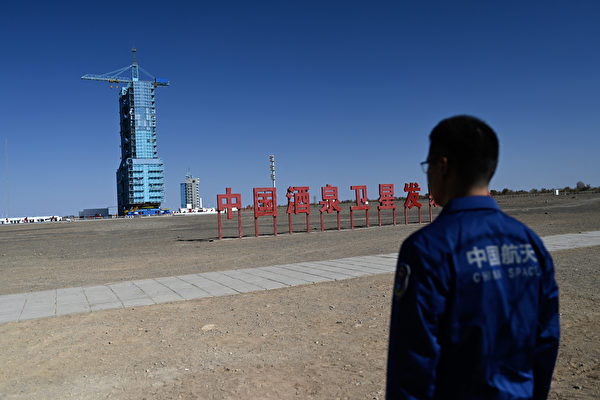
The National Secrecy Bureau under the Chinese Communist Party (CCP) revealed a case of aerospace industry leakage today, stating that an aerospace engineer sold classified information to a foreign country.
According to an article published on May 25 by the “Secrecy Perspective” public account under the Golden City Publishing House of the National Secrecy Bureau, from 2006 to 2018, a certain individual named Zhu pursued a doctoral degree at a prestigious university and later worked as an engineer in multiple aerospace research institutes. Zhu had long-term access to classified documents and data in the aerospace and military technology fields. After being approached by a foreign espionage organization, Zhu took numerous photos of documents and data related to aerospace and military technology and transmitted them to the espionage operatives, earning a total of 596,400 yuan. Zhu was sentenced to fifteen years in prison for espionage.
The article did not specify which country the foreign organization belonged to, nor did it disclose Zhu’s specific affiliation and the timeline of the leakage.
The article described Zhu as being “blinded by money temptations,” leading to widespread discussions among netizens in the comments section, with some attributing the issue to “political ideological problems.”
Chinese affairs expert Li Linyi told Epoch Times that individuals like Zhu may not be motivated solely by money but could also hold anti-CCP authoritarian beliefs. The official CCP stance is to discredit the legitimacy of Zhu’s actions.
In recent years, the CCP’s military-industrial complex has undergone significant purges. Since 2024, at least 10 military-academy-accredited academicians have been expelled from the Chinese Academy of Sciences and the Chinese Academy of Engineering, sparking speculations that it might be linked to the leakage incidents.
In February 2026, overseas sources revealed that the National Supercomputing Center in Tianjin, China, allegedly suffered a large-scale cyber intrusion, resulting in the leakage of data amounting to approximately 10 petabytes (around 10 million gigabytes), involving core technologies such as missile design, aerospace, and nuclear fusion simulations. While there has been no official response, network engineer Zhu Quan from Nanjing, in an interview with Epoch Times, suggested that such massive data leaks could not rule out the possibility of internal assistance.
In April of this year, it was disclosed by sources within the CCP system that, to prevent similar leaks from occurring again, various ministries issued strict notices, banning employees from bringing any mobile phones into office areas and requiring that terminal equipment such as printers not be directly connected to networks. Externally, this move is believed to be related to the supercomputing center leakage incident.
The rocket army purge that erupted in mid-2023 is also rumored to be linked to leakage incidents.
In early 2024, Bloomberg reported information from US intelligence sources, highlighting alarming levels of internal corruption within the CCP’s defense industry. It was reported that ballistic missiles were found to be filled with water instead of fuel, and many missile launch silo covers in the west were discovered to be unable to open properly, rendering them unusable in wartime.
Significantly, since 2023, the once discreet State Security Department of the CCP has opened a public account on WeChat, frequently discussing “national security” in various fields and disclosing cases that are considered by outsiders to be fabricated. Similarly, the previously low-profile National Secrecy Bureau began publishing articles in November of last year addressing the issue of “foreign forces’ spy infiltration and intelligence theft.”
Independent commentator Cai Shunkun previously told Epoch Times that these CCP agencies are seeking recognition and rewards by constantly presenting cases, creating an illusion of enemies everywhere. In reality, it is a means for Xi Jinping to further strengthen social control, turning both inside and outside the CCP system into a large prison.