
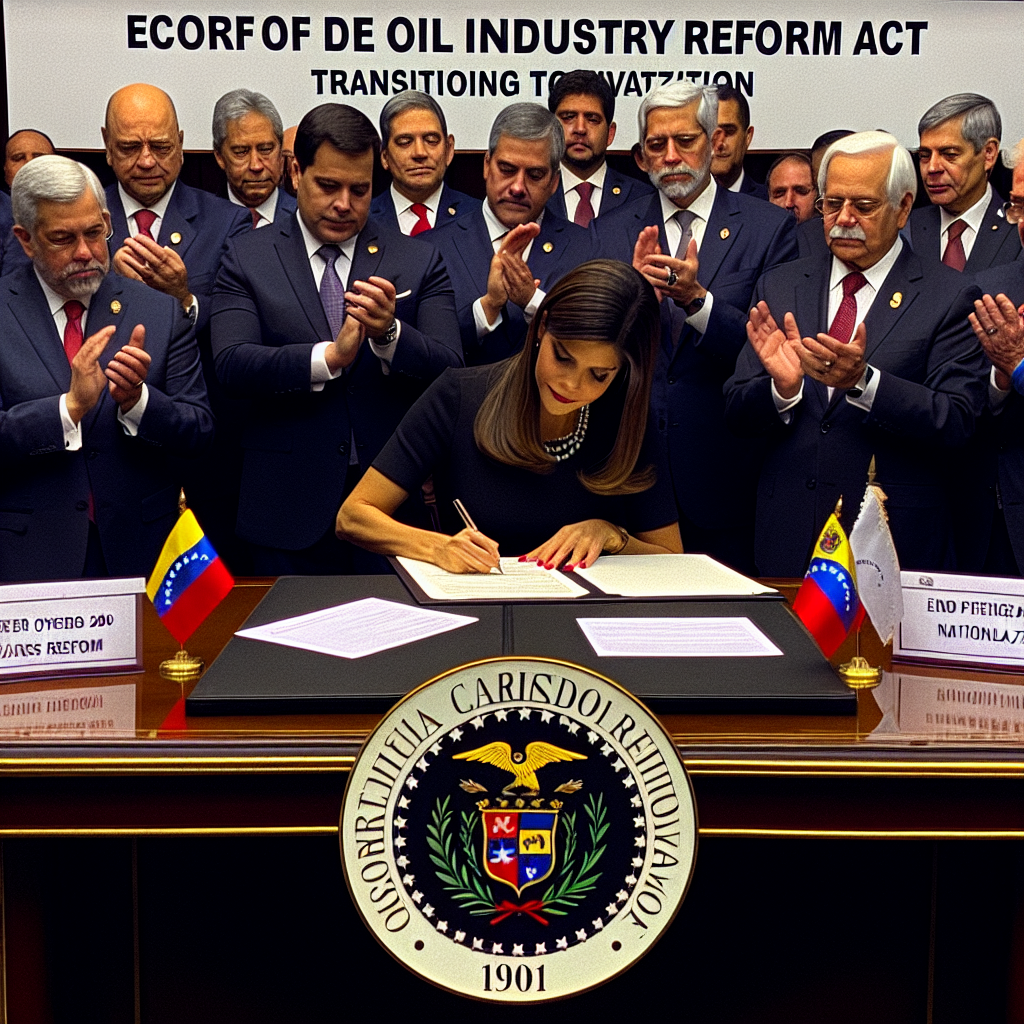
Venezuela’s acting President, Delcy Rodriguez, on Thursday (January 29) officially signed the Oil Industry Reform Act, putting an end to the country’s over 20-year history of oil nationalization and transitioning to a privatization model.
At the same time, the U.S. government simultaneously eased sanctions, authorizing American companies to participate in the buying, selling, and transportation of Venezuelan oil, marking a significant transformation in the energy landscape of South America.
The U.S. Department of the Treasury’s Office of Foreign Assets Control (OFAC) issued the latest general license, allowing U.S. entities to engage in various transactions with Venezuela’s state-owned oil company PDVSA, including buying, selling, transporting, storing, and refining.
White House officials stated that this move “will help the current products flow into the market” and hinted at more announcements of further relaxation of restrictions in the near future.
However, this license has clear exclusivity, limited only to U.S. entities and explicitly excluding companies and individuals from countries such as China, Russia, Iran, North Korea, and Cuba.
Nevertheless, Francisco Monaldi, Director of the Latin America Energy Program at Rice University’s Baker Institute, estimates that about 22% of Venezuela’s current oil production comes from joint ventures with China and Russia. It remains uncertain whether excluding Chinese and Russian entities will make it difficult for PDVSA to sell some of its crude oil.
Internally in Venezuela, a law passed by the National Assembly grants control of oil production and sales to private companies.
In order to rebuild investor confidence, the new law sets a ceiling of 30% on oil royalties and allows for disputes to be resolved through independent arbitration rather than Venezuela’s government-controlled courts to ensure that foreign assets are not arbitrarily seized.
Rodriguez signed the law amidst cheers from supporters, stating, “We are talking about the future. We are talking about the country we will leave to our children.”
Orlando Camacho, a ruling party lawmaker and Chairman of the Petroleum Committee, also emphasized that the reform “will change the country’s economy.”
Prior to this, the U.S. military arrested Venezuelan leader Nicolas Maduro on January 3, causing a significant shake-up in the country’s political situation.
Trump stated that the U.S. hopes to attract $100 billion in investment from American oil companies to restore Venezuela’s long-damaged production capacity.
An initial agreement has been reached between the U.S. and Venezuela to sell 50 million barrels of Venezuelan crude, with European traders such as Vitol and Trafigura responsible for marketing. This oil primarily comes from inventory stockpiled in Venezuelan oil depots and tankers due to previous sanctions and blockades.
The proceeds from sales will be deposited into an account overseen by the U.S., reportedly to be used for improving the livelihoods of Venezuelans and related stability programs.
At the call of the ruling party, a large number of oil workers gathered in front of the parliament to celebrate and express support for the law. Opposition lawmakers, on the other hand, demand the inclusion of transparent and accountability mechanisms, such as the establishment of a public website, to curb systemic corruption.
The passage of this law also completely overturns the state-led model established by former leader Hugo Chavez in 2006, which resulted in the seizure of assets from major U.S. companies like ExxonMobil and Conoco.
Now, with the implementation of the new law, companies like Chevron, Spain’s Repsol, and Italy’s ENI are closely watching for opportunities to re-enter the Venezuelan market.