
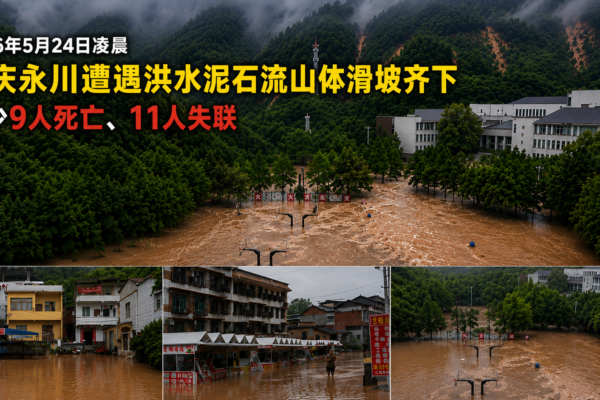
On the evening of May 23rd and into the early hours of May 24th, Chongqing City experienced heavy rainfall, leading to flash floods, mudslides, and landslides in multiple areas, resulting in road closures. The most severely affected area was Yongchuan District. In the aftermath of the flooding, official reports mysteriously removed mentions of the newly built reservoir in Chongqing and strategies for scientifically preventing flood disasters.
According to mainland media reports, Yongchuan in Chongqing experienced extreme heavy rain from the night of May 23rd to the early morning of May 24th. In the Chaoshan Zhuhai Street of Yongchuan District, between 2 am and 4 am on the 24th, nearly 300 millimeters of rain fell within two hours, with the maximum hourly rainfall exceeding 100 millimeters, reaching the level of “extraordinary heavy rain.”
Apart from flash floods in Yongchuan, geological disasters such as mudslides and landslides also occurred, resulting in at least 9 deaths and 11 missing persons.
Chongqing University of Technology and Science is located near Guangcai Avenue in Yongchuan District and was severely affected by the disaster, drawing attention from the public. According to students from the university speaking to reporters, low-lying areas of the campus were heavily flooded, with seven buildings completely submerged, including shops and stands. Additionally, a long wooden bridge disappeared, leading to water and power outages on campus, resulting in class cancellations.
While students mentioned that they could still get meals from a few shops that remained open on higher ground within the campus, they were advised against staying on campus due to the power and water outages.
Some students expressed dissatisfaction with the school’s arrangements, accusing the school of avoiding responsibilities by not providing accommodation off-campus or declaring a break, leaving students to fend for themselves. They noted that hotels off-campus had significantly increased their prices due to the flood situation.
Footage captured by netizens showed flooded streets in Yongchuan, littered with debris and inundated shops, causing significant losses. The netizen described it as a disaster not seen in three to four decades.
Officials described the incident as a small basin flash flood disaster triggered by “instant heavy rainfall.”
According to data released by the Chongqing Hydrological Monitoring Station on May 24th, 22 medium and small rivers in Chongqing exceeded the alert water level, with 12 exceeding the guaranteed water level. The situation of exceeding the guaranteed level more than the alert level indicates heightened flood risks, with potential breaches of river banks and local flooding.
The authorities have made no mention of how reservoirs were managed during the flood or whether there were any breaches.
There is speculation among the public that the sudden surge in river levels may be related to water discharges upstream, overflow from small reservoirs, or breaches in embankments.
Chongqing is one of the regions in southwestern China with a high concentration of reservoirs. According to historical water resource system records and official documents, there are approximately over 3,000 reservoirs in the greater Chongqing area, predominantly small reservoirs, embankments, and agricultural irrigation reservoirs.
As a reporter was browsing an article on the Chongqing government’s official website titled “By 2030, Chongqing will have more than 100 new reservoirs in the preliminary construction of a modern water network system,” the article vanished suddenly, showing a 404 error. Luckily, the reporter had captured screenshots of the article beforehand.
The article mentioned the completion or substantial completion of two large reservoirs, Guangjiakou Reservoir and Zaodu Reservoir, along with 104 medium and small reservoirs, and 93 newly initiated reservoir projects. The article highlighted the significance of these projects in stabilizing water resources through storage and regulation mechanisms.
Another deleted article from April 27th titled “Chongqing Implements Multiple Measures to Safeguard Reservoir Flood Safety” reported on a citywide video conference on reservoir safety for 2026 held on April 24th. The authorities emphasized extreme disaster risks, reservoir reinforcement against risks, integrating AI technology for waterbody safety, and comprehensive flood alerts. Similar to the previous article, this one also disappeared while the reporter was reading it.
With these articles now deleted, the public is questioning the reasons behind the disaster, considering the presence of AI warnings, drones, digital twins, and around-the-clock monitoring. Why were there still casualties, missing persons, and areas unexpectedly flooded?
Water resources expert Wang Weiluo explained to reporters that despite the Chinese government considering large dams and reservoirs as primary flood control tools, the presence of hundreds of thousands of such structures has not effectively mitigated flood risks.
Moreover, he noted that incidents of reservoirs releasing water without any prior warning have actually increased since the implementation of reservoir management systems. Regarding the floodwaters inundating towns as seen in the videos, which were described as yellowish, Wang clarified that this was not just due to the inadequacies of urban drainage systems.
[Translated and rewritten from a Chinese news article]