
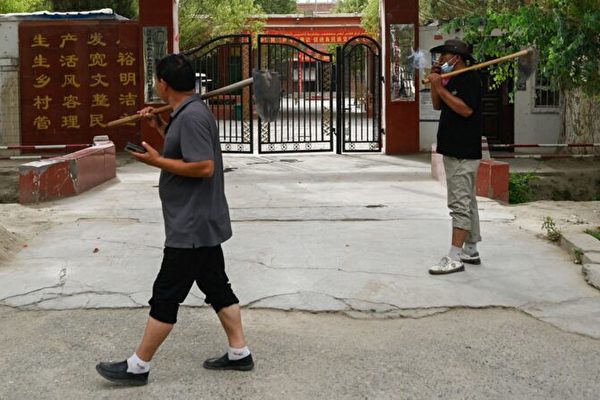
The Chinese Communist Party media recently reported prominently on the “first peasant county mayor in Jiangsu Province being investigated,” claiming that the suspect, Song Shimin, who rose to prominence in Songkou Village, was the head of a criminal gang, with the police gathering criminal clues about him. Experts say that while the details of Song Shimin’s case are unknown, a group of rural leaders who were touted as examples of the success of rural reform in China have all fallen, signaling the total collapse of the rural reform illusion touted by the Chinese Communist Party at that time.
According to reports from mainland Chinese media such as Upstream News, Da Wan News, and Qilu Evening News on October 28, the Public Security Bureau of Lianyungang City in Jiangsu Province issued a notice on October 22, seeking illegal criminal clues related to the criminal gang headed by Song Shimin.
The notice listed basic information about four suspects, including Song Shimin, Song Shituan, Song Zhongbai, and a 55-year-old woman, all hailing from Songkou Village in Qingkou Town, Ganyu District, Lianyungang City.
Some Chinese media outlets claimed that the brothers Song Shimin, Song Shituan, and Song Zhongbai were known as the “Three Pythons of the East,” but some villagers pointed out that Song Zhongbai is not actually related as a brother to the other two. Song Shimin, referred to as the “First Python,” Song Shituan, as the “Second Python,” is the younger brother of Song Shimin, and Song Zhongbai, as the “Third Python,” is the eldest son of Song Shimin. The fourth person mentioned, the female, is Qiu Dede, the former women’s director of Songkou Village who later served as the village accountant.
Public records show that Song Shimin, born in 1955, a native of Songkou Village, Qingkou Town, Ganyu County, Jiangsu Province, built his fortune through aquaculture and became a successful farmer entrepreneur. Starting in 1995, he served as the Party branch secretary and Party general branch secretary of Songkou Village, and in 1999, he established the only provincial-level aquaculture seedling group company in Jiangsu Province with a registered capital of 150 million yuan. In 1998, Songkou Village was named the “First Village in Northern Jiangsu” by the Development Research Center of the State Council of the CCP. In 2000, Song Shimin was selected as one of the “Top Ten Outstanding Farmers in the country” jointly evaluated by the CCP Ministry of Personnel and the Ministry of Agriculture.
In 2002, the domestic GDP of Songkou Village, where the Yucheng Group was located, reached 280 million yuan, with a per capita net income of 6,000 yuan. Previously, in 1992, Songkou Village was known for its poverty, with an average income of less than 700 yuan.
Reports about Song Shimin mainly focus on 2003. In June 2003, at the age of 48, Song Shimin, the then Party general branch secretary of Songkou Village, was appointed as a deputy county mayor in charge of marine economy. The CCP official media praised Song Shimin as the “first deputy county mayor in Jiangsu Province directly selected from farmers since the reform and opening up.”
According to reports, the original Song Shimin was undoubtedly a genuine farmer, but later became a nationally renowned entrepreneur. Although he still lived in the countryside, and even considered himself a “farmer,” no matter how you look at it, his identity when he was elected deputy county mayor was no longer that of a farmer.
Even after becoming a deputy county mayor, Song Shimin continued to serve as the chairman of Jiangsu Yucheng Group for a long time. According to public records, Jiangsu Yucheng Group Co., Ltd. is still in existence, with Song Shimin serving as chairman and general manager, holding a stake of over 70%. The company is located in Songkou Village.
However, reports from Chinese media indicate that the company had only one insured person according to its business annual report in 2021, and had zero insured persons in 2022 and 2023. The registered phone number of Jiangsu Yucheng Group Co., Ltd. is now out of service. Some villagers have stated that the land of the enterprise was requisitioned by the local government two years ago, and the company building has been demolished.
Furthermore, there are 10 other enterprises associated with Song Shimin, but currently only two of them are still in operation.
In 2013, Song Shimin was reported to be implicated in corruption. An informant disclosed that Song Shimin had a good relationship with some local leaders, and his arrest this time may be related to involvement with organized crime. Song Shimin was reportedly arrested around July this year, leaving behind a glamorous exterior and a tormented interior in Songkou Village.
Chinese affairs expert Wang He told Epoch Times that the current situation in Songkou Village represents the complete decline of the so-called rural villages or collective enterprises that became wealthy after the CCP’s reform and opening up, and it is also the shattered illusion of the CCP’s rural reform. “Villages like Nanjie Village in Henan, Daqiu Zhuang in Tianjin, and Huaxi Village in Jiangsu have all declined.”
Wang He said that the development model of these villages or town enterprises has not been resolved due to internal governance problems, and the CCP’s implementation of rural cooperative mechanisms has not been truly realized, turning these enterprises into family businesses.
“They either turn into criminal organizations or collapse economically due to large debts, as in Huaxi Village. Or if they have a conscience, like Dawu Group in Hebei, which tried to establish democratic governance within the enterprise, the CCP would not tolerate it and shut it down. Or like Daqiu Zhuang, it became a local power, and the CCP also took it down.”
Regarding Song Shimin’s appointment as deputy county mayor and the many honors he received, Wang He said that since this kind of enterprise achieved monopoly in the locality and became a money-making machine, the authorities would bestow many honors upon them.
Wang He stated that the reason behind Song Shimin’s troubles may be due to internal problems within the enterprise and conflicts with the local government because of the continuous leadership changes. The authorities have only announced seeking criminal clues, without publicly stating that they are treating them as a criminal organization, so the details are still to be understood. Given that the CCP itself has gang-like characteristics, with local governments everywhere scheming against each other, it’s more likely a case of “one gang battling another.”
Township enterprises were flourishing in the 1980s and 1990s but have largely fallen into obscurity since the 1990s.
Among them, Nanjie Village in Henan was widely reported as the “Red Millionaire Village.” Every morning, villagers marched into the factory to the tune of “The East Is Red,” and every afternoon, they marched out to “Sailing the Great Sea Depends on the Helmsman.” They emphasized their collective spirit, with only a small monthly salary, where leaders received the same pay as workers. However, media later revealed that self-proclaimed Nanjie Village Party Committee Secretary and Nanjie Village Group Chairman Wang Hongbin, who claimed to still receive a monthly salary of 250 yuan, actually owned 9% of the equity. After the death of former Village Chief Wang Jinzhong, at least 20 million yuan in cash and several real estate certificates were found in a safe in his office. Furthermore, several women claiming to be Wang’s mistresses brought children to the funeral asking for a share of the family estate.
In August 2007, after the arrest of Guan, the director of the Agricultural Bank of Nanjie Village, it was revealed that the debt of the Nanjie Village group had exceeded 1.6 billion yuan. With only 3,200 residents, Nanjie Village’s per capita debt reached 500,000 yuan, earning it the title of the “Number One Debt Village in China.”
The self-proclaimed “Number One Village in the World,” Huaxi Village, was once touted as a utopia of Chinese socialism, with the key figure being the former village secretary Wu Renbao. Due to Huaxi Village Group’s annual sales exceeding 50 billion, Wu Renbao graced the cover of Time magazine in 2005.
According to research data from Fudan University’s Sociology Department in 2004, Wu Renbao’s four sons controlled 90.7% of the funds available in Huaxi Village, while ordinary villagers earned barely over a thousand yuan per month. The Wu family occupied important leadership positions for three generations. On March 18, 2013, Wu Renbao passed away, leaving behind a debt of up to 38.9 billion for Huaxi Village.
The BBC referred to the downfall of Huaxi Village as the “collapse of a Chinese Communist utopian experiment.”
There’s also Daqiu Zhuang in Tianjin. After 1978, under the leadership of the then Daqiu Zhuang Party Secretary Yu Zuomin, Daqiu Zhuang became the wealthiest village in the country by directly developing enterprises and industries, with a non-agricultural income reaching 4 billion yuan in 1992. Yu Zuomin, a farmer entrepreneur, was also among the earlier Chinese farmers to own a luxury Mercedes SL600 armored vehicle.
However, in April 1993, Yu Zuomin was arrested and sentenced to 20 years in prison on charges of sheltering criminals, obstructing official duties, bribery, unlawful detention, and illegal control. Yu Zuomin died on October 3, 1999, reportedly from a heart attack, although there are rumors of suicide.