
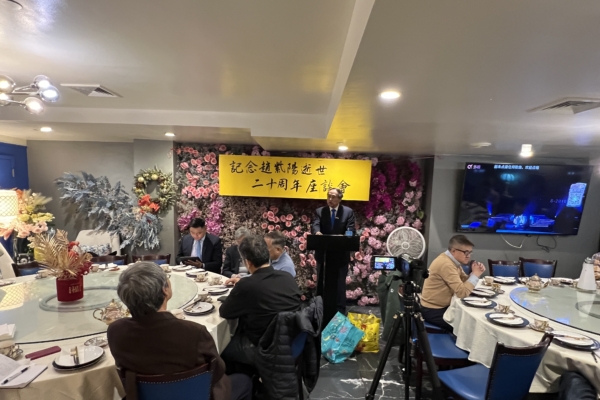
On January 17, 2025, the 20th anniversary of the passing of Zhao Ziyang was commemorated. During the 1989 student movement, he was suppressed for sympathizing with students and was under house arrest for nearly sixteen years. The Hu-Zhao Foundation and the China Democracy Party jointly sponsored a memorial event in New York. Speakers pointed out that during the June Fourth Incident in ’89, Zhao Ziyang prioritized humanity over party ideology, but within the framework of the CCP, the path of political reform advocated by Hu and Zhao was deemed unattainable; the authoritarianism of the Communist Party eventually creates its own enemies, with a function that leads to “self-destruction.”
The event was hosted by Hu Ping, the honorary editor of “Beijing Spring,” with Wang Juntao, the chairman of the National Committee of the China Democracy Party, as the keynote speaker. Hu Ping emphasized that Zhao Ziyang played a significant role in China’s economic reforms; during the ’89 democracy movement, he opposed the use of force to suppress peaceful protesters, leading to his long-term house arrest by the Chinese authorities.
Hu Ping mentioned that, although the events of ’89 are now history, justice has not been fully served. The three characters of Zhao Ziyang remain sensitive in China, posing a strong challenge to the current CCP’s authoritarian regime. This commemoration itself serves as a form of resistance and protest.
Wang Juntao stated that all the achievements of China in the 1980s were interconnected with Zhao Ziyang, and the reform and opening up brought vigorous economic development to China in the 1990s. However, a fundamental issue with the Communist Party’s reforms is that those spearheading the changes eventually face purges. At that critical juncture, one must choose to compromise or decisively break away from the system. Zhao Ziyang made a choice where humanity triumphed over party ideology. Once the guns opened during ‘June Fourth,’ the Communist Party resolved to be unreasonable, effectively closing off China’s opportunity for a peaceful transition to democratic constitutionalism.
In an interview, Wang Juntao pointed out that Zhao Ziyang’s ultimate expulsion illustrated the impossibility of people with any remnants of humanity gaining power within the evil Communist Party. This underscores the significance of movements like the current wave of resignations (quitting the party, the Youth League, and the Young Pioneers) aiming to distance individuals involved with the wicked party. A future China without the CCP might provide opportunities for these individuals.
Dr. Qin Jin, a sociology Ph.D. from the University of Sydney, noted that Zhao Ziyang was a person who exhibited weakness in dealing with challenges. When entrusted with crucial political decisions in China, he lacked the courage to confront difficulties. During the events of ’89, his thoughts leaned more towards “my gratitude towards Deng Xiaoping, towards the Communist Party,” rendering him unable to break free from this ideological cage.
Independent columnist Zhang Jie expressed that within the CCP system, the path of political reform advocated by Hu and Zhao is blocked, as the CCP cannot tolerate reforms that would ultimately lead to constitutional democracy. With Xi Jinping approaching a “Lin Biao moment,” authoritarianism inherently carries the function of self-destruction, reaching a point where it generates its own enemies, ultimately leading to its own downfall. The internal power struggles among high-ranking CCP officials are intensifying, marked by escalating infighting and extreme measures, instilling fear among officials. In this environment, the future ‘Lin Biao’ figure remains unknown, as anyone could potentially become the new target. After the 20th Party Congress, a chaotic era seems to have begun.
In the 8th chapter of “Nine Commentaries on the Communist Party” titled “Assessing the Cultish Nature of the Chinese Communist Party,” a closer analysis is conducted on leaders like Zhao Ziyang within the CCP: “In the history of the CCP, figures like Chen Duxiu and Qu Qiubai, who retained some traditional intellectual ideas, individuals like Hu Yaobang, Zhao Ziyang, who still held people’s interests at heart, and someone like Zhu Rongji, aspiring to be a clean official working for the people, regardless of their contributions to the party or lack of personal ambition, inevitably faced purges or were sidelined, constrained by the party’s interests and discipline. The deeply ingrained party spirit cultivated through years of struggle often leads them to compromise and yield at critical moments. In their subconscious, the party’s survival reigns supreme, prompting them to sacrifice themselves, even witnessing the party’s evil powers committing atrocities, yet they dare not voice their conscience and benevolence, thereby affecting the party’s survival. This is the result of the CCP’s struggle mechanism, transforming good individuals into tools to be used, while maximizing party spirit to limit or even eradicate human conscience. Throughout over a dozen “line struggles” within the CCP, more than ten party leaders or designated successors have been toppled, with none of the party’s top leaders meeting a good end.”
Zheng Xuguang, Wen Guanzhong, Xiang Xiaoji, Rong Wei, Gu Weiqun, Wan Yanhai, He Pin, and Cichen Jiacuo also delivered speeches at the event.