
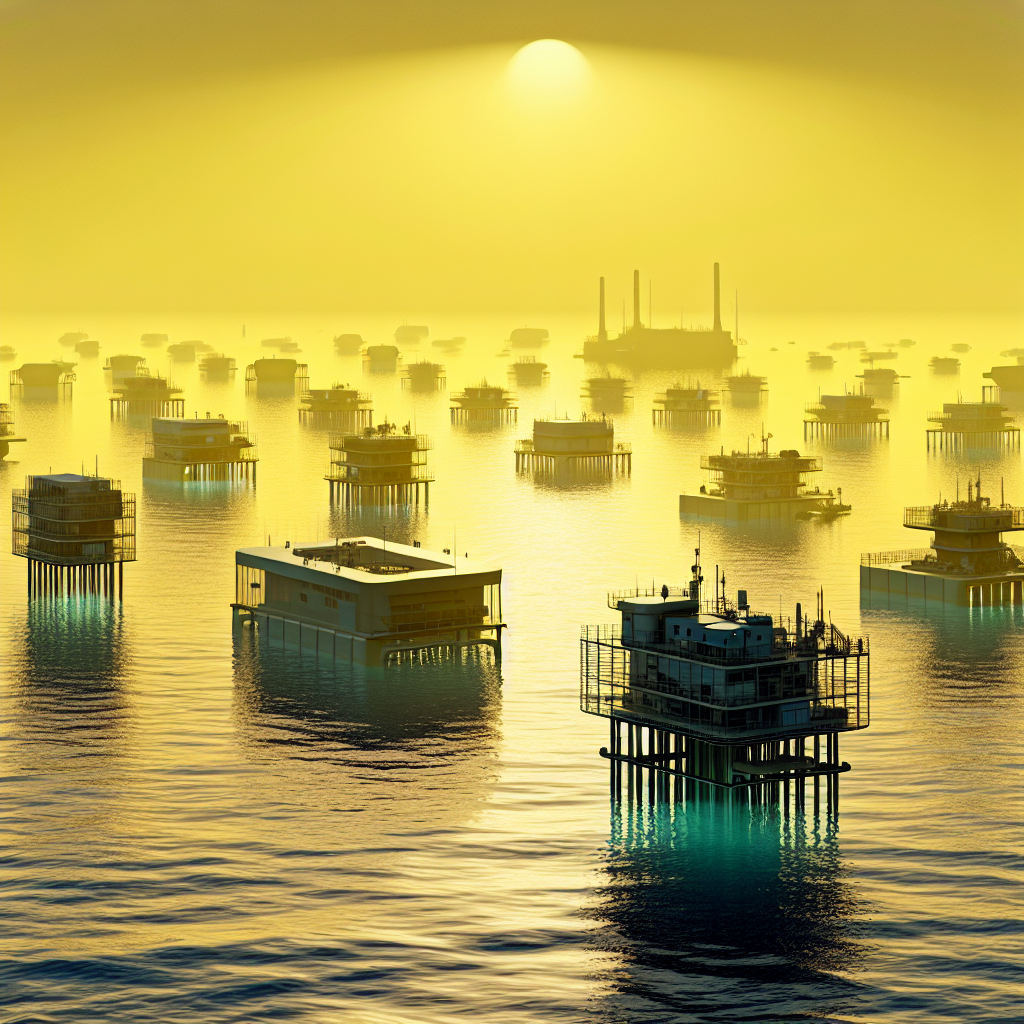
On December 14, 2025, a report from a US think tank revealed that in recent years, the Chinese Communist Party (CCP) has unilaterally set up 16 facilities in the waters of the Yellow Sea under the Sino-Korean provisional measures, utilizing a strategy of “progressive sovereignty expansion”. These ostensibly civilian facilities have potential military uses, and South Korea’s monitoring attempts were intercepted by the CCP 27 times.
Experts point out that this move, similar to CCP’s militarization in the South China Sea and East China Sea, aims to secure maritime rights in the Yellow Sea, posing a creeping threat to South Korea’s maritime sovereignty.
The Center for Strategic and International Studies (CSIS)’s specialized North Korea website “Beyond Parallel” released a report on December 9, exposing photos of the 16 facilities set up by CCP in the waters under the Sino-Korean provisional measures.
The report indicated that since 2018, CCP unilaterally deployed 13 buoys in the area without prior consultation, along with constructing two deep-sea aquaculture platforms named “Deep Blue 1” and “Deep Blue 2”, as well as an integrated management platform called “Atlantic Amsterdam”.
According to the 2001 China-Korea Fisheries Agreement, the Yellow Sea overlapping exclusive economic zones were designated as a “temporarily agreed area” to be jointly managed by both countries. The report emphasizes that setting up permanent facilities in the waters under the provisional measures violates this agreement.
CCP not only repeatedly refused South Korea’s requests to relocate these facilities but also unilaterally established a “restricted navigation zone” in the region. The report revealed that since 2020, South Korean ships attempted to monitor CCP activities 135 times, with 27 instances of interception by CCP Coast Guard.
The report suggests that the US and South Korean governments should consider publicly disclosing the coordinates of the CCP-related facilities and view this case as another “gray zone” tactic targeting Indo-Pacific allies.
An article by the South Korean newspaper “Chosun Ilbo” in July this year pointed out that for the first time since its founding, South Korea is facing a territorial threat from the Korean War 75 years ago, and today, a “second invasion is underway – this time from the West.” The article warned that if CCP successfully turns the Yellow Sea into its own inland sea, the consequences for South Korea would be very severe.
Regarding CCP unilaterally deploying 13 buoys in the Yellow Sea, Taiwan’s Institute for National Defense and Security Studies analyst Shen Ming-shi analyzed in an interview with Epoch Times that these buoys have multiple functions, can measure water temperature, salinity, and importantly, “they can place devices to listen to underwater sounds, detect the movements of submarines, especially nuclear-powered submarines”.
Shen Ming-shi analyzed that CCP “is adept at illegitimate activities under legal cover, carrying out military derivatives through legitimate purposes”. These buoys “originally have dual uses”, “the more they are arranged, the more they indicate that the area is a key area or that there may be important activities in the future”.
Taiwan’s Institute for National Defense and Security Studies assistant researcher Lin Chih-hao further explained the strategic intent. Situated at the mouth of the Bohai Sea in Shandong Province, “if the aircraft carrier formation of the Southern Naval Base in Shandong Province or the Bohai Base has to sail south, maintaining influence or control in the Yellow Sea will ensure that the naval fleet can smoothly pass through the Yellow Sea”.
Lin Chih-hao told Epoch Times that although CCP claims it is for “civilian use, monitoring, and maintaining marine ecology”, in “an emergency situation or when necessary, it can monitor the sea situation at first time, ensuring that the South Korean navy or coast guard will not act unfavorably towards the CCP navy in the Yellow Sea.”
According to a previous report by “China Newsweek,” the “Deep Blue 1” deep-sea aquaculture platform among the 16 facilities mentioned was operational in 2018, located approximately 120 nautical miles offshore in the Yellow Sea. “Deep Blue 2” has a farming capacity close to twice that of “Deep Blue 1” and integrates systems including hydrology, water quality, meteorological monitoring, underwater imaging, and biomass monitoring, achieving a synergy between land and sea.
In fact, since 2023, CCP has strongly supported deep-sea aquaculture, with local governments providing substantial subsidies for related projects. Currently, large-scale deep-sea aquaculture equipment is mainly constructed by central enterprises, state-owned enterprises, and a few private enterprises, deployed in the waters of the Yellow Sea, East China Sea, and South China Sea.
Lin Chih-hao analyzed CCP’s gray zone tactics as “often extending sovereignty through buoys or justifying the behaviors of local governments in relevant areas through buoys. These actions may progressively erode the sovereignty or legitimacy of law enforcement by other countries in the region”.
He pointed out that CCP’s actions have a clear negative impact on Sino-Korean relations: “It does not improve CCP’s image, and continuing to passively respond to South Korea’s requests to remove the buoys is very unfavorable for South Korea’s perception of CCP, and even in the long run, it is detrimental to Sino-Korean relations.”
Lin Chih-hao further analyzed that this tactic could lead to changes in the regional security landscape: “Instead of military cooperation, it is more likely to alert neighboring countries to CCP’s gray zone behavior in these waters, leading them to form stronger security relationships.”
He believes that CCP’s actions in the Yellow Sea “will make South Korea feel that I must continue to develop South Korea-US relations. Even in necessary cases, trilateral security cooperation among South Korea, the US, and Japan or South Korea-Japan multilateral security cooperation may become necessary to continue.”
Shen Ming-shi pointed out that the response from other countries could be divided into two types: “The first is if you place buoys, I will also place buoys, if you send fishing boats, I will also send fishing boats, which is a corresponding or symmetric counteraction. The other is to unite with other countries to condemn CCP’s threatening behavior and take joint countermeasures.”
Regarding CCP’s unilateral establishment of 16 facilities in the Yellow Sea, the South Korean newspaper “The Chosun Daily” stated in an article on December 12 that South Korea should immediately take reciprocal measures. Based on the principle of reciprocity, there is no reason why South Korea cannot set up an equal number of buoys and similarly sized large structures as China.
The article mentioned that Vietnam is taking “reciprocal measures” to counter CCP’s tactics. Vietnam is imitating CCP’s construction of military facilities on reefs and beaches through cement pouring, expanding to approximately 70% of the area of Chinese artificial islands. While CCP threatens to “take measures,” rash actions may face abandonment by the entire Southeast Asia.
Facing CCP’s maritime expansion, South Korea has already begun taking countermeasures. In March of this year, South Korean Minister of Maritime Affairs Kang Do-hyung announced the installation of a fixed floating platform in the disputed waters of the Yellow Sea as a “reciprocal measure”, ostensibly for “environmental surveys”, but in reality, to monitor CCP’s movements.
Meanwhile, US-Korea military cooperation is also strengthening. On November 13, the United States officially approved South Korea’s construction of a nuclear-powered submarine plan and supported South Korea in obtaining uranium enrichment and spent fuel reprocessing capabilities.
On December 10, South Korean shipping giant Hanwha Group announced a collaboration with the US defense startup Vatn Systems to jointly develop autonomous underwater drones for the US Navy to counter CCP’s naval expansion.
Lin Chih-hao, in concluding the profound impact of CCP’s Yellow Sea strategy, stated: “If CCP expands its influence in the Yellow Sea, it means that North Korea will likely expand smuggling routes and even the scope of maritime activities through CCP’s territorial expansion.”
He warned that this would not only affect the operations and economic transport in the western waters of South Korea but also “squeeze the interests of other countries at sea” and “make Northeast Asia more tense.”