
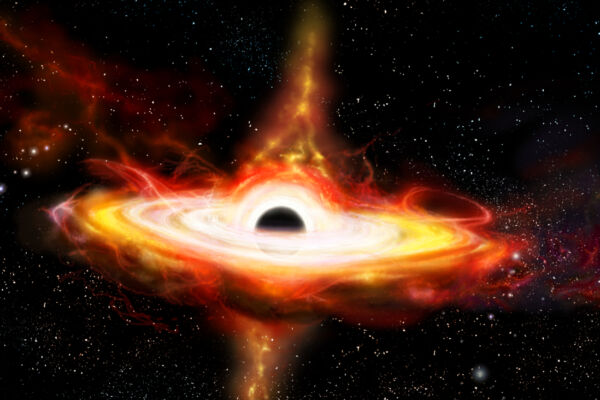
A rare and mysterious cosmic explosion phenomenon is sparking discussions in the field of astronomy. Since the first observation of a powerful explosion named “The Cow” in 2018, scientists have recorded approximately 12 similar events. These explosions, known as Luminous Fast Blue Optical Transients (LFBots), are not only extremely bright but also flash instantaneously before disappearing, unlike typical supernovae.
Anna Ho, an astronomer at Cornell University in the United States, mentioned, “They are very bright, with a color temperature of up to 40,000 degrees Celsius, causing the light to shift to the blue spectrum.”
In 2018, the Asteroid Terrestrial-impact Last Alert System (ATLAS) in Hawaii captured the first explosion of “The Cow” in a galaxy located 200 million light-years away from Earth. It was a hundred times brighter than typical supernovae and faded rapidly within days, as opposed to the weeks or months it takes for supernovae to completely fade.
Initially, theories suggested that LFBots were failed supernovae, with stars not fully exploding and instead collapsing into black holes that devour from within. However, as research progressed, more and more scientists lean towards another hypothesis – that these explosions may be caused by intermediate-mass black holes devouring stars.
A research team led by Zheng Cao at the Netherlands Institute for Space Research reanalyzed the X-ray data from the “The Cow” event in 2024 and identified the presence of a surrounding disk of material, likely remnants of a star, being devoured by an intermediate-mass black hole with a mass ranging from a hundred to a hundred thousand times that of the Sun.
Daniel Perley, an astronomer at Liverpool John Moores University, pointed out that this theory might bridge the crucial ‘missing link’ between stellar-mass black holes and supermassive black holes and could potentially reveal clues about dark matter. He emphasized, “This is currently the most exciting theory.”
Since “The Cow,” other LFBot events named after animals have been observed, such as the 2018 “Koala,” 2020 “Camel,” 2022 “Tasmanian devil,” and the 2023 “Finch/Fawn.” The most recent discovery in 2024, AT2024wpp, temporarily named “Wasp,” ranks just below “The Cow” in brightness and was detected early in its explosion, allowing agencies like NASA’s Hubble Space Telescope to swiftly observe its evolution.
Ho mentioned that to definitively determine the nature of LFBots, more observational samples are needed. While these events are extremely rare, the upcoming launch of the Israeli space telescope “Ultrasat” in 2025 is expected to discover more such phenomena, taking a crucial step towards unraveling the mystery of intermediate-mass black holes.
(*This article references reports from BBC, Unilad, and Live Science.)