
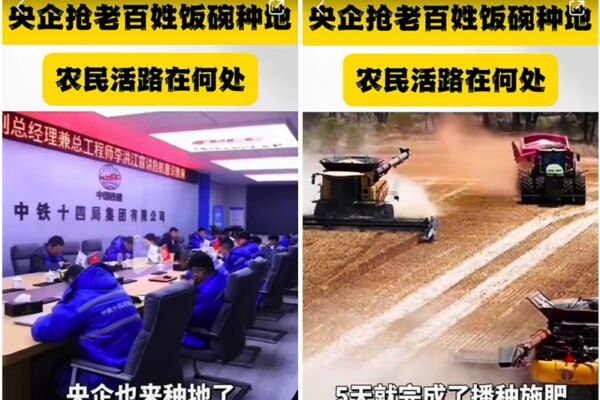
Recently, the state-owned enterprise China Railway 14th Bureau has contracted 15,000 acres of land in Shandong under the high-standard farmland policy of the Chinese Communist Party, sparking heated debates online and concerns among the public about the future prospects of farmers. Experts believe that this mandatory agricultural entity economic model implemented by the CCP may not be able to break through past failures, and the outcome could be a mess.
According to mainland media reports, the state-owned enterprise China Railway 14th Bureau obtained the land operating rights for a total area of 15,000 acres of basic farmland in the Huawo Dadi land in Kuanli District, Dongying City, Shandong through competitive bidding. Crops being cultivated include corn, wheat, and rice, with a team of nearly a hundred professionals established.
In addition, the state-owned enterprise China Railway 21st Bureau also held a modern agriculture promotion meeting in Lanzhou.
According to publicly available CCP policies, the goal is to establish 1.2 billion acres of high-standard farmland by 2030, with a significant amount of financial resources being allocated for this purpose to encourage social capital participation. Previously, the CCP planned to establish ten thousand new farms.
Observers believe that China Railway 14th Bureau’s foray into farming is just the beginning, and with state support, more state-owned enterprises will likely enter the agricultural sector in the future, becoming a trend.
Chinese-American economist David Huang analyzed for Epoch Times that policy support implies funding and other favorable policies, which means profitability and benefits, so state-owned enterprises and national enterprises will actively participate. “Moreover, as state-owned enterprises and national enterprises enter the agricultural market, the level of state-owned economy will increase further.”
He emphasized that the CCP authorities aim to break free from the reliance on a large amount of imported agricultural products, increase the possibility of self-sufficiency in Chinese food production, but the actual implementation poses significant challenges.
Another Chinese-American economist, Li Hengqing, pointed out that state-owned enterprises’ entry into agriculture is not only due to government subsidies and incentives but also due to loyalty. He said, “By meeting Xi Jinping’s demand for high-quality and high-quality future agricultural development, there is also the possibility of promotion and prosperity in the future.”
He believes that from a strategic point of view, the CCP aims to enhance China’s self-sufficiency capability to alleviate the impact of potential sanctions from Western countries in the event of a military reunification with Taiwan. “China currently relies heavily on imports of major agricultural products such as soybeans, corn, and wheat.”
China Railway 14th Bureau, known for building houses and bridges, has ventured into agriculture instead, sparking discussions and raising concerns in various sectors of society.
Some farmers expressed confusion upon hearing the news about China Railway 14th Bureau, especially those who have been farming their entire lives, wondering about their future. Many bloggers share similar concerns.
A Shandong blogger named “Zhijing Shuo Shangye” stated in a program on December 19, “Having a professional team from the construction sector plant crops means competing with ordinary people for a job. Does this mean that farmers will soon disappear?”
He gave examples of past government policies that encouraged rural residents to buy houses in the county by offering subsidies, leading to land transfer where farmers had to sell their land, raising questions about the difference between selling and transferring rights. Concerns were also raised about the consequences of losing land and livelihoods.
Another blogger from Guangdong named “Nongren Junshi” mentioned in a program on December 11 that large state-owned enterprises with abundant funds and resources are eliminating ordinary people’s livelihoods. The lack of basic security measures for farmers was highlighted, leading to a situation where state-owned enterprises compete with farmers for opportunities, depriving ordinary people of livelihoods.
A businessman named Lao Pan, who has been involved in investment promotion for more than a decade, recently remarked in a program that this situation reflects increasingly fierce competition, making it challenging for ordinary individuals to start businesses. He noted that opportunities for entrepreneurship are diminishing.
David Huang, the economist, expressed his concern to Epoch Times that safeguarding the rights of farmers during this wave of land acquisition and transfer is challenging. The gap between the policies emphasizing protection and participation rights of farmers and the practical implementation, like in the Constitution with rights to freedom, democracy, protest, and press publication, is apparent and not easily reconciled.
He also pointed out that once farmers lose their land, they may face significant challenges in securing their livelihoods. The transition from an agrarian society to an industrial one without a significant decline in living standards is difficult and might lead to criticism as farmers are pushed to cities, struggling with high rents and property prices.
Huang emphasized that the current national strategic approach reflects historical patterns of mandatory entity economic models and macroeconomic agricultural planning. Similar approaches in countries like China, Cambodia, Myanmar, Vietnam, and the Soviet Union have led to food shortages, even famine.
Huang referred to historical instances of failed agricultural collectivization models like the Soviet collective farms and China’s People’s Communes, where farmers lost their lands, production suffered, leading to food crises and even starvation. He highlighted how China resolved its agricultural issues in the 1980s by returning land to farmers for individual responsibility.
He stressed that throughout human history’s agricultural societies, it has been challenging to impose agricultural production forcibly, and such efforts have often failed.
David stressed his lack of optimism in whether this so-called high-standard farmland construction initiative can learn from past experiences, reverse the inevitable failures of the entity economy, or adhere to economic and natural laws.
Li Hengqing believed that by not adhering to market principles or basic human nature, everything seems to be dictated by Xi Jinping’s wishes. The discrepancies between reality and intentions might eventually lead to a failure.
He warned that if local governments fail to protect farmers’ interests during land acquisitions, it could spark public outrage and lead to rural unrest.