
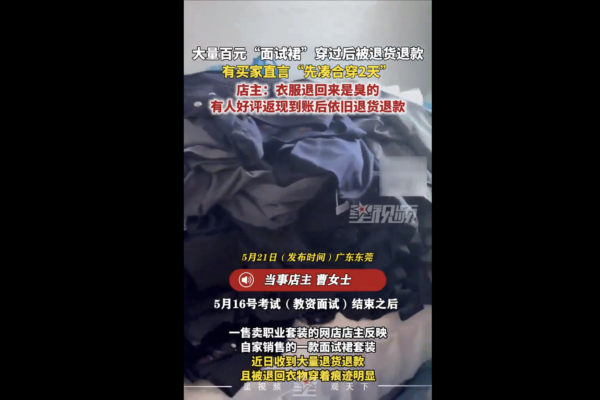
Recently, after the teacher qualification interviews in many parts of mainland China concluded, there was a sudden surge of unusually high returns on e-commerce platforms specializing in “interview attire.” Many previously sold hundred-yuan professional skirts were returned en masse after the interviews, with some buyers even applying for “refund only, no return.”
These returned clothes have mostly been visibly worn. The original tags have been removed, yellow stains appear on collars and cuffs, and the clothes retain smells of sweat and perfume, making them basically unsellable.
According to a report by “Lychee News” on May 21, Mrs. Cao, who operates an online shop selling professional suits in Dongguan, Guangdong, stated that after the teacher qualification interviews in the first half of 2026 ended on May 16, she quickly received a large number of return requests for “interview skirts.”
“Around the 17th and 18th, we had received nearly 300 returns,” Mrs. Cao said. Many of the returned clothes showed obvious signs of wear, with some shirt collars turning yellow and some tags being cut off. Additionally, many clothes had mixed scents of perfume and sweat, with some clothes even being returned smelly. The return addresses mainly came from universities and vocational schools.
Mrs. Cao operates two small online stores, primarily selling products obtained from factories. Currently, the accumulated returns have exceeded 400 orders, with over 30 being “refund only.” Due to the difficulty of providing online evidence on the platform, it is challenging for the system to recognize the smells and wear marks on the clothes, leading to her inability to appeal successfully.
Currently, almost all of these returned clothes are piled up in her home, unable to be resold. Mrs. Cao estimated her losses to be close to 40,000 to 50,000 Chinese yuan.
Buyer chat logs provided by Mrs. Cao show some customers bluntly stating they wore the clothes “for a couple of days” and questioning, “Can’t I return them after wearing them?” What puzzled Mrs. Cao the most was that some buyers participated in positive review cashback activities, yet still chose to return the items after wearing them.
Furthermore, Mrs. Cao added shipping insurance for the products, but many buyers still chose to send back the items themselves. “By doing this, they can pay their own shipping fees, and whatever they fill in will be directly deducted from us, the merchants.”
After the incident was exposed, it quickly sparked discussions online and became a trending topic.
Many netizens believe that this behavior fundamentally takes advantage of the platform rules as a way to “rent clothes for free,” which is unfair to small businesses. Some even suggested exposing buyers who make malicious returns because such actions raise clear moral issues.
An article by a popular blogger “Watch Global” pointed out that this wave of mass returns actually reveals the contradictions between e-commerce platform rules and reality.
For many young people, the teacher qualification interview is a crucial milestone, prompting many to buy specific professional attire to make a good impression. However, the issue lies in the fact that these clothes are often worn only once, as they have limited utility outside of interview settings, leading them to be left unused for extended periods.
It is because of this that some consumers have started treating the “seven-day no-reason return policy” as a way to essentially “low-cost rent clothes”: they purchase interview outfits, wear them for the interview, then promptly request a refund, essentially achieving their look at almost no cost.
Some of those requesting returns do not see an issue with their actions. They believe that since the clothes were only worn “briefly,” they should still be eligible for returns. Furthermore, some take advantage of platform benefits like positive review cashback to receive money back before returning the items.
As these practices spread online, more people began to imitate them, leading to this wave of concentrated returns, with many small businesses already facing thin profit margins becoming the biggest victims.
The article argues that the “seven-day no-reason return policy” was initially designed to protect consumers and reduce online shopping risks, with the underlying premise not being “return after use.” For clothing businesses, once a garment exhibits noticeable signs of wear, stains, or odors, it becomes challenging to resell it, and costs such as transportation, packaging, and labor all directly contribute to losses.