
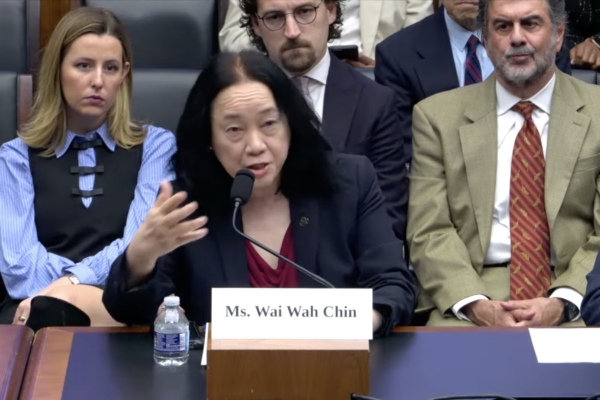
In academic excellence, which should have been the core foundation of K-12 education, has gradually been marginalized in previous years of educational policy discussions. On April 28th, the “Subcommittee on Early Childhood, Elementary, and Secondary Education” of the United States Congress held a hearing titled “Downgrading: How Fairness Policy Undermines Excellence and Harms Students” to examine whether schools are excessively prioritizing uniform outcomes or “fairness,” neglecting individual achievements, and thereby limiting opportunities for advanced learning.
The hearing took place in Washington, D.C., with Chen Huaihua, the president of the New York Association of New Yorkers, as the only Chinese representative among the four witnesses.
During her testimony, Chen Huaihua pointed out that the core issue of education is: “What values are preventing our next generation?” She emphasized that for the next generation, “excellence” is crucial.
She gave examples, such as when boarding a plane, using a cellphone, conducting online searches, or even undergoing surgery, people would not want services based on so-called “fair choices” but rather on “excellent choices.”
She stressed that the United States must establish high and objective academic standards at all levels of schools, especially in the STEM (science, technology, engineering, and mathematics) fields, as the nation’s innovation capability, economic prosperity, and national security heavily rely on top talents.
Despite the United States ranking among the top in education spending per student, its overall academic performance lags behind leading nations. According to international assessments such as TIMSS (Trends in International Mathematics and Science Study) and PISA (Programme for International Student Assessment), American students are already trailing leading nations by about three to four years in math proficiency by the 8th grade, and the gap remains unbridged by the age of 15.
Additionally, the National Education Report shows that only about 22% of 12th-grade students reach proficiency in math, and this standard itself is considered relatively low. Chen Huaihua pointed out that these data reflect not minor setbacks but systematic failures.
She criticized that some school districts are weakening rigorous academic curriculums, emphasizing social-emotional learning (SEL), culturally responsive teaching methods, and various “equity and diversity” initiatives, squeezing core academic time and injecting non-academic or politicized content into classrooms.
Simultaneously, traditional gifted and talented education programs and accelerated learning initiatives, such as Gifted and Talented (G&T) programs and accelerated courses, have been reduced or weakened due to “fairness” policies. Public elite high schools historically known for cultivating a large number of STEM talents also face challenges with standard adjustments and admission system reforms, as these schools have long relied on objective academic entry standards based on academic abilities. The current alterations not only lower academic thresholds but also may negatively impact Asian American students.
Chen Huaihua cautioned that the United States’ global leading position in crucial areas such as artificial intelligence, semiconductors, and quantum computing is under threat due to inadequate talent cultivation. If standards continue to be lowered and excellence is neglected, the gap between the United States and other countries will only widen further.
She advocated for expanding high-quality gifted education and accelerated programs, maintaining evaluation systems based on objective academic abilities to ensure talent cultivation and national competitiveness. A country’s future competitiveness depends on whether it remains willing to uphold “excellence.”
Using New York City’s specialized high schools as an example, she pointed out that while these schools have a significant number of students from low-income families, they have produced outstanding alumni, including 15 Nobel laureates, whose influence surpasses that of many countries.
The hearing chairman, Congressman Kevin Kiley (California Republican), noted that parents generally support advanced academic opportunities. According to surveys conducted by EdChoice and Morning Consult, 63% of parents consider advanced courses “very important,” with only 8% viewing them as unimportant.
Congressman Tim Walberg (Michigan Republican) also emphasized the importance of gifted and accelerated programs, noting that these programs often serve as vital avenues for additional learning opportunities for low-income students.
Scholar Daniel Buck stated that research shows students from disadvantaged backgrounds benefit significantly from gifted programs. He criticized some education policies that lower standards in the name of “fairness,” actually undermining students’ motivation for learning and long-term skill development.
Several attendees pointed out that certain “fairness-oriented” grading methods, such as allowing multiple retakes or reducing grading standards, no zeros, no homework, or no penalties for late submissions, could weaken students’ sense of learning responsibility and discipline.
Congressman Mark Harris (North Carolina Republican) believes that lowering expectations may cause greater harm to disadvantaged groups rather than helping them improve their situations.