
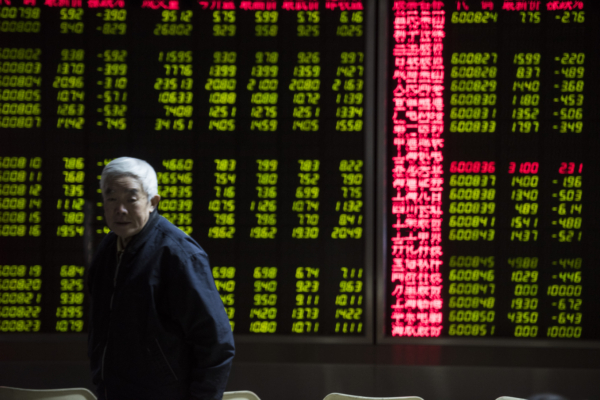
Recently, the Chinese stock market has been experiencing continuous fluctuations and downward trends, with thousands of individual stocks plummeting, causing severe losses for investors and leading to a sense of despair within the market. Against this backdrop, official media outlets have pointed fingers at the phenomenon of “self-media stock recommendation chaos,” specifically targeting some financial bloggers who are allegedly exploiting investors’ anxiety through paid stock recommendations. Analysts believe that amidst the market downturn, the scrutiny on self-media stock recommendations signals a crackdown on such practices, although the deeper reasons behind the distress of stock investors are closely related to market performance and regulatory oversight.
With millions of followers, the popular financial influencer account “Financial Wisdom Sheep” has been shut down, reigniting public focus on the chaos surrounding self-media stock recommendations. “Just buy when I tell you it’s time to buy,” a financial blogger confidently asserts in a short video, seamlessly shifting the conversation from international employment data to the global futures market, culminating in a pitch for membership fees starting at 1288 yuan for basic and 4288 yuan for premium members.
According to a report by mainland Chinese state media on April 7th, in recent years, a large number of new stock investors have entered the market, propelling a group of self-proclaimed “financial experts” and “investment mentors” in the finance blogging sphere and live streaming platforms to fame. They monetize their influence through paid courses, membership communities, and real-time stock recommendations, effectively capitalizing on investors’ financial anxieties through a “paid plagiarism” scheme.
On the knowledge payment platform Knowledge Planet, investment and financial management content such as stocks and funds have consistently dominated the weekly bestseller charts. One financial blogger boasts a membership base of up to 17,000 people, generating over 20 million yuan annually from membership fees alone, priced at 1499 yuan per year.
Professor Ma Liang from Peking University’s School of Government Management stated that many individuals currently harbor anxieties about asset preservation and appreciation, which some financial influencers and live streamers exploit and magnify to reap significant profits for themselves.
The topic of “self-media stock recommendation chaos” trended on April 7th.
In recent times, the overall Chinese A-share market has displayed a trend of volatile decline. On March 18th, the Shanghai Composite Index closed at 4062.98 points. By March 31st, A-shares witnessed a general decline with all three major indices collectively falling, as the Shanghai Composite Index slipped below the 3900-point mark, accumulating a 6.51% decline for the month of March.
At the close of trading on April 7th, the Shanghai Composite Index stood at 3890 points.
A verified Weibo member named “Mr. Lin from Shenzhen” with 373,000 followers shared a post expressing distress over the recent market turmoil and heavy losses suffered by stock investors. Many investors have become exceedingly disillusioned with the stock market and have even liquidated their positions to exit the market altogether.
The article highlights that the signal emanating from official media is that the chaos in self-media recommendations has exacerbated the anxieties of stock investors, indicating a forthcoming crackdown on the superficial issue of “self-media stock recommendations”. The article also raises questions: If this market could enable the majority to make profits, would there still be so much anxiety? What is the fundamental reason behind the distress of A-share investors?
Weibo user “Brother Bull Doesn’t Eat Noodles” shared a post indicating that the revelations by official media about industry anomalies send a clear message: a severe crackdown on illegal self-media stock recommendations seems imminent!
The article suggests that if the market were to return to rationality, providing genuine opportunities for ordinary investors to make profits, then why would so many individuals be trapped in anxiety, despondency, and ultimately exit the market? Ultimately, the proliferation of market chaos, lack of investment confidence, coupled with sustained market downturns, are the root causes that weigh heavily on stock investors.
A recent report by the “Shanghai Securities News” recounted the story of Mr. Zhang from Shanghai, who has had sleepless nights ever since following the account of “Stock Market Wizard Lao Han”. Initially, Lao Han shared daily recap videos on short video platforms, which accurately predicted market trends and occasionally mentioned certain stocks that subsequently soared the following day. Fans clamored for his advice, leading Lao Han to establish a paid WeChat group charging a monthly fee of 1888 yuan, promising stock recommendations that would double their returns.
Mr. Zhang reluctantly paid the fee, only to witness losses as the recommended stocks consistently dropped in value. Encouraged by Lao Han to “hold long-term” and “average down,” he kept increasing his positions, ultimately incurring losses exceeding 50,000 yuan. When he attempted to question the recommendations within the group chat, he was promptly kicked out.
This is not an isolated case. Numerous unlicensed financial influencers operate beyond regulatory oversight, leveraging knowledge-sharing and experience exchange as a façade to unlawfully promote stocks, leaving investors trapped in a challenging cycle of difficult discovery, proof, and recourse.
Reportedly, self-media influencers fabricate false profit screenshots through stock simulators, advocating for “get-rich-quick” schemes, promoting “chasing highs and selling lows,” and offering paid stock recommendations without proper qualifications. This path from “making money with you” to “making money off you” has evolved into a mature industry chain.
In response, some netizens question why the chaos of self-media influencers exploiting stock investors persists for an extended period and attribute it primarily to regulatory shortcomings. They ask, “Why has regulation, platform qualification reviews, and content control failed?”
Under these circumstances, investors often find it challenging to hold these influencers accountable, as they lack sufficient evidence or face prohibitive costs in seeking legal redress, further exacerbating the market’s sense of distrust.