
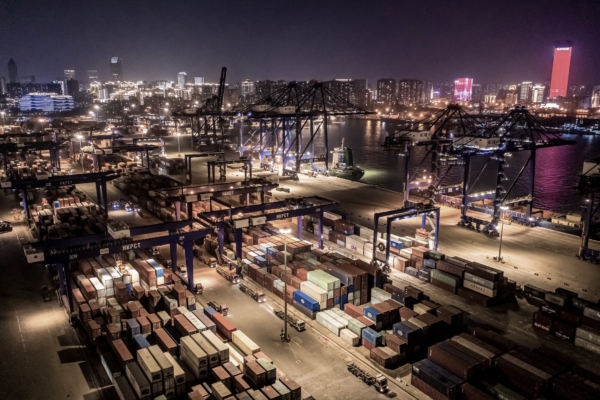
On December 18th last year, the Chinese Communist authorities officially initiated the operation of closing off Hainan. Since then, the official propaganda surrounding the construction of the free trade port has been intensively promoting “eye-catching data” such as growth in foreign trade, record-breaking tax-free sales, increased port throughput, and the rising number of new enterprises. They are trying to shape the image that “high-level openness” is accelerating, providing political and public opinion legitimacy support for the institutional arrangements after the closure. However, these statistical performances more reflect the effects of policy packaging rather than the true progress of institutional openness.
After the closure of the Hainan free trade port, the Chinese official media referred to it as the “world’s largest free trade port.” However, the reality one and a half months after the closure operation began starkly contrasts with the official narrative. On January 24th, a netizen uploaded a video from the scene at Yangpu Port, stating that on the 37th day of the closure operation, the area around the port was sparse with vehicles, with only a few private cars occasionally seen, and no freight ships or container cargo vessels parked in concentration.
In apparent contrast to the public’s intuitive perception, the Chinese state media recently quoted the Yangpu Maritime Bureau as claiming that during the first month of the closure of the Hainan free trade port, the various operations had a “smooth transition,” with 3,510 ship movements and a cargo throughput of 14.54 million tons at Yangpu Port. Among them, international ships entering and exiting the port numbered 492, with a throughput of 5.06 million tons, representing a year-on-year increase of 27.13% and 50.71%, respectively.
The related video circulating on the internet has sparked discussions. Some netizens questioned, “Hainan is thousands of kilometers away from the main international shipping lanes, why would cargo ships specifically detour here? Isn’t this like feeling one’s way across a river by groping stones?” Others sarcastically commented, “Surpassing Hong Kong, the result is a lonely closure. ‘Fake it till you make it’, lead by creating fake data and images.”
In response, Mr. Zeng, a financial scholar from Guangdong, pointed out in an interview with this newspaper that simply citing the growth in foreign trade total volume is not sufficient to prove that Hainan is genuinely forming an open economic system. He stated that from a more detailed structural analysis, these data show significant deviations in statistical calibers, sources of composition, and sustainability, resembling stage-specific flows formed under policy stimuli rather than long-term choices made by the market based on institutional trust.
Mr. Zeng believes that the recent growth in foreign trade in Hainan is mainly concentrated on specific products and types of enterprises, especially state-owned enterprises, policy-platform companies, and trade activities related to tax exemption, energy, and primary processing. These trades heavily rely on administrative arrangements and are essentially more akin to “administratively driven flows” rather than the long-term investments made by international capital based on institutional stability.
He pointed out, “If it is genuine openness, we should see long-term entry of foreign enterprises, the anchoring of supply chains locally, rather than pushing policies leading to an increase in figures. Currently, it is more about projects and goods being transferred, with capital not staying behind.”
According to a report by the “China Youth Daily” on January 14th, since the closure, Hainan has added 4,709 new foreign trade companies, a number that within 24 days is nearing the level of a quarter in 2024, with a total registration number exceeding 100,000.
In response to this, Wang Bing, a regional economic enthusiast, pointed out that in Hainan’s current foreign trade statistics, there is a high proportion of transit trade, bonded warehouse circulation, and internal related transactions. These transactions can quickly boost foreign trade volume on paper but do not bring continuous industrial upgrades, technological accumulation, or institutional benefits to the region. The gap between expanding foreign trade and strengthening the economy is intentionally blurred by official narratives.
Wang Bing also stated that the expansion of tax-free sales in Hainan reflects more on the redistribution of domestic consumption between regions rather than the actual entry of international consumption or international elements. “In terms of consumption structure, tax-free business is highly concentrated among a few operating entities and limited categories of goods, providing very limited stimulation for local manufacturing, research and development capabilities, and high-value-added service industries.”
Media personality Fang Xiaomin, familiar with local investment operations in Haikou, cited that over the past year, many businesses registered in Hainan are “project companies” or “shell companies” with low registered capital, minimal personnel configuration, and sometimes no actual office address for a long time. The main purpose is to obtain the identity of a free trade port enterprise first, and then invest substantively depending on whether the policy details are clear.
Fang Xiaomin said, “Some companies have been registered for over a year, without substantial business activities or additional investment, just to secure a spot in the quota.”
She mentioned that while these companies are included in the statistics as new market entities, they more indicate enterprises’ defensive layout against policy uncertainties rather than long-term commitments based on clear institutional expectations. “If the rules were clear and stable enough, there wouldn’t be so many companies ‘register first, then wait and see.'”
Based on the current information, after the closure of Hainan, crucial areas such as capital projects, cross-border capital, and data flows are still under tight control by the Chinese Communist Party. The so-called “closure” does not lead to free openness but rather to hierarchical, filtered, and controlled movement of factors within a stricter administrative framework. The data looks “good,” but it serves the official narrative itself rather than the actual level of openness.
For the external world, what is truly worth observing is not the tax-free sales or the total foreign trade volume but whether there is a substantial increase in foreign long-term projects after the closure, whether capital can move freely, and whether enterprises are willing to continue investing without additional policy incentives. Otherwise, the so-called “openness” remains at the level of propaganda.