
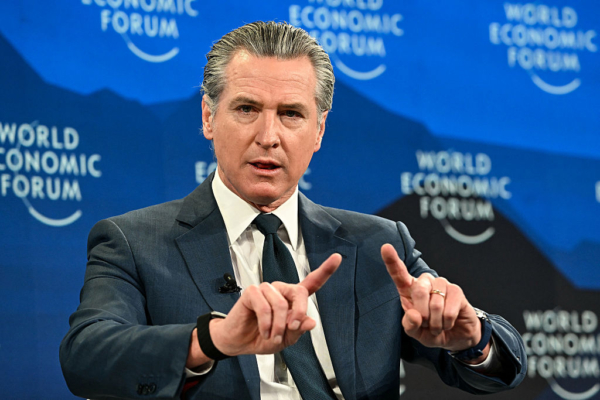
After California Governor Gavin Newsom unveiled the budget proposal for the 2026-2027 fiscal year, the economic outlook did not align as optimistically as the governor had hoped.
Newsom’s budget expenditures reach $348.9 billion, an increase of $27.8 billion from the previous year, with an anticipated deficit of only $2.9 billion. The proposal is set to be approved by the state legislature in May. However, the non-partisan Legislative Analyst’s Office estimates a $18 billion deficit and expresses concerns regarding the proposal.
This budget relies heavily on artificial intelligence (AI) to drive economic growth. State Treasurer Joe Stephenshaw stated, “Market downturns will be one of the biggest risks.” He further predicts deficits could reach $22 billion in the 2027-2028 fiscal year. Some warning experts caution that California’s AI prosperity may not be sustainable and could recede. Additionally, the proposed “wealth tax” may lead to an exodus of the affluent and businesses, significantly reducing government revenue.
Republican Assemblyman Josh Hoover from the 7th District criticized Newsom’s speech, stating that most of the content exhibited a detachment from reality, ignoring the urgent challenges facing California.
In his address, Newsom claimed that California remains at the forefront in key areas such as manufacturing, technology, education, and agriculture, dismissing critics as suffering from “California delusional syndrome,” attempting to undermine the state’s achievements. However, Hoover highlighted that California ranks at the top in poverty rates, unemployment, low literacy rates, homeless population, gas prices, and outmigration. These are not just abstract figures but reflect the skyrocketing cost of living and the real struggles faced by families in California.
Hoover believes that Newsom failed to address these issues adequately, selectively highlighting accomplishments in his speech while avoiding discussions on systemic failures. His proposal exacerbates this disconnect. Even with his most optimistic projections showing a $2.9 billion deficit, drastic spending cuts and increased tax collection would burden residents further.
The Legislative Analyst’s Office is concerned about the sustainability of California’s finances, as Newsom’s optimism depends on $42.3 billion in new revenue, primarily from capital gains driven by AI. This risky venture exposes California to market fluctuations, such as previous market crashes, potentially resulting in significant structural deficits.
The office notes that in 2022, Newsom exaggerated revenue growth, claiming California would see its highest-ever $95 billion growth, leading to extravagant government spending. This surplus was never realized, compounded by lack of accountability in aid funding for the homeless and business insurance funds, resulting in today’s deficits.
The governor’s budget also suspends deposits to the $2.8 billion Rainy Day Fund, one of the few tools California has to address the next economic downturn. Newsom, in his final year in office, leaves these issues to his successor instead of addressing them now.
Part of the budget expansion is designated for healthcare, with an additional $2 billion planned for this fiscal year and $2.4 billion for the following year, including $1.1 billion to offset federal funding cuts.
In education, Newsom proposes a $3.5 billion increase for the University of California (UC) and $3.65 billion for the California State University (CSU). According to Proposition 98, 40% of general funds will be allocated to K-12 schools and community colleges, resulting in an estimated $22 billion increase in K-14 funding, totaling $125.5 billion, amounting to $20,427 per student; including federal funds, the support for each California student would be $27,418. Additionally, this fiscal year includes $1.9 billion for expanding transitional kindergarten in California and an additional $1 billion in the new budget to establish more community schools.
Since assuming office as governor in 2019, Newsom’s first fiscal year budget amounted to $214.8 billion, increasing to $348.9 billion in the final year of his 8-year term, a $134.1 billion increase.
During the state legislature session, the governor claimed a 9% reduction in the homeless population as a successful outcome, but lawmakers remain cautious. The homeless population for 2025 is under calculation, while in 2024, it reached a historic high of 123,974 people, with 63,110 residing in shelters.
Republican State Assemblywoman Diane Dixon from the 72nd District expressed concern over California having the highest gas prices, electricity rates, rents, and mortgage loans in the country. She stated, “This is the third consecutive year of budget deficits in the state; mismanagement of the budget results in suffering for residents, from gas stations to daily bills. Our communities feel the increasing cost of living, leading some to leave California for areas with lower living costs.”
The budget prioritizes the governor’s main projects, including allocating over $12 billion annually from the general fund to provide comprehensive Medi-Cal healthcare benefits to undocumented immigrants and funding the California High-Speed Rail Authority with $1 billion annually until the 2045-46 fiscal year.
Republican State Senator Tony Strickland from the 36th District was “shocked” by the continued investment in the over-budget high-speed rail project. He described the governor’s speech as more of a campaign address than a state of the state speech.