
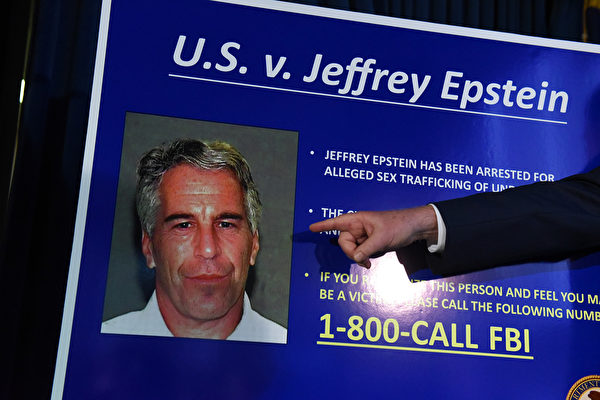
According to the latest batch of Jeffrey Epstein files released by the U.S. Department of Justice last week, the late sex offender Epstein had email exchanges with officials from Tsinghua University, China’s top academic institution, in 2016. The emails discussed the possibility of establishing a Tsinghua University campus in Boston.
The emails revealed that Chinese-American mathematician Shing-Tung Yau played a key role in connecting the parties. Yau left Harvard University in 2022 and joined Tsinghua University. The Tsinghua administration also arranged for Epstein to visit Beijing.
The Harvard Crimson, Harvard University’s school publication, also reported on these email exchanges.
On July 6, 2019, Epstein was arrested and imprisoned on charges of sex trafficking of minors, and he was found dead in jail on August 10 of the same year, ruled as a “suicide.”
According to the emails, Epstein, Yau, and Harvard biology and mathematics professor Martin A. Nowak had been working for years to enhance the connection between Harvard and Tsinghua. Over a dozen emails in the DOJ-released documents showed Yau actively facilitating connections between Epstein and senior Tsinghua officials.
In April 2016, Yau emailed one of Epstein’s assistants, stating that Tsinghua University was “seriously considering establishing a branch school here.”
In May, Epstein met with Tsinghua University’s then-president Qiu Yong in New York, coordinated by Yau. At the time, Qiu Yong was visiting the U.S. and had met with then-Harvard University President Drew G. Faust.
Qiu Yong responded to Epstein’s email, instructing his subordinates to follow up on the matter.
Yau sent a “confidential” preliminary proposal for a Tsinghua campus in Boston to Epstein in June, indicating the need for secrecy.
Qiu Yong’s subordinate invited Epstein to visit Tsinghua’s Beijing campus in October 2016.
On September 27, Epstein’s assistant mentioned in an email that Tsinghua wanted to know when Epstein would arrive. The assistant also stated that his Chinese visa had been processed and was ready at his home.
Due to a family emergency, Epstein postponed his Tsinghua visit.
Yau hoped Epstein would sponsor traditional Chinese medicine, Chinese student trips to the U.S., and the establishment of Tsinghua’s Boston campus. He inquired through Epstein’s assistant about what Epstein might expect in return.
The assistant replied in the email, stating that Epstein always enjoys supporting new ideas and never seeks anything in return.
Epstein seemed interested in Harvard and Tsinghua collaborations in artificial intelligence, as well as brain and neuroscience research.
In November of the same year, Yau introduced Harvard alumnus and donor Gerald Chan to Epstein as a potential investor.
However, the Tsinghua Boston campus project did not materialize.
In May 2017, Yau recommended in an email that Epstein promote a proposal for Tsinghua to establish a relationship with another U.S. institution, similar to what Harvard was doing.
The Crimson report mentioned that Yau, a renowned mathematician who taught at Harvard University for 35 years, had a meeting with Epstein as early as 2011.
Despite Harvard University publicly cutting ties with Epstein in 2008 following his conviction for soliciting prostitution from minors, many Harvard professors continued to maintain contact with Epstein, with Yau being just one of them.
In a November 2025 email response to The Crimson, Yau stated that his “sole contact” with Epstein was through Professor Nowak, claiming complete ignorance of Epstein’s background.
Yau also stated that no one in China showed interest in the proposed visitation by Epstein, and the matter was never implemented.